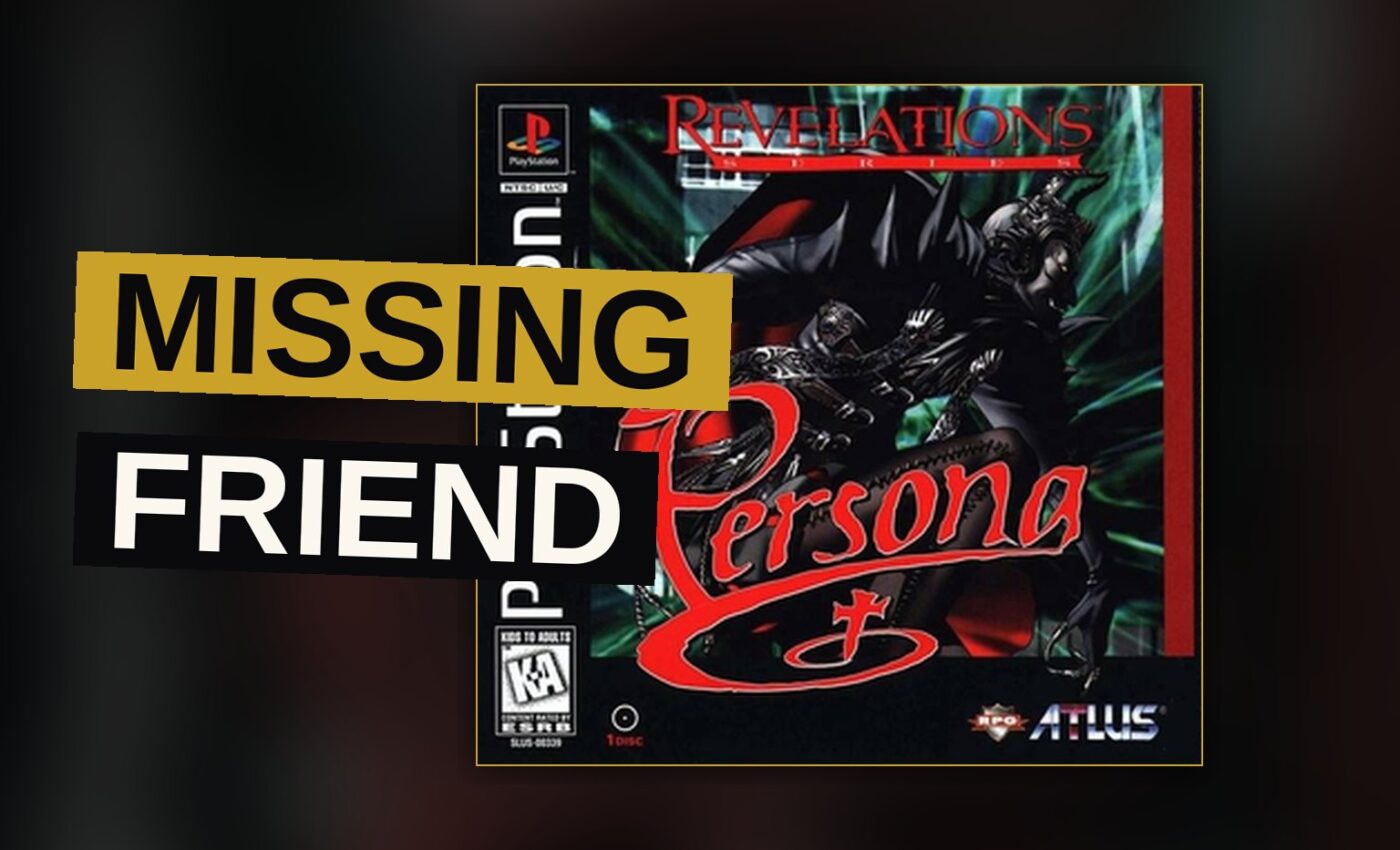
Revelations: Persona arrived on the original PlayStation in 1996 as the first Persona game and the first role-playing entry in that series to reach the West. Atlus developed it. ASCII Corporation and Atlus published it. A Microsoft Windows port followed in 1999.
The publishing credit is not a footnote. ASCII and Atlus split the release, and the game’s later history runs through that arrangement: a 2009 PlayStation Portable port, retitled Shin Megami Tensei: Persona, arrived with new cutscenes and a reworked English script that hewed closer to the Japanese original. The 1996 North American localization had been criticized for its unfaithfulness to that original.
A Fortune-Telling Game in Mikage-cho
The game is set in Japan in 1996, in the town of Mikage-cho. The main characters attend St. Hermelin High, all of them in Class 4 under teacher Saeko Takami. The town’s other landmark is the local branch of SEBEC, the Saeki Electronics & Biological & Energy Corporation.
The story follows a group of high school students caught up in a series of supernatural incidents. After playing a fortune-telling game, they gain the ability to summon Personas. Under the guidance of Philemon, a benevolent being representing humanity’s subconscious, they face multiple forces that threaten the world.
Philemon acts as the party’s spiritual guide and helper, appearing in both a human form and as a butterfly. The manual calls the Personas “the power of their hidden selves.”
The Students of Class 4
The player controls a silent protagonist, a second-year student who serves as their in-game representation. The rest of the cast is named and distinct.
- Maki Sonomura, whose near-constant ill health has made her inwardly bitter
- Kei Nanjō, a self-confident heir to an important family business
- Yukino Mayuzumi, a former gang member reformed through Saeko’s efforts
- Hidehiko Uesugi, who puts on a facade of strength to cover his weaknesses
- Yuka Ayase, who consciously acts like a stereotypical “high school girl”
- Masao Inaba, a spoiled and rebellious youth
- Eriko Kirishima, of half-American parentage, with an interest in the occult
Three Camera Angles and a Moon
Navigation shifts depending on where the player is. The students’ hometown is seen from overhead. Standard environments, such as outside areas and story locations, use an angled third-person view. Dungeons and most other buildings are walked in first-person.
A lunar phase icon sits in the top right-hand corner of the screen. It shows the passage of in-game time, and its status sets the activity patterns and moods of enemy demons. Progress is saved by visiting certain predetermined locations.
Fights start either through story events or through random encounters on the world map and in dungeons. Attacking an enemy from behind grants the party a set of attacks that cost no magic points or health points. Combat unfolds on a grid-based arena, and characters and enemies move according to their position on it.
Contact, Analyze, Form
The party has four commands. Attack fights enemies. Contact talks with one. Analyze checks an enemy’s strengths and weaknesses. Form rearranges the party on the grid.
Personas are the main weapon. A character summons one into battle to cast a spell that can heal the party or deal physical or elemental harm to an enemy. A Persona carries up to eight skills, and a character can switch Personas on their turn. Personas collect experience separately from the characters they are attached to, and extended use unlocks new abilities. The game awards experience based on how often a player uses particular characters or Personas. New Personae are built from spell cards won in battle or obtained by talking with enemies.
| Version | Platform | Year | Notes |
|---|---|---|---|
| Revelations: Persona | PlayStation | 1996 | Released in Japan and North America |
| Revelations: Persona | Microsoft Windows | 1999 | Port |
| Shin Megami Tensei: Persona | PlayStation Portable | 2009 | New cutscenes, reworked localization; Europe in 2010 |
The Script Atlus Later Rewrote
Two facts sit next to each other here, and the source does not join them. The 1996 North American localization drew criticism for unfaithfulness to the Japanese version. The PlayStation Portable port, out in North America and Japan in 2009 and in Europe the following year, shipped a reworked English localization that was more faithful to the Japanese original.
The source never says the criticism caused the rework. It reports both. That gap is where most of the loose talk about this game lives, and it is worth refusing to fill.
What the source does establish is that the Personas are described as the power of the characters’ hidden selves, and that the cast is drawn around contradiction: Maki’s bitterness beneath illness, Uesugi’s facade over weakness. Whether the first English script flattened those characterizations is not something the source states, and this paper will not assert it.
What the Source Supports
The Persona system is the game’s clearest design fact. Summoned beings earn experience on their own track, and characters can swap Personas mid-turn. The lunar phase ties enemy behavior to in-game time. Contact and spell cards feed the creation of new Personae.
The three navigation styles are described, not judged. Battles come from both story events and random encounters, stated as fact. On the localization, the source gives criticism and a later rework without linking them.
Play either version, but know what each one is: the 1996 release with the criticized script, or the 2009 port with the reworked one. The source does not say which Atlus preferred, and neither will this paper.
Get the Notebook.
The day's best stories and every fresh verdict, in plain English, in your inbox by seven. One email a day, no more.