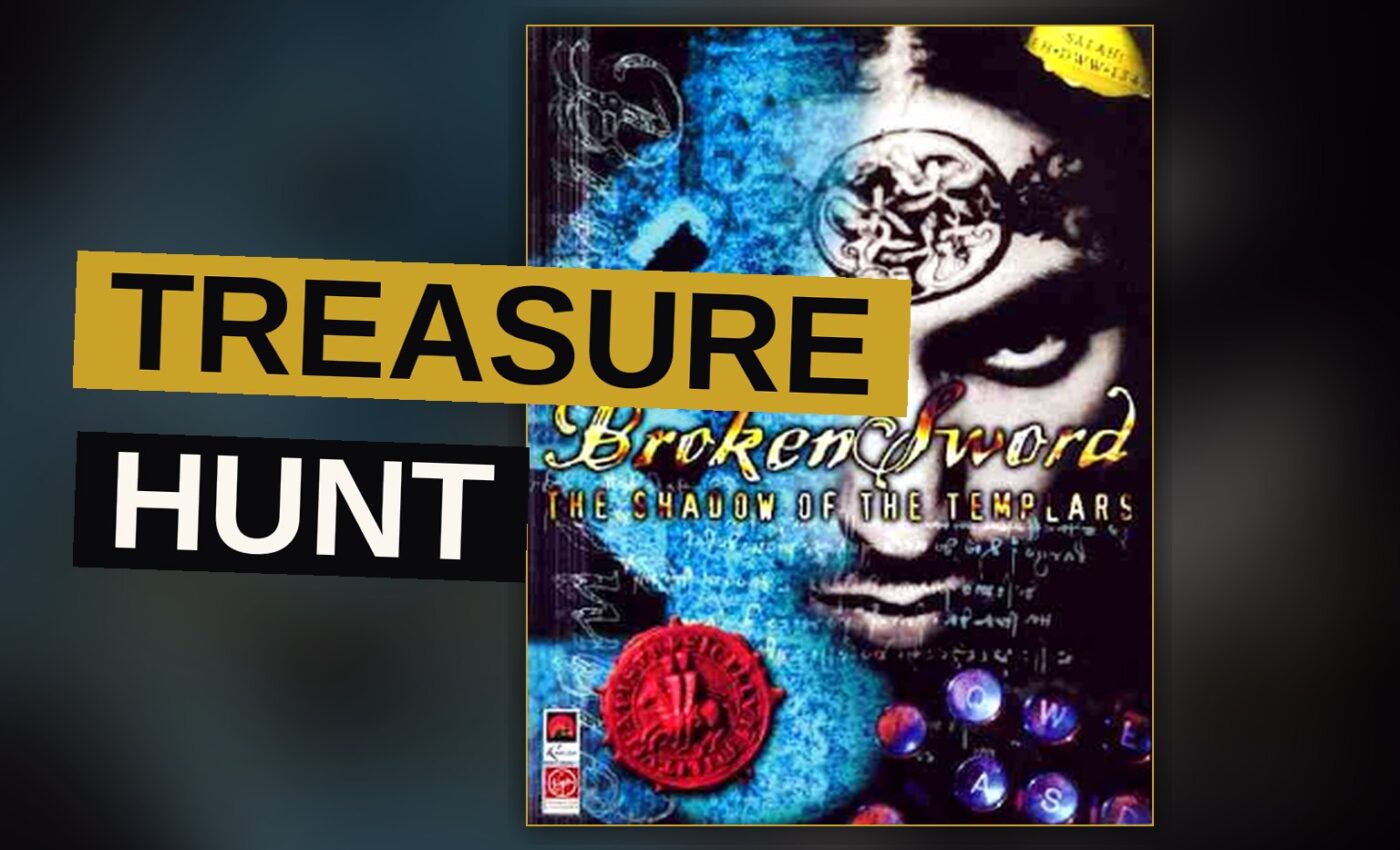
This is a review of the original 1996 game, not its later ports. Broken Sword: The Shadow of the Templars came out on September 30, 1996, and nearly thirty years later it is still the game people mean when they talk about a great point-and-click adventure. Revolution Software, with Charles Cecil co-writing and directing, built a conspiracy thriller with real research behind it, and then had the good sense to make it funny.
George Stobbart
You play George Stobbart, an American tourist in Paris, voiced by Rolf Saxon. A bombing outside a café pulls him into a conspiracy involving a sinister cult and a hidden treasure, and the trail takes him across Europe and into the Middle East. Saxon’s performance is the game’s great asset. George is curious, decent and slightly out of his depth, and he narrates the world with a dry wit that makes even the dead ends enjoyable.
The Templars
Cecil researched the Knights Templar heavily, and the story was conceived with a serious tone. What keeps it from turning into a lecture is the humor threaded through every conversation and the animated-film look of the art. Eoghan Cahill and Neil Breen drew the backgrounds in pencil and colored them digitally, and the result has held up far better than the 3D of the same era. Barrington Pheloung’s score does the rest.
How It Plays
This is a 2D adventure from a third-person view. You point, you click, you collect items and combine them, use them on the environment or hand them to characters. Conversations run through dialogue trees presented as icons, and the puzzles come out of paying attention to what people tell you. Tony Warriner and David Sykes handled the design, and the game runs on Revolution’s Virtual Theatre engine, the same one behind Lure of the Temptress and Beneath a Steel Sky.
The puzzles are mostly fair, which was not a given in 1996. They reward logic and listening more than pixel hunting.
The Reception
Critics praised the story, puzzles, voice acting, writing and music, and the game was a commercial success as well as a critical one. It was released as Circle of Blood in the United States, which is a worse title for the same game.
Where It Shows Its Age
A few puzzles rely on the old adventure-game logic of trying everything on everything, and the pacing sags in the middle stretch of travel. The mobile port, published by Astraware for Windows Mobile in 2006, is essentially the same game with its graphics adapted to that hardware’s constraints.
The Verdict
Broken Sword is the first game in its series, and it is the one to play. It is confident, beautiful and written by people who trusted the player. That is why it is still played.
Get the Notebook.
The day's best stories and every fresh verdict, in plain English, in your inbox by seven. One email a day, no more.