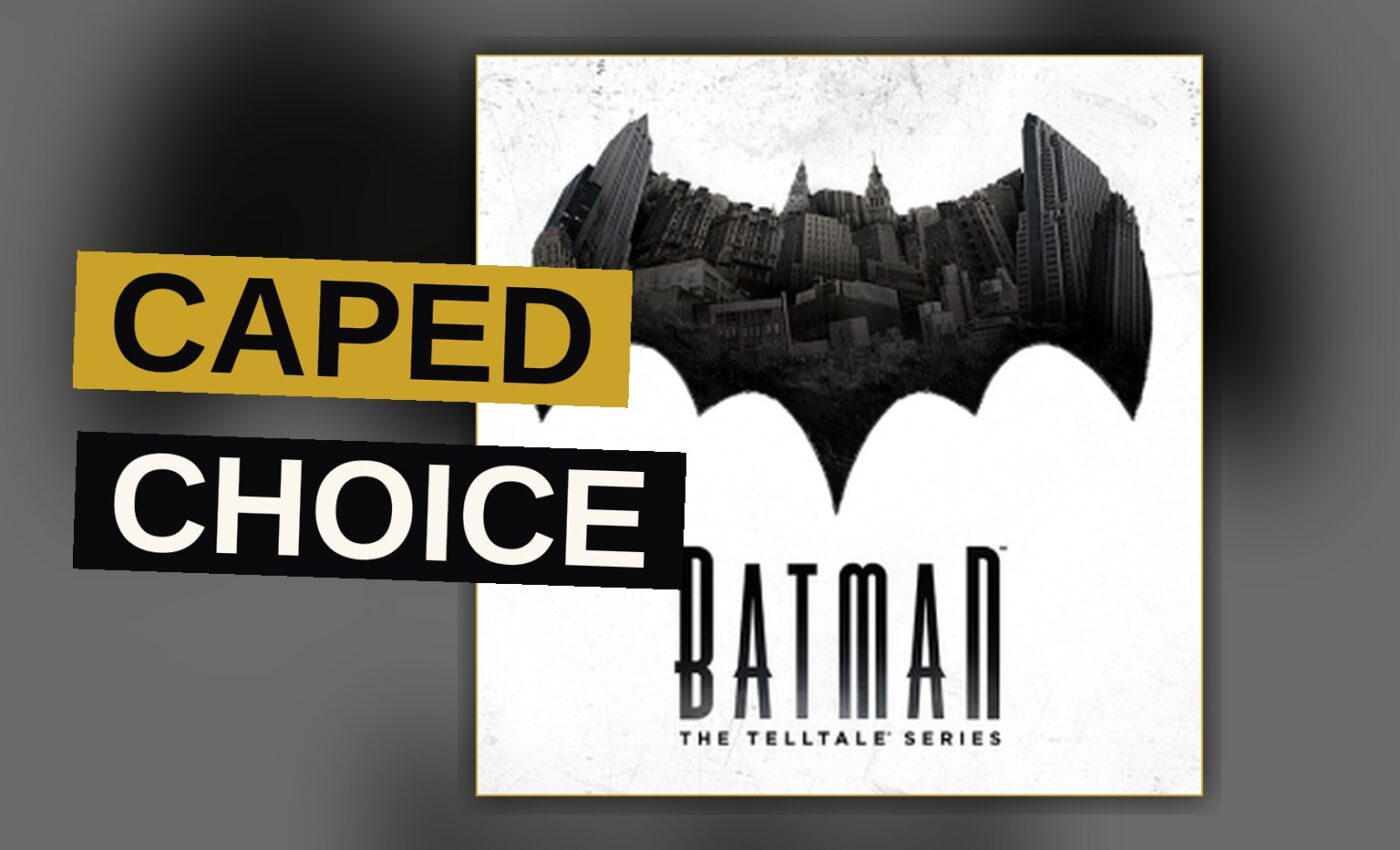
Batman: The Telltale Series landed in 2016 as a choice-driven adventure from Telltale Games, built on a simple promise: you spend as much time as Bruce Wayne as you do as Batman, and the story remembers what you did. It shipped on PlayStation 3, PlayStation 4, Android, PC, iOS, Mac, Xbox 360, Xbox One and later Nintendo Switch. It is a point-and-click adventure with action and drama, single player, third person, and a branching narrative. It is also the clearest record of what that studio could do with a licensed hero, and where it fell short.
Trailer, via IGDBcom.
A Gotham of Smartphones and Drones
The game is set in Gotham, a city the source describes as infested with crime and corruption. The period reads as the mid-to-late 2010s: characters use smartphones, and drones appear in the story. Most of the plot moves through the city, but the player keeps returning to a fixed set of landmarks — Wayne Manor, the Batcave, Gotham City Hall, the police headquarters and Arkham Asylum. That list is the game’s real map, and it tells you where the drama lives.
Arkham is not decoration. The player meets inmates there, including the convicted serial killer Victor Zsasz, voiced by Kiff VandenHeuvel, former ventriloquist Arnold Wesker, voiced by Larry Brisbowitz, and a mysterious figure listed only as “John Doe,” voiced by Anthony Ingruber.
Troy Baker’s Bruce, Laura Bailey’s Catwoman
The player-protagonist is Bruce Wayne, voiced by Troy Baker, secretly the titular character. He is CEO of Wayne Enterprises and heir to the Wayne fortune, and he funds his vigilante work with that wealth. Alfred Pennyworth, his butler and former guardian, is voiced by Enn Reitel. Lucius Fox, head of technology at Wayne Enterprises, is voiced by Dave Fennoy.
Harvey Dent, the District Attorney and a Mayoral candidate, is voiced by Travis Willingham. Vicki Vale, a reporter for the Gotham Gazette, is voiced by Erin Yvette. James Gordon, a lieutenant and a contact inside the Gotham City Police Department, is voiced by Murphy Guyer. Selina Kyle, also Catwoman, is voiced by Laura Bailey — a skilled thief who works with Batman when their needs line up.
The antagonists are a terrorist organization called the Children of Arkham, led by a masked figure called Lady Arkham. The source credits that role to Steven Blum, who also voices Roland Desmond, also known as Blockbuster. Oswald Cobblepot, the Penguin, is voiced by Jason Spisak.
The Choice That Splits the Playtime
The playtime is split evenly between Batman and Bruce Wayne. Sometimes the game hands the player the choice outright: approach a situation as Wayne or as Batman. That is the whole design in one sentence, and it is why the game is still worth a look.
Telltale’s stated aim was a fresh interpretation of the universe set in current times, not tied to any existing iteration of Batman in games, film or comics. The story sits a few years after Wayne decides to become Batman, which gives the writers room to let the player shape the character. The result is a Batman who can be traditional and inspiring, or much colder and more aggressive than the usual portrayal.
The mechanics are the studio’s standard kit. Dialogue drives the story. Action sequences resolve through quick time events. Investigation sequences let the player use Batman’s detective skills to move things forward. Choices carry into later episodes.
Crowd Play, the Feature That Dated Fastest
The series introduced a feature called crowd play, available on both the PC and console versions. It lets an audience watch and take part in the decision-making. When it is active, the player sends the audience a link to Telltale’s website with a unique code.
It was a genuine idea. It also assumed a room full of people who wanted to vote on a Batman story together, which is a narrower audience than the feature’s name suggests.
The Break-In at City Hall
The story begins with a break-in at Gotham City Hall. Batman fights a group of mercenaries and Catwoman, who has cracked the Mayor’s safe and taken a drive. Batman steals the drive from Catwoman during the fight; she escapes.
Back at Wayne Manor, Bruce endorses Harvey Dent’s Mayoral campaign against Hamilton Hill, and meets the crime lord Carmine Falcone in the process. While Bruce works on decrypting the drive, Alfred tells him that his childhood friend Oswald Cobblepot — now a criminal called Penguin — has returned to Gotham. They meet in Cobblepot Park, where Oswald warns Bruce of a revolution coming to the city.
Then the accusations land: that Thomas and Martha Wayne were affiliated with the Falcone family. While meeting Harvey to discuss the claims, Bruce also meets Harvey’s date, Selina Kyle, and the two deduce each other’s identities.
That is the engine. Bruce Wayne’s family name is the crime scene, and the game knows it.
Mixed Reception, Real Atmosphere
Upon release, Batman: The Telltale Series received a mixed reception. Praise went to its atmosphere, its action sequences and its faithfulness to the Batman mythos. Criticism went to its technical issues and its plot. A second season, Batman: The Enemy Within, followed in 2017 and was viewed as an improvement over the original.
Telltale Games shut down in 2018. The licenses for both the Batman and The Enemy Within games were acquired by Athlon Games, and both were re-released by LCG Entertainment under a new Telltale Games label as the combined Shadows Edition in December 2019.
The game’s narrative offers a “fresh interpretation of the universe set in current times, not tied to any existing iteration of Batman in games, film, or comics”, according to Telltale.
What Holds Up and What Does Not
The atmosphere is the part that lasts. Gotham here is a working city with phones and drones, not a Gothic diorama, and the landmarks — City Hall, the police headquarters, Arkham, the Batcave — give the story a geography the branching plot can actually use. The cast is deep and specific. Baker’s Bruce, Bailey’s Selina, Willingham’s Harvey Dent and Spisak’s Oswald Cobblepot give the dialogue scenes something to push against, and the split between Wayne and Batman is not a gimmick bolted on. It changes what a scene is about.
The plot is the weaker half. The Falcone accusations against Thomas and Martha Wayne are the most interesting idea in the game, and they arrive as a mid-story turn rather than the spine. The Children of Arkham and Lady Arkham give the episodes a villain to chase, but the masked figure is a thinner creation than the family secret underneath. The technical issues that drew criticism at launch are not a mystery either: this is a studio pushing its own engine through an episodic schedule, and the seams show.
Crowd play is the clearest sign of the game’s moment. It was built for a shared living-room audience at the exact point that audience was leaving. It is available on PC and console, and it is the part of Batman: The Telltale Series that has aged least gracefully — not because it was badly made, but because the behavior it assumed has mostly gone.
The Enemy Within being viewed as an improvement is the fairest note on the first season. Telltale needed a season to learn what this Batman could carry, and the second season got the benefit. That does not make the 2016 game disposable. It makes it a first act.
The Numbers
- Score: 7.7 of 10
- Release year: 2016
- Developer and publisher: Telltale Games
- Distributor: Warner Bros. Interactive Entertainment, under its DC Entertainment label
- Platforms: PlayStation 3, PlayStation 4, Android, PC (Microsoft Windows), iOS, Mac, Xbox 360, Xbox One, Nintendo Switch
- Genres: Point-and-click, adventure
- Themes: Action, drama
- Modes: Single player
- Perspective: Third person
- Second season: Batman: The Enemy Within, 2017
- Shadows Edition re-release: December 2019, by LCG Entertainment
The Score
7.7 of 10. Batman: The Telltale Series is a good licensed game with a great central idea and a plot that never quite earns it. The Wayne-Batman split is the reason to play, and the cast sells it. The atmosphere holds. The technical problems and the uneven story are real costs, and the 2017 follow-up is the better game. But as a document of what Telltale was in 2016 — ambitious, fast, occasionally sloppy, and willing to hand a licensed hero to the player — it earns its place.
Get the Notebook.
The day's best stories and every fresh verdict, in plain English, in your inbox by seven. One email a day, no more.