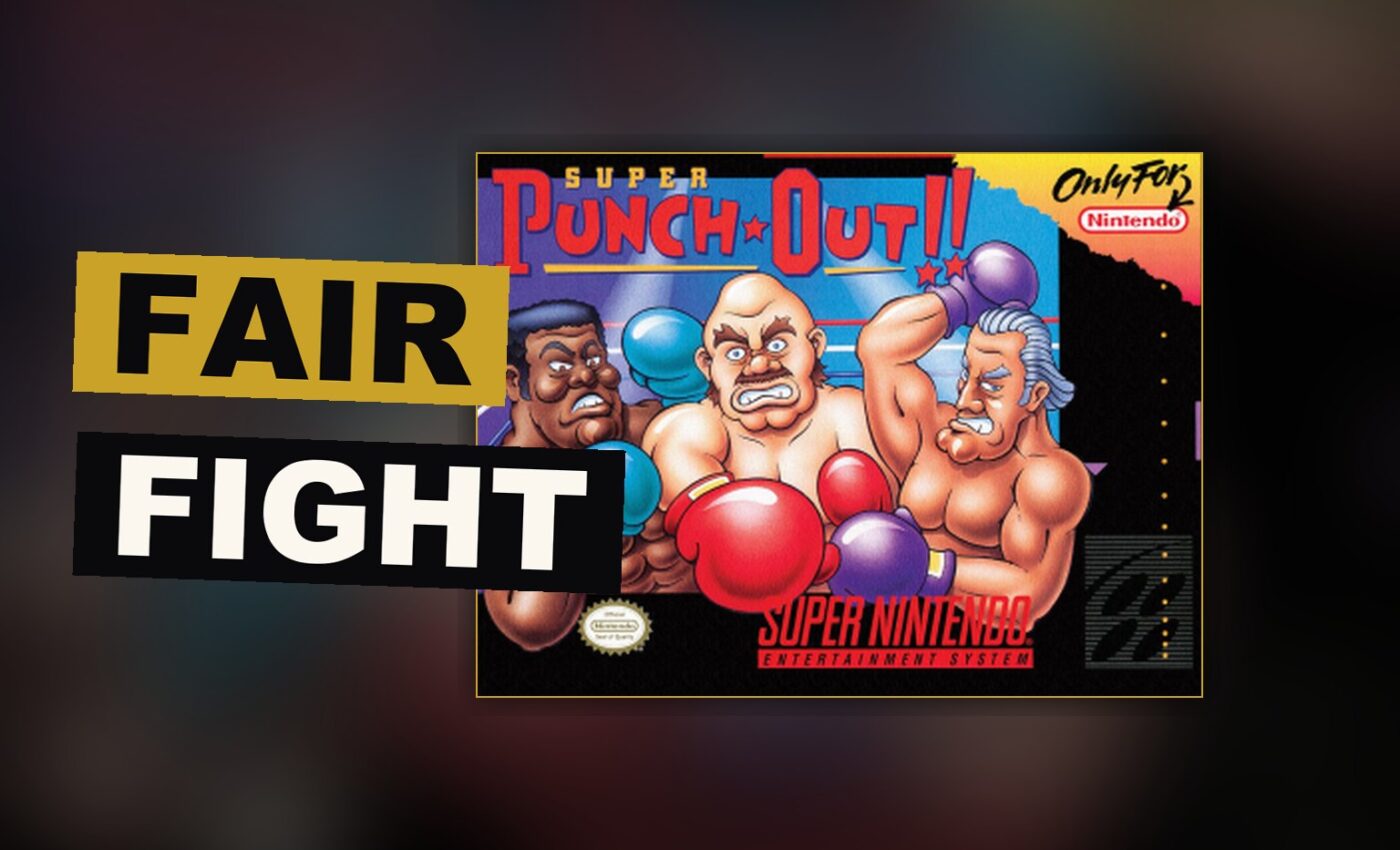
Nintendo’s Super Punch-Out!! came out in North America on October 24, 1994, for the Super Nintendo Entertainment System, and it arrived carrying a problem the series never quite solved. The arcade original and the NES Punch-Out!! built their fame on a fighter who was small, breakable and visibly outmatched. The sequel hands you a nameless boxer from a “behind the back” perspective, translucent on screen, and asks you to punch your way to the World Video Boxing Association championship. It is a cleaner game. It is also a colder one.
Three Minutes in the Minor Circuit
The rules are strict and they never bend. Players must knock out their opponent inside three minutes to win. You jab to the face or throw body blows from either hand, and the opponent can deflect whatever you throw, so every punch has to land on the open spot where the gloves are not.
Stances matter. Opponents guard themselves differently depending on how they stand, which means the correct punch changes from fighter to fighter and from moment to moment. Read the stance wrong and you eat a counter.
The Power Meter at the Bottom of the Screen
As in the first two arcade games, a power meter sits at the bottom of the screen. It fills as you land punches and drains as you take them. Fill it completely and you unlock knockout punches — uppercuts, hooks and rapid punches — which come with a slight delay in execution but deal heavier damage.
There is a second readout too. The background color behind your face in the upper left corner climbs from blue to green to yellow to red. Reach red and you hit Power-Up status, gaining punch speed and power. Get knocked down and it is gone.
Bear Hugger, Piston Hurricane and the Old Favorites
The roster is where Super Punch-Out!! earns its keep. Bear Hugger, Piston Hurricane, Bald Bull, Mr. Sandman and Super Macho Man all return, joined by a cast of new and weird challengers. The circuits run Minor, Major, World, then a Special Circuit at the top.
The referee calls “Knock Out!” and your opponent lies face down. That moment still lands.
A Release Schedule Spread Over Decades
| Release | Date |
|---|---|
| North America (Super Nintendo Entertainment System) | October 24, 1994 |
| United Kingdom | February 10, 1995 |
| Japan (Super Famicom, Nintendo Power) | 1998 |
| Europe (Wii Virtual Console) | March 20, 2009 |
| North America (Wii Virtual Console) | March 30, 2009 |
| Japan (Wii Virtual Console) | July 7, 2009 |
| New Nintendo 3DS eShop | May 5, 2016 |
| Super NES Classic Edition (United States) | September 2017 |
| Wii U | not specified in the source |
That is a long tail for a boxing game, and it says something about how well the core holds up.
Ducking, Dodging and What You Cannot Do
Defense is where the design gets interesting and where it gets stubborn. You can dodge left or right, or duck, but you cannot punch while dodging or ducking. You also cannot duck body blows. Blocking works against attacks to the head or the body, but not against strong punches.
Every escape costs you offense. That trade is the whole game.
Genyo Takeda and the Development Team
Nintendo Integrated Research and Development (Nintendo R&D3) made Super Punch-Out!!, led by Genyo Takeda, Minoru Arakawa and Makoto Wada, with development by Locomotive Corporation. Playtronic and Nintendo published it. Mike Shapiro and Charles Martinet handled voice acting. It is the fourth game in the Punch-Out!! series, following the NES Punch-Out!!.
The Fight Night Round 2 Extra
The game is also included in the GameCube version of Fight Night Round 2 as an extra game, included because Little Mac appears in that game. It is an odd home for it, but a welcome one.
What Super Punch-Out!! Gets Right
The punch-reading is sharp. Stance-based guarding forces you to look at your opponent instead of mashing, and the power meter gives every exchange a visible stake. The three-minute limit keeps matches tight.
What it loses is the vulnerability. The translucent avatar never feels like it is in danger the way the NES fighter did, and the nameless boxer removes the personality that made the earlier game stick. The Special Circuit is the real test; everything before it is a warm-up.
Score: 7.3/10 (IMDb)
Get the Notebook.
The day's best stories and every fresh verdict, in plain English, in your inbox by seven. One email a day, no more.