Nintendo’s Balloon Fight asks you to flap a man’s arms until he floats. It is a 1984 arcade idea wearing a 1985 console coat, and the seams show.
The game was developed by Nintendo and HAL Laboratory and published by Nintendo for the Nintendo Entertainment System. It began in arcades as VS. Balloon Fight. The console version reached Japan in 1985 and the rest of the world in 1986. A different team built the arcade original, which shipped first. That production history explains a lot about what Balloon Fight is: a conversion, not a ground-up design.
Two Balloons and a Helmet
You control an unnamed Balloon Fighter. Two balloons are tied to his helmet. Press A repeatedly, or hold B, and he flaps his arms and rises. Pop one balloon and he floats worse, climbing becomes a chore. Pop both and you lose a life.
The threats are specific and they are all cheap. Enemy Balloon Fighters pop your balloons. The water kills you if you fall in. A large piranha near the surface eats you. Lightning strikes you out of the sky. None of these are telegraphed with much grace, and the piranha in particular turns the bottom of the screen into a zone you learn to fear rather than read.
There are two modes. The 1-player and 2-player game asks you to clear the screen of enemies. Balloon Trip is a side-scrolling stage where you avoid obstacles. Balloon Trip is not in the arcade original. The arcade version also uses completely different level layouts, built to take advantage of vertical scrolling, along with some minor gameplay differences. So the home version is not a straight copy — it is its own arrangement of the same parts.
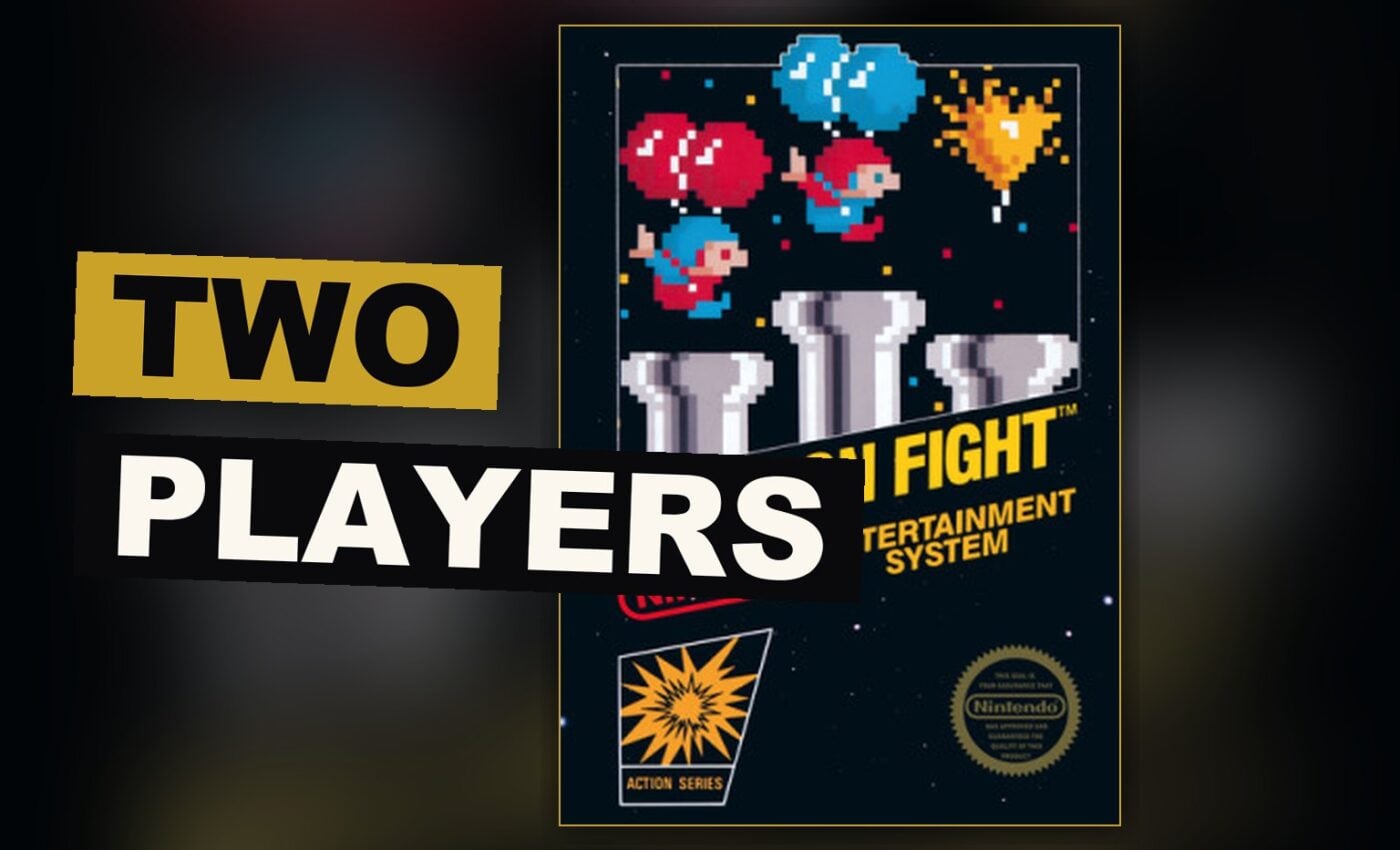
The two-player mode is cooperative. Two players work together to get past each stage. That is the best thing Balloon Fight has going for it, and it is not close.
Joust, but in the Air and Slower
The gameplay is similar to the 1982 game Joust from Williams Electronics. That comparison is the whole review in miniature. Joust is a duel of momentum and nerve. Balloon Fight is a float. Your fighter drifts, and the flapping that keeps him up is a repeated input rather than a physical commitment. You are not jousting. You are managing buoyancy.
The balloon-popping system is the one genuinely good idea here. Losing a balloon does not kill you, it degrades you. Suddenly the same gap you cleared a second ago is out of reach. That is a clean piece of design, and it is the reason the game has any tension at all.
But the enemies do not have enough personality to make popping them satisfying. They are other balloon fighters, which means they are you, which means the screen fills with mirrors. There is no bestiary, no escalation of threat types, no boss. Clearing a screen of enemies is the goal, and it stays the goal.
Every Port, Every Platform
Nintendo moved this game everywhere. The platforms tell the story of a company squeezing a small idea for decades.
- Family Computer Disk System
- Arcade
- Family Computer
- Nintendo Entertainment System
- Game Boy Advance, as Balloon Fight-e for the e-Reader in the United States on September 16, 2002
- Famicom Mini Series in Japan on May 21, 2004
- Wii
- Nintendo 3DS
- Wii U
- Legacy Mobile Device
The home Nintendo Entertainment System version was ported to the NEC PC-8801 in October 1985 and the Sharp X1 in November 1985. A sequel, Balloon Kid, arrived in 1990. The source lists Sharp as a publisher alongside Nintendo but does not say which platforms it handled.
That is a lot of mileage for a game with two modes and one mechanic.
What the Score Says
Balloon Fight holds a published critical score of 5.6 out of 10 on IMDb. That number is fair, and it is fair for reasons the game’s reputation tends to skip past.
This is a competent port of a competent arcade game. It is not a classic. The 5.6 lands where it should because Balloon Fight does exactly one thing well — the degraded flotation after a balloon pops — and surrounds it with hazards that feel arbitrary. Lightning is not a mechanic. Lightning is a punishment. The piranha is not a mechanic either. It is a floor made of teeth.
The gameplay is similar to the 1982 game Joust from Williams Electronics.
That line is the kindest thing anyone can say about Balloon Fight, and it is also the most damning. Similar to Joust is not the same as Joust. Williams built a game about impact. Nintendo built a game about hovering, and hovering is less interesting than hitting.
The Two-Player Case
Here is where the game earns its keep. Cooperative two-player Balloon Fight is a real thing, and it is better than the single-player mode by a wide margin. Two players clearing a screen together, each one balloon away from disaster, produces the kind of shared panic that a solo run never generates.
The 1-player game is thin. Clear the screen. Clear the next screen. The enemies do not change enough to make the repetition feel like progression. Balloon Trip is the more interesting solo mode, and it is the one the arcade original did not have — a side-scrolling obstacle course that asks you to steer rather than fight. It is a different game tucked inside the same cartridge, and it is arguably the better half.
Neither mode solves the core problem. The Balloon Fighter is unnamed, and he plays like it. There is no character here, no arcade personality, no reason to care whether the balloons stay inflated beyond the score counter.
A 5.6, and Nothing Above It
Balloon Fight is a 5.6 game. Not a hidden gem, not a misunderstood masterpiece, not a forgotten classic. It is a solid conversion of an arcade title that was itself second-tier, and its long tail across the Family Computer Disk System, the Nintendo Entertainment System, the e-Reader, the Wii, the Nintendo 3DS, the Wii U and legacy mobile devices says more about Nintendo’s willingness to re-release its catalog than about the game’s quality.
The balloon mechanic deserves credit. Losing one balloon and still flying is a smart, legible piece of design that other games could learn from. The rest of Balloon Fight is a man flapping his arms over water that wants to kill him, and after a few stages you understand exactly why he never got a name.
The two-player mode is the reason to load it. Everything else is the reason it sits at 5.6.
Get the Notebook.
The day's best stories and every fresh verdict, in plain English, in your inbox by seven. One email a day, no more.