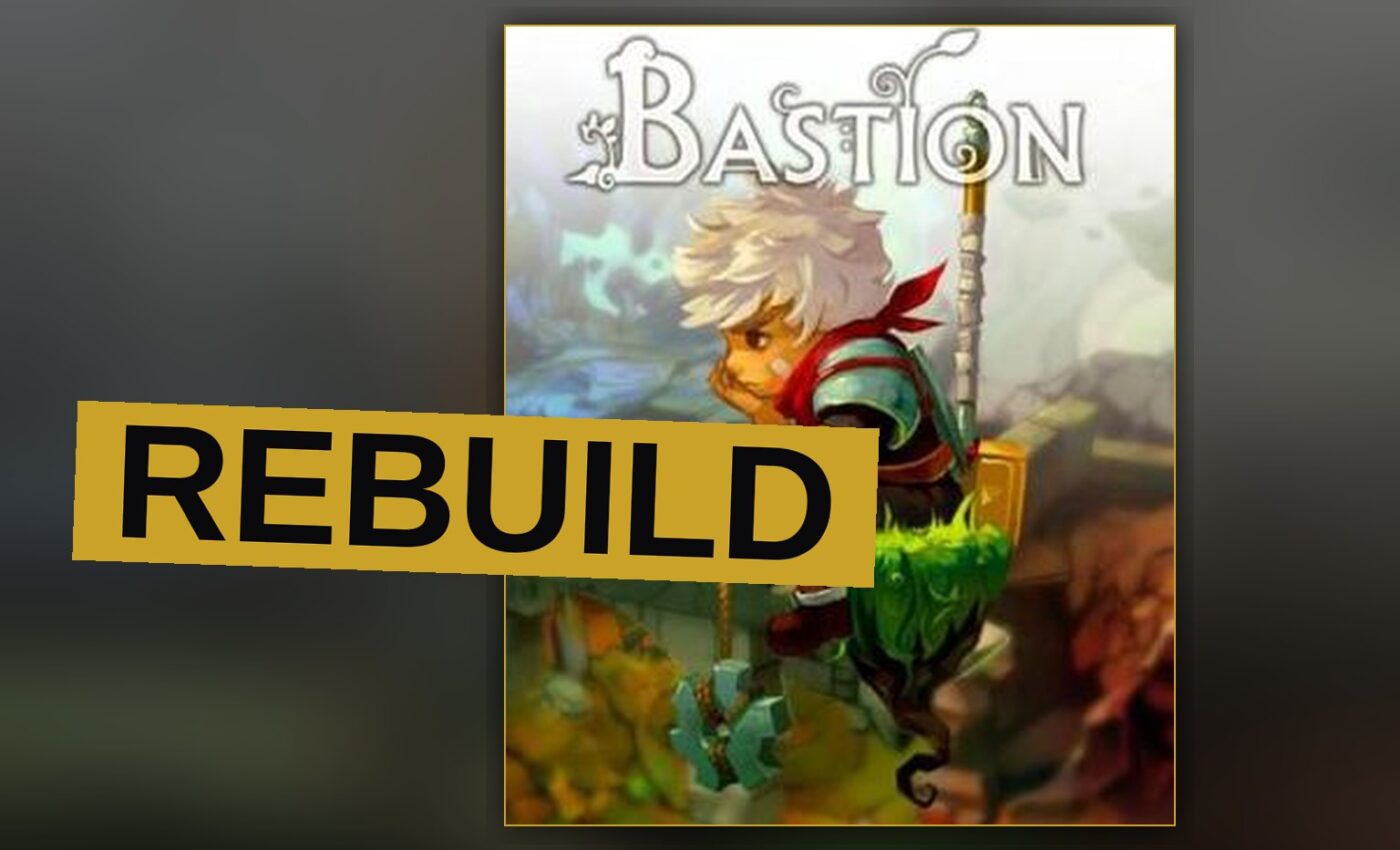
Bastion opens with a boy waking up on a shattered world. The ground beneath him broke into floating pieces, and he has to rebuild it one step at a time. That is the whole game in a single image: a journey across ruins, with the player deciding what gets put back together.
The boy is called the Kid. He does not speak. He walks through the remains of a city called Caelondia, picking up a weapon, finding a path, and listening to a narrator who tells him what is happening. That narrator, Rucks, is the voice of the game. He speaks in a warm, gravelly drawl, describing the Kid’s actions as they happen.
“Kid just rages for a while.”
The story unfolds in his telling. The narration is not a gimmick. It is the game’s spine. Rucks comments on everything, from the weapons the Kid picks up to the enemies he fights. He reacts to the player’s choices, sometimes with surprise, sometimes with dry humor. The writing is sharp and plain, and it gives the broken world a sense of memory. Caelondia had a war, a betrayal, and a calamity called the Calamity that tore everything apart. The Kid is walking through the aftermath, and Rucks is the one who remembers.
Trailer, via Supergiant Games.
Rucks and the Voice of Caelondia
The voice work is matched by the music. The score, composed by Darren Korb, mixes folk guitar, electronic beats, and a humming vocal track that carries the mood. The song “Build That Wall” plays at key moments, and it sticks with you long after the screen goes dark. The sound design is just as careful. Every footstep on the crumbling ground has weight. Every sword swing has a metallic ring.
Weapons, Upgrades, and the Forge
The Kid fights with a rotating set of weapons. He can carry two at a time, and the game encourages switching. A hammer swings slow and heavy. A bow shoots fast from a distance. A pair of pistols fires in quick bursts. Each weapon has its own feel, and each can be upgraded at the Forge between levels. The combat is fast and readable. Enemies telegraph their attacks, and the Kid can dodge, block, and counter.
The game does not lock the player into one style. You can lean on the hammer, or you can stay back with the bow, or you can mix and match. The choice is yours, and the game respects it. The difficulty is fair, though it does not hold your hand. Enemies come in waves, and some of them hit hard. Death sends you back to the start of a level, but the levels are short, and the checkpoints are generous.
Walking Through the Broken World
Bastion is built around a hub. The Kid walks through a central structure, and each level is a new piece of the world that rises into place as he approaches. The levels are varied. One is a lush jungle. Another is a dusty canyon. Another is a frozen tundra. Each one has a distinct look, and the hand-painted art style is beautiful. The colors are warm and rich, and the lighting shifts with the time of day.
The levels also tell the story. The Kid is not just fighting through random spaces. He is visiting places that mattered to Caelondia, and each one reveals a piece of what happened. The narrative is delivered in small doses, through Rucks’s commentary and through the objects the Kid finds. The game trusts the player to piece things together, and it rewards attention.
The Final Choice
The story builds to a choice. At the end of the game, the Kid has to decide what to do with the Bastion, the structure that holds the last pieces of the world. He can restore Caelondia to how it was, erasing the Calamity and everything that followed. Or he can leave the ruins as they are and carry the survivors forward into an unknown future. The choice is presented without a moral lecture. Rucks lays out the options, and the Kid acts.
The choice changes the final scene, and it gives the game a quiet, resonant ending. There is no grand villain to defeat, no final boss to beat. The conflict is internal, and the resolution is bittersweet. That restraint is part of what makes Bastion work. It does not overstate its themes. It lets the player feel them.
Replay Value and the Stranger’s Dream
Bastion is not a long game. A first playthrough takes about six hours, and a second run can be done in less. But the game has a New Game Plus mode that carries over upgrades, and the score attack mode, called the Stranger’s Dream, offers a different way to play. The game also has a series of challenge levels, called the Proving Grounds, that test specific weapons. These are optional, but they add depth for players who want to master the combat.
The narrative also rewards a second run. Once you know how the story ends, Rucks’s early lines take on new weight. The game is built for that kind of rereading. It is a short game that rewards a long look.
Supergiant’s First Step
Bastion was the first game from Supergiant Games, the studio that later made Transistor, Pyre, and Hades. It set the template for their style: strong narration, hand-drawn art, a killer soundtrack, and a story that trusts the player. It holds up well. The combat is still crisp, the art is still striking, and the music is still memorable.
The game is available on PC, PS4, Linux, and iOS, and it runs well on all of them. The controls are simple enough for a touchscreen, and they translate cleanly to a controller or a keyboard. The game does not feel dated. It feels like a classic.
Bastion is a game about memory and repair. It asks what you keep when everything falls apart, and it lets you answer. The Kid does not speak, but the game does, and its voice is worth hearing.
Get the Notebook.
The day's best stories and every fresh verdict, in plain English, in your inbox by seven. One email a day, no more.