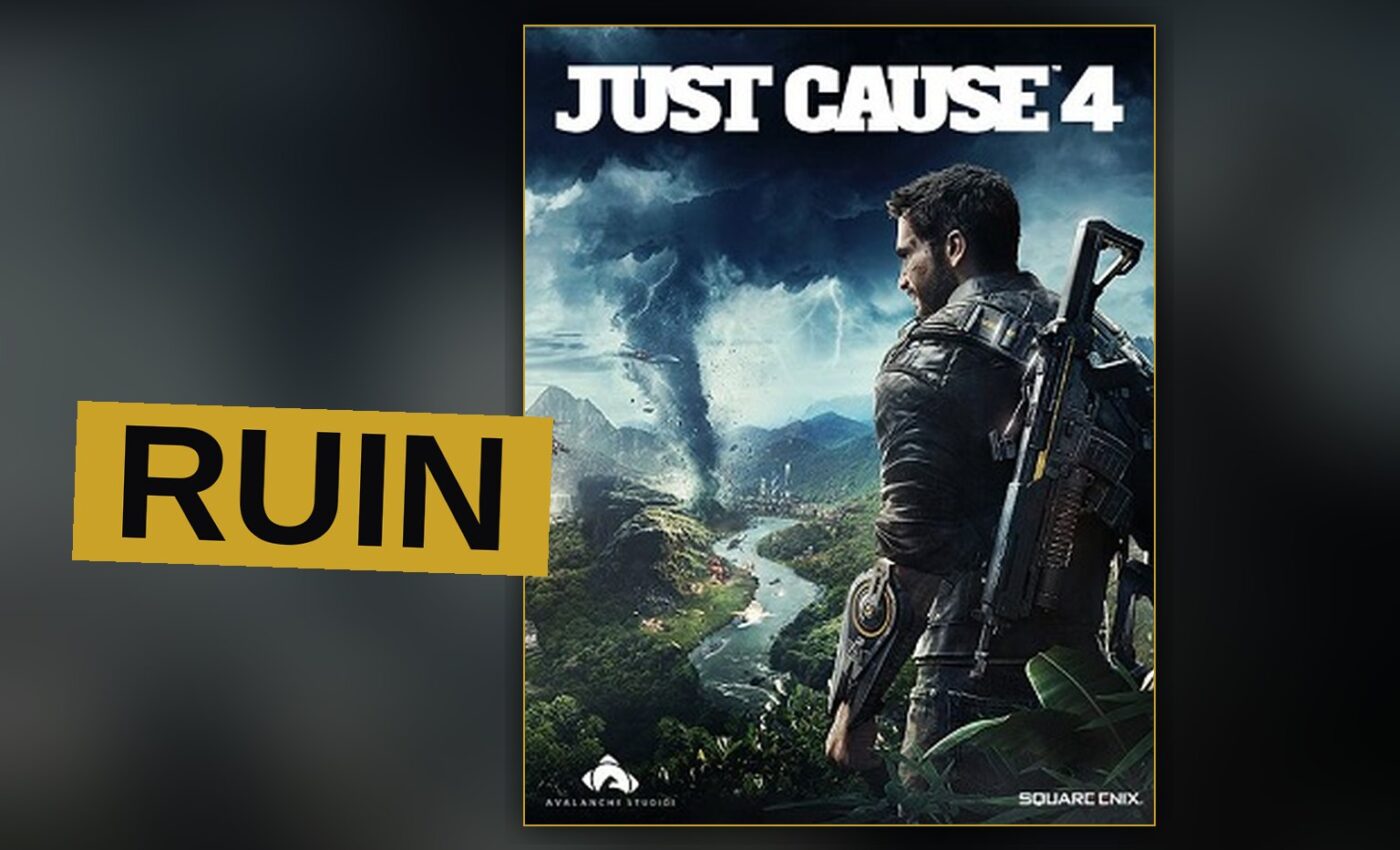
Just Cause 4 gives you a grappling hook, a wingsuit, a parachute and a South American country the size of a small continent to ruin. It hands you tornadoes, sandstorms and blizzards and asks you to fly through them. Almost nothing else in the game is as good as that pitch, and the gap between the pitch and the execution is the whole story of Avalanche Studios’ 2018 release.
The game came out on 4 December 2018 for PlayStation 4, PC and Xbox One, published by Square Enix and built on a new version of Avalanche’s Apex engine. It is the fourth entry in the Just Cause series and the sequel to 2015’s Just Cause 3. Square Enix External Studios worked with Avalanche on development.
Trailer, via Just Cause.
Rico Rodriguez Returns to Solis
Rico Rodriguez is back, and so is his trademark gear. The grappling hook gets the biggest overhaul, gaining new functions and full customisation, which makes it the most powerful and creative tool the player has ever had in the series. You can now attach hot air balloons and rocket boosters to objects and watch the physics do the rest.
The setting is Solis, a fictional South American nation. It is home to the Black Hand, described as the world’s most powerful private army and the biggest private military in the game’s fiction. The Black Hand once served dictators in Rico’s earlier campaigns, including Salvador Mendoza in the first Just Cause and Sebastiano Di Ravello in Just Cause 3.
The new face on the other side is Gabriela Morales, who leads the Black Hand. She is a newly introduced character, and she is the one Rico has to get through to reach the truth about his family.
The Story That Sends Rico South
The hook is personal this time. Rico is shown evidence that his late father, Miguel Rodriguez, once worked with the Black Hand. He travels to Solis, the mercenaries’ homeland, to confront the army and its leader and to uncover what his father’s past actually was.
The fuller plot goes further. Mira Morales, a native of Solis, approaches Rico after the events of Just Cause 3 and tells him his father was working on the Illapa Project, a weather weapon that Oscar Espinosa is using to control the people of Solis. Rico’s first attempt at deposing Espinosa fails, and he runs into the Black Hand, which is led by Mira’s cousin Gabriela Morales.
From there Rico builds his own force with Mira, the Army of Chaos, aimed at taking down Project Illapa and ending Espinosa’s regime. Along the way he picks up a supporting cast:
- Luis “Sargento”, an eager commander of the Army of Chaos
- Izzy, a hacker
- Garland King, a filmmaker obsessed with filming stunts in Solis
- Javi Huerta, an archeologist who wants to uncover the history behind Solis and the Espinosa legacy
- Lanza Morales, Mira’s uncle and a scientist who worked on Project Illapa
- César Pedrone, a former pilot turned conspiracy theorist
- Tom Sheldon, Rico’s old handler at the Agency
The backstory that eventually surfaces is that Miguel worked on the project years ago with Lanza and with Espinosa’s father, Leon Espinosa, intending to control the weather for the good of the people. Espinosa took over after his father’s sudden death, convinced his father had wasted the family’s money, and planned to weaponise Illapa’s technology and sell it to the highest bidder. Miguel left in disgust. Espinosa used his control of Di Ravello in Medici and his Agency connections to have Miguel killed, then imprisoned Lanza to force him to keep working.
Four Biomes, Four Kinds of Weather
Solis is split into four distinct biomes: Rainforest, Grasslands, Alpine and Desert. Each one carries its own fully simulated weather event, so the world changes character as you move through it.
The new wind and particle system matters most in the air. It affects Rico’s traversal with the wingsuit, which turns a simple flight from A to B into something you have to read and react to. Environmental hazards include tornadoes and thunderstorms, and the game also lists blizzards and sandstorms among the extreme weather it can throw at you.
The world itself is a large open world, and the traversal kit is the reason to be in it. The grappling hook, wingsuit and parachute combine into a movement system that no other open-world game of this era really matches.
The Frontline and the Toy Box
Combat and conquest run through a frontline system. Rebel forces fight the Black Hand army at the borders of their territories, and Rico can join those battles at any time. During combat he can be assisted by allies controlled by artificial intelligence.
The arsenal is broad and deliberately strange. There is a large variety of vehicles and firearms, including exotic weapons like the Wind Gun and the Lightning Gun. Every weapon has an alternate firing mode. Players can call for a supply drop at any time.
The four prototype weather cores being tested in Solis are the spine of the campaign’s objectives. Destroying them is how Rico pushes back against Project Illapa while the Army of Chaos grows.
| Element | Just Cause 3 (2015) | Just Cause 4 (2018) |
|---|---|---|
| Setting | Medici | Solis |
| Main antagonist | Sebastiano Di Ravello | Gabriela Morales and Oscar Espinosa |
| Grapple hook | Standard | New functions, fully customisable |
| Weather | Not a headline feature | Tornadoes, thunderstorms, blizzards, sandstorms |
| Engine | Earlier Apex build | New version of Apex |
| Biomes | Not broken out as four | Rainforest, Grasslands, Alpine, Desert |
What Works and What Does Not
The traversal and the weather are the parts that hold up. The wind system gives the wingsuit a real feel, and the four biomes give the map a reason to be as large as it is. Attaching rocket boosters and balloons to objects is the kind of toy that keeps paying off because the physics are the point.
The rest is thinner. The story is the weakest part of the package, and it is not close. A plot that hinges on Rico’s father, a weather weapon and a private army should land harder than it does. The mission design and the cutscenes do not carry the weight the script asks them to, and the voice acting does not rescue them.
The open-world mechanics, the controls, the graphics and the sound design are the parts that earned praise. The frontline system gives the sandbox a strategic layer, but it is a layer, not a replacement for hand-built missions.
The Score and What It Means
Just Cause 4 sits at 6.9 out of 10 on the IGDB critic aggregate across 15 outlets. That number is fair. It reflects a game with a genuinely great movement system and a genuinely forgettable campaign, and it reflects a game that failed to meet Square Enix’s sales expectations.
The mixed reception breaks down cleanly: criticism for the story, mission design, cutscenes and voice acting; praise for the graphics, sound design, controls and open-world mechanics. Both lists are accurate, and they describe a game split down the middle.
The thing worth watching here is not the review score. It is that Avalanche built the best traversal tool in the series and then built a campaign that gives you almost no reason to use it with purpose. The weather is the headline, but the weather is also a distraction from the fact that Solis is a playground with a weak story bolted to it.
If you want a sandbox to break, Just Cause 4 delivers. If you want the story about Rico’s father to mean anything, it does not. That is the trade, and at 6.9 out of 10, it is a trade most players should make at a discount.
Get the Notebook.
The day's best stories and every fresh verdict, in plain English, in your inbox by seven. One email a day, no more.