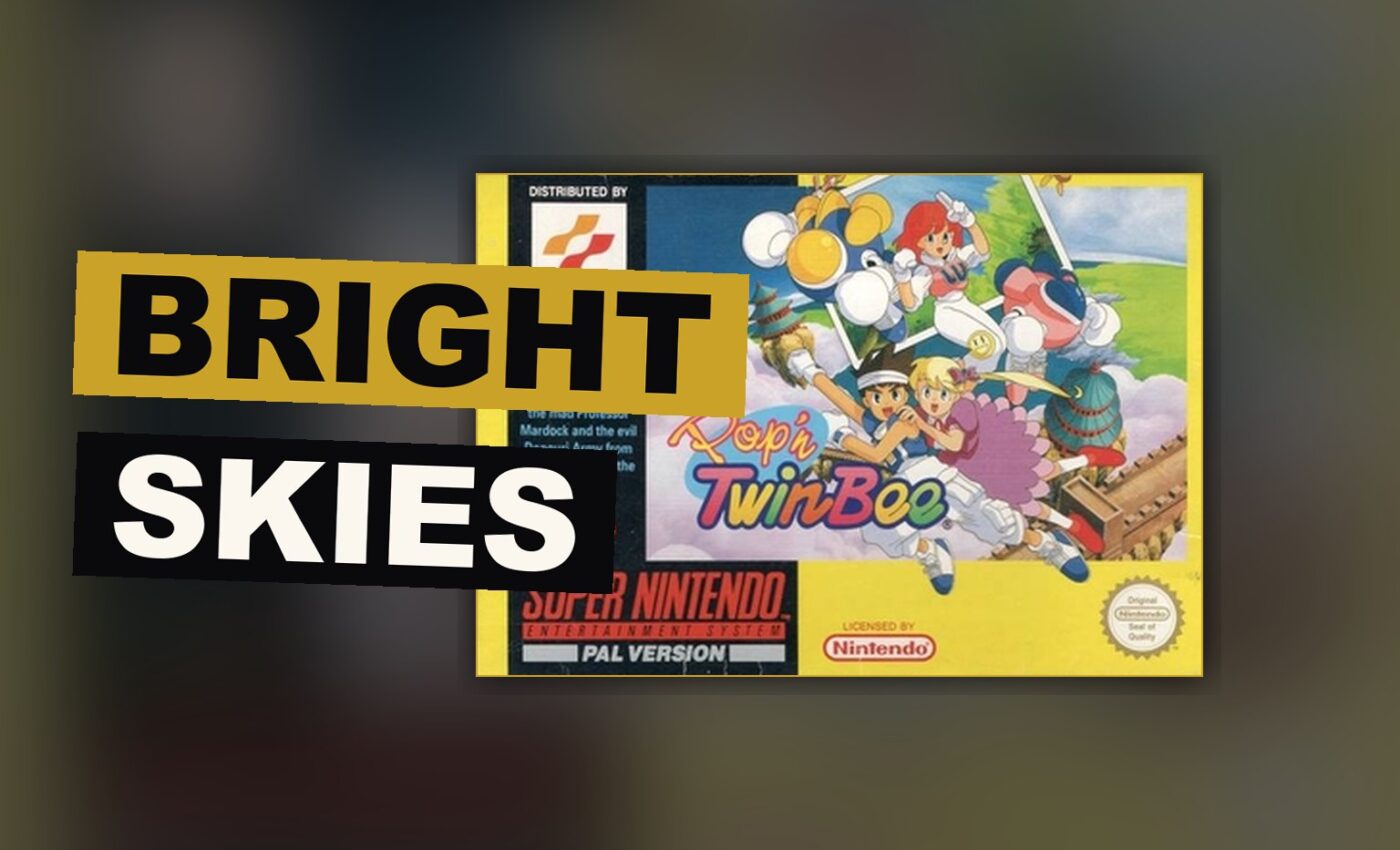
Pop’n TwinBee arrived on the Super Famicom in 1993, and Konami built it around a simple promise: two ships, seven stages, and a bell system that rewards players who shoot straight and think fast.
TwinBee and WinBee Over Donburi Island
Pop’n TwinBee sends TwinBee and WinBee patrolling the skies of Donburi Island. A distress signal arrives from Madoka, the granddaughter of Dr. Mardock. The doctor was once a benevolent scientist until a bump on the head turned him insane. He now wants to conquer the world with an army of Acorn Men, and only the two ships can stop him.
That is the whole plot, and it is enough. The setup is an excuse for the shooting.
The game is a direct follow-up to the arcade title Detana!! TwinBee, also known as Bells & Whistles, and the sixth entry in the series. Konami published the Super Famicom version in Japan and brought it to the PAL region on the Super Nintendo Entertainment System, where Konami’s Palcom Software division handled the release. It was the first of three TwinBee games localized for Europe, ahead of a Game Boy version of Pop’n TwinBee and the platform game Pop’n TwinBee: Rainbow Bell Adventures.
North America waited 27 years. The game finally arrived there through a February 2020 update to the Nintendo Classics service.
A Life Meter and Three Companion Types
The core loop will be familiar to anyone who played Detana!! TwinBee. Two players can fly at once, with Player 1 on the blue TwinBee and Player 2 on the pink WinBee. Before the shooting starts, each player enters a name and picks one of three companion ship types: companions that follow the ship, engulf it, or surround it.
Then come the seven stages. Each one ends with a boss, and the player has to survive all of them.
Konami changes one thing that matters: extra lives are gone, replaced by a life meter that tracks how much damage a ship can take. Lose, and the game offers a restart at the stage where you stopped, though only a limited number of continues are handed out. The rest of the kit is classic TwinBee. Players shoot airborne enemies with a gun and drop bombs on ground targets. Ships can punch at close range. They can fire tiny replicas of themselves that attack every on-screen enemy, limited by how many stocks the player holds.
In two-player mode, one player can hand over some life energy to refill the other’s meter, or grab the partner’s ship and use it as a projectile.
Bells remain the heart of the upgrade system. Shoot them in the air to change their color, and each color delivers a different upgrade when collected.
What the Bell System Gets Right
The bell mechanic is the reason Pop’n TwinBee holds up. It turns every screen into a small decision: keep firing at enemies, or spend shots nudging a bell toward the color you actually need. That tension runs through all seven stages, and the life meter raises the stakes on every mistake.
The companion selection is a quieter win. Three arrangements mean three different ways to cover the screen, and the choice lands before the first shot is fired.
The two-player mode is where the design gets strange and good. Passing life energy between ships makes cooperation a resource, not a gesture. Using a partner’s ship as a projectile is the kind of idea that sounds like a joke and plays like a tactic.
A 1993 Shooter That Still Reads Clearly
Pop’n TwinBee does not reinvent the series. It refines it. The shift from extra lives to a life meter is the biggest change, and it makes the game harsher in the right way — mistakes cost damage instead of a full reset, so a bad stage does not erase progress.
The European release history is a footnote, but a telling one. Konami saw enough in the TwinBee formula to localize three games for that market, and this is the strongest of the three.
The 27-year gap before North America got the game through Nintendo Classics is the strangest part of the story. A shooter this clean should not have taken that long to cross the ocean.
| Release | Platform | Region |
|---|---|---|
| 1993 | Super Famicom | Japan |
| 1993 | Super Nintendo Entertainment System | PAL region |
| February 2020 | Nintendo Classics | North America |
Pop’n TwinBee is not the deepest shooter Konami ever shipped, and the seven stages run out faster than the bell system deserves. What remains is a tight, two-player game with one genuinely great mechanic and a companion system that rewards a second look. It earns its place in the series and its place in the Super Nintendo Entertainment System library.
Get the Notebook.
The day's best stories and every fresh verdict, in plain English, in your inbox by seven. One email a day, no more.