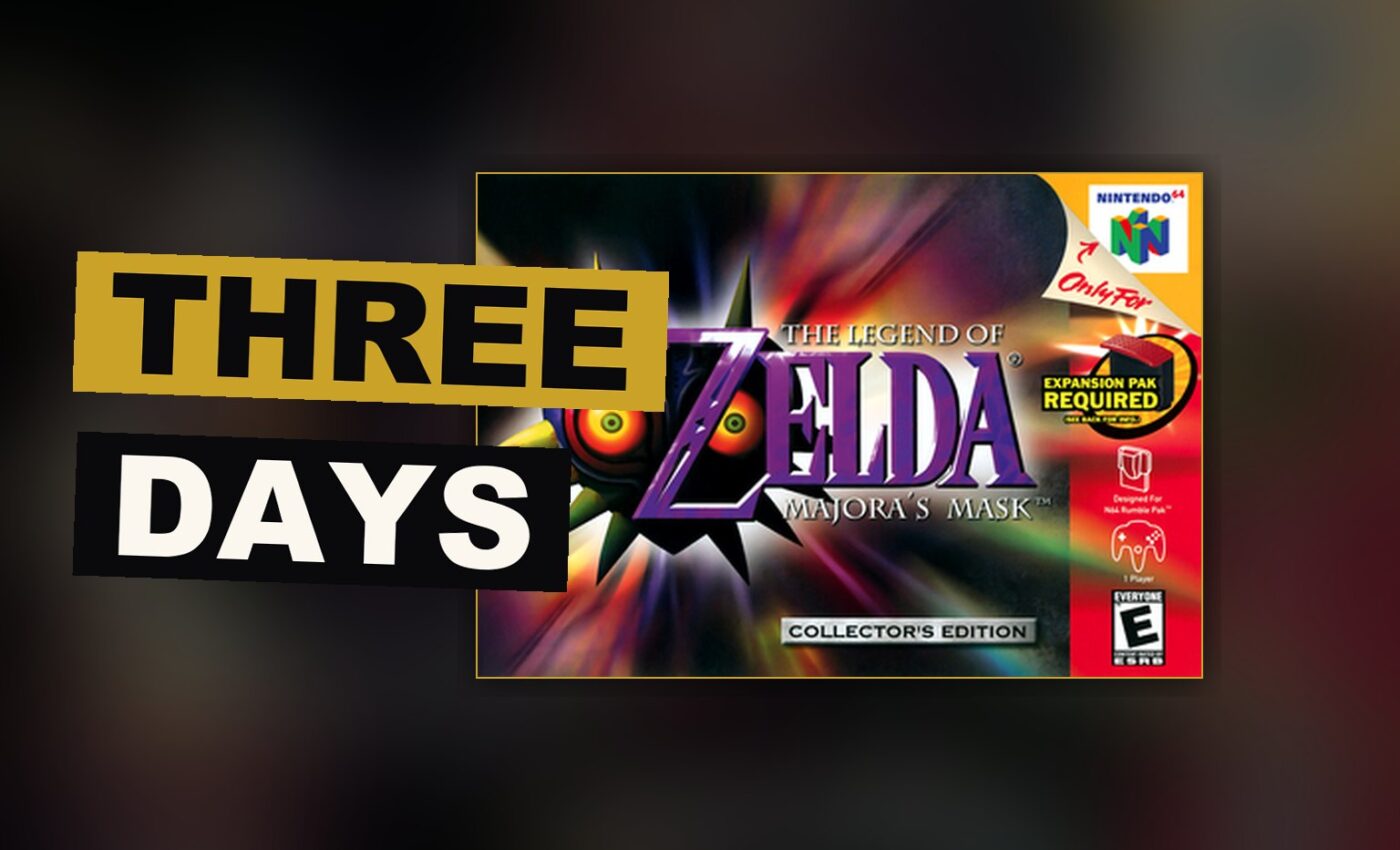
Nintendo handed itself less than two years to follow one of the most celebrated games ever made. The Legend of Zelda: Majora’s Mask arrived on the Nintendo 64 in 2000, and it refused the safe path. It took the Ocarina of Time engine and its character models and pushed them toward something stranger: a parallel world called Termina, a moon dropping out of the sky, and a three-day clock that never stops.
The premise is blunt. Link has three days to stop the moon from hitting Termina. When the clock runs out, he plays the Song of Time and returns to the first day. What he learned stays. Everything else resets.
A Mask, a Skull Kid, and Three Days
The story picks up several months after Ocarina of Time. Link is hunting for Navi, his missing companion, who left after the previous game. He is ambushed by a Skull Kid in a mysterious mask, traveling with two fairies, the siblings Tatl and Tael. They take his horse, Epona, and the Ocarina of Time.
Link chases them and walks into a trap. Skull Kid curses him into a Deku Scrub. Tatl is inadvertently left behind in the confusion, and she guides Link to Clock Town to reunite with her brother. There they meet the Happy Mask Salesman, who pressures Link into recovering the stolen mask and promises to break the curse if he succeeds.
The mask is Majora’s Mask, an ancient item used in hexing rituals. Worn by the Skull Kid, it calls forth a menacing moon over Termina. Impact is predicted for dawn on the day of the Carnival of Time, an annual harvest festival that begins in three days.
That deadline is the game. The moon hangs overhead, grimacing, moving inexorably closer. Below it, people keep living.
Termina Is Hyrule With the Comfort Removed
Termina is an alternate version of Hyrule, the main setting of most Zelda games. It is depicted as a darker, more unsettling version of that world. Landmarks are familiar but twisted. Minor characters from Ocarina of Time return with individual stories of misfortune.
This is where Majora’s Mask splits from its predecessor. Ocarina of Time built a kingdom worth saving. Majora’s Mask builds a town worth watching fall apart.
In the center of Termina, the people of Clock Town endlessly debate evacuating the city or continuing to prepare for the festival. The failure of the festival would be devastating to the economy. That debate runs while a moon falls toward them.
Three Days That Reset Forever
The game introduces gameplay concepts built around a perpetually repeating three-day cycle and the use of various masks that transform Link into different forms. The cycle must be reset periodically to progress.
As the player advances, Link learns to play numerous melodies on his ocarina. Those melodies let him control the flow of time, open hidden passages, or manipulate the environment. The ocarina is not a side activity here. It is the spine of the design.
Compared to earlier Zelda games, Majora’s Mask is more oriented toward interaction with non-player characters. It carries a larger variety of items, optional quests, and mini-games. The structure rewards players who stop moving and start paying attention to the people around them.
Majora’s Mask requires the Expansion Pak add-on for the Nintendo 64. The add-on primarily supports the game’s complex mechanics, such as the repeating three-day cycle and the extensive mask system. It also allows for graphical enhancements and more on-screen characters.
Link Fights, Blocks, and Transforms
Majora’s Mask is an action-adventure game set in a three-dimensional environment. Players control Link from a third-person perspective to explore dungeons, solve puzzles, and fight monsters. Basic actions like walking, running, and context-based jumping use the analog stick, and items are required to navigate the environment.
Link wields a sword, and he can block or reflect attacks with a shield. He stuns enemies by throwing Deku Nuts, attacks from a distance with a bow and arrow, and uses bombs to destroy obstacles and damage enemies. The Hookshot lets him latch onto objects or paralyze enemies.
These actions are aided by the “Z-targeting” system introduced in Ocarina of Time. The player may lock the camera onto a particular character, object, or enemy and keep it in view regardless of Link’s motion through the environment.
Dungeons return, and they contain numerous puzzles the player must solve. They also contain optional puzzles that award collectible fairies. Gather all of them and Link gains additional abilities.
Majora’s Mask retains its predecessor’s gameplay systems and control scheme while adding character transformations and the three-day cycle.
What the Two Games Share, and What They Don’t
| Feature | Ocarina of Time (1998) | Majora’s Mask (2000) |
|---|---|---|
| Setting | Hyrule | Termina, an alternate version of Hyrule |
| Graphics | First 3D entry in the series | Enhanced graphics, reused character models |
| Core structure | Standard dungeon progression | Perpetually repeating three-day cycle |
| Transformation | None | Various masks transform Link into different forms |
| Development time | Not stated in the source | Completed in less than two years |
| Required hardware | Base Nintendo 64 | Expansion Pak add-on |
The table says it better than a paragraph can. Majora’s Mask is not a bigger Ocarina of Time. It is a tighter one, built on a clock.
A Team Racing Its Own Deadline
Majora’s Mask was designed by a creative team led by Eiji Aonuma, Yoshiaki Koizumi, and Shigeru Miyamoto. It was completed in less than two years.
It features enhanced graphics and several gameplay changes, but it reuses elements and character models from Ocarina of Time. That creative decision was made necessary by time constraints.
That is not a caveat. It is the origin of the game’s identity. The reuse was forced by the schedule, and the schedule is the reason the game looks the way it does. A shorter production left the team with borrowed models and an unfamiliar world to fill.
The game is a critical and commercial success. It is the second game in The Legend of Zelda series to use 3D graphics, following Ocarina of Time.
The Clock Is the Point
Here is what matters, and it is not the mask system. The masks are clever. The transformations are clever. The dungeons are well made.
The clock is the thing. Majora’s Mask gives every character in Termina a schedule, a problem, and a deadline they do not know about. The people of Clock Town are preoccupied by their own troubles while the moon falls.
It is predicted to impact at dawn on the day of the Carnival of Time, an annual harvest festival that begins in three days.
That is the part worth watching. A game about a falling moon could have been a countdown to a boss fight. Majora’s Mask makes the countdown the whole town’s problem, and then lets you live the same three days again and again.
The three-day cycle is also the game’s hardest demand. It asks players to accept repetition as a tool rather than a punishment. Reset the cycle and the world moves back. Your progress stays. That trade is the entire emotional argument of the game, and it holds.
The Expansion Pak requirement is worth naming plainly. Majora’s Mask asked Nintendo 64 owners to buy an add-on to run its central mechanic. That is a real cost, and it is the least elegant part of the package. The hardware demand was not a marketing flourish. It was the price of the cycle.
Where Ocarina of Time was an adventure about a kingdom, Majora’s Mask is an adventure about people who will not be saved in time. It is smaller, darker, and stranger than the game it follows. It is also the better one.
The Legend of Zelda: Majora’s Mask is a 2000 action-adventure game developed and published by Nintendo for the Nintendo 64. It is a direct sequel to Ocarina of Time, and it uses the same engine and visual style. It is not a retread. It is a game that took a two-year deadline and turned it into a design.
Get the Notebook.
The day's best stories and every fresh verdict, in plain English, in your inbox by seven. One email a day, no more.