Pokémon Stadium, released by Nintendo for the Nintendo 64 in 1999, is built on a single promise: the battles you had been fighting on a two-inch monochrome screen, rendered in 3D on a television, with the monsters animated and a commentator calling the fight. In 1999 that promise was enormous. The game keeps it, and it does not do a great deal else.
The Battles
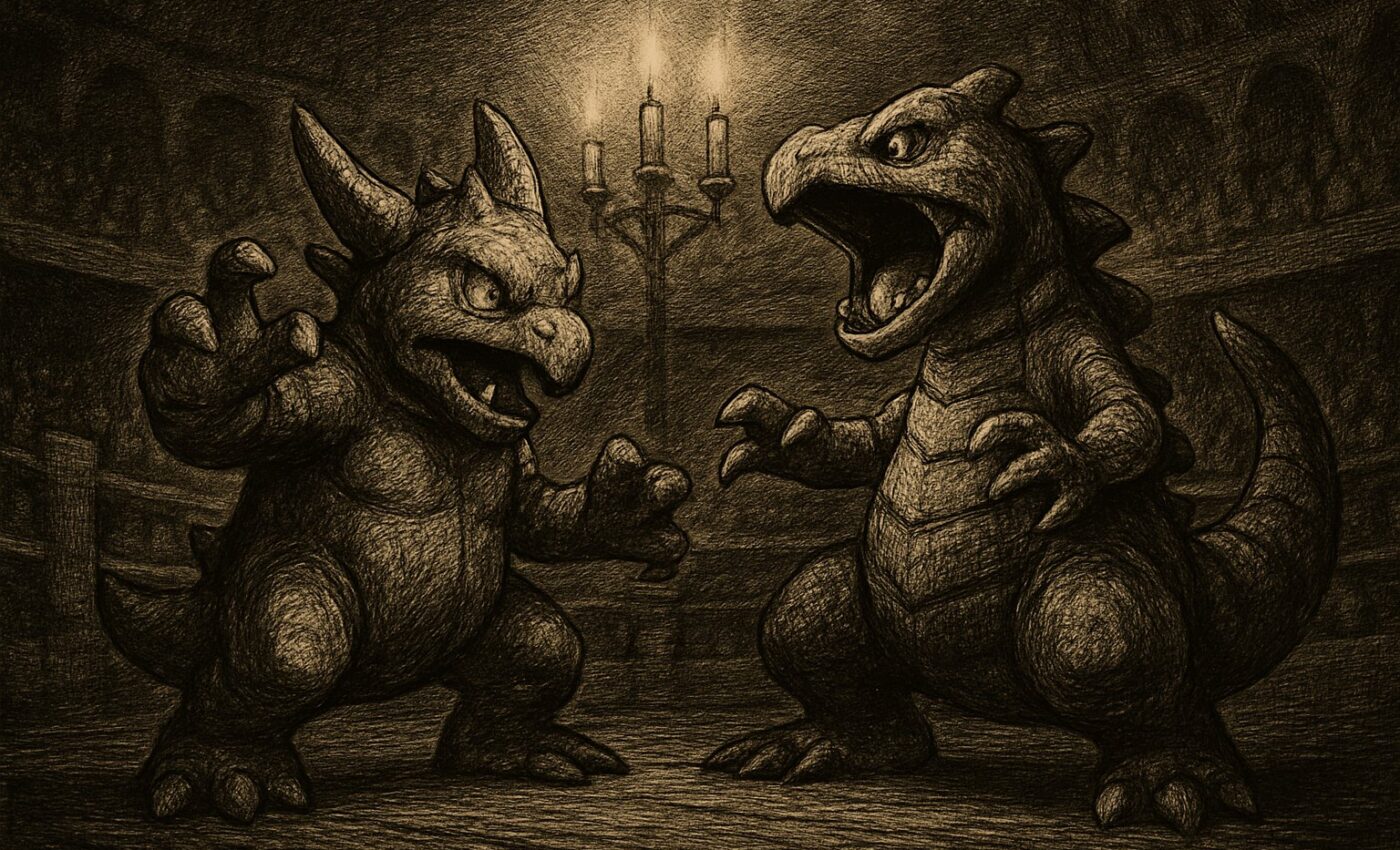
The core is a 3D turn-based battling system that reproduces the Game Boy rules faithfully. You pick six Pokémon, enter a cup, and fight through rounds of trainers. The animations are the draw. Every move has a visual, every monster has an idle, and the announcer’s commentary turns a menu-driven fight into something that feels like an event. For a generation of players who had only ever imagined what a Hyper Beam looked like, this was the first time they saw one.
The Transfer Pak
The game’s smartest feature is the accessory that came with it. The Transfer Pak plugs a Game Boy cartridge into the N64 controller, and your own team, the one you raised on the handheld, walks onto the stadium floor. That connection is the reason the game mattered. Without it, Stadium is a rental set of monsters. With it, it is the arena your team was training for.
The Gym Leader Castle
Beyond the cups, the Gym Leader Castle runs you through the gym leaders and the Elite Four from the handheld games in sequence, which gives the single-player mode a spine. Clearing everything unlocks a harder second round, and the difficulty jump in that second pass is real.
The Sequel
Pokémon Stadium 2 followed in 2000 from HAL Laboratory and Nintendo, expanding the roster to 250 Pokémon, including legendaries, and adding a rival who appears once the cups and the castle are done. The sequel is the fuller game. The original is the one that proved the idea.
Where It Falls Short
There is no adventure here, no world and no story. It is a battle simulator with mini-games attached, and a player without a Game Boy cartridge to import will find it thin quickly. The AI trainers are predictable, the cups repeat, and the mini-games, charming as they are, are a diversion rather than a mode. The 3D models, thrilling in 1999, are stiff now.
The Verdict
Pokémon Stadium is a companion piece rather than a game in its own right, and as a companion it was exactly what its audience wanted. Judged alone it is a handsome, shallow arena. Judged with a Game Boy plugged into the controller, it is the payoff for a hundred hours of training.
Get the Notebook.
The day's best stories and every fresh verdict, in plain English, in your inbox by seven. One email a day, no more.