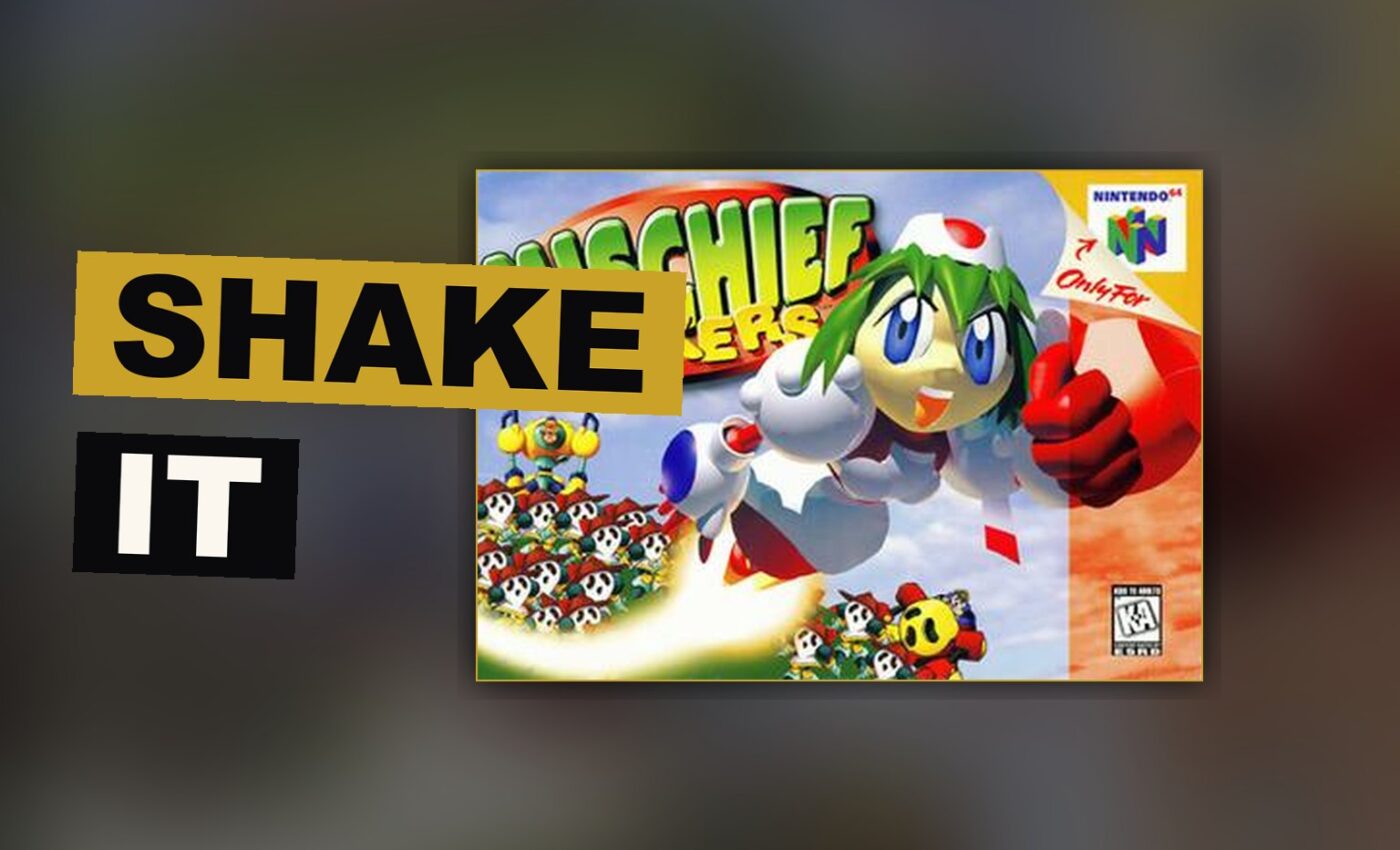
Mischief Makers hit the Nintendo 64 in the United States on October 1, 1997. It did not look like anything else on the shelf. Treasure built a 2D side-scroller for a console that had almost none, wrapped it in pre-rendered 3D backgrounds, and handed the player a robotic maid named Marina Liteyears whose entire relationship with the world is grabbing it and shaking it until something falls out.
That is the whole idea. It is also, twenty-eight years on, still the most interesting thing about the game.
Treasure Built a 2D Platformer for a 3D Console
Treasure’s 12-person team started work in mid-1995, before the console was finished, with little knowledge of the prototype hardware. The stated goal was a novel mechanic. The result was a “catching” technique the team has described as its most difficult task to implement. The effort shows, in the good way and the bad way.
Mischief Makers is the first single-player 2D side-scrolling platform game on the Nintendo 64, and Treasure’s first release for a Nintendo console. It combines platform mechanics with action and puzzle ideas, and its structure is more exploratory than the run-and-gun games Treasure had made before.
The look is 2.5D. Characters and backgrounds are modeled in pre-rendered 3D in the manner of Donkey Kong Country’s Advanced Computer Modeling, with 3D backgrounds sitting behind 2D play.
Marina Liteyears Can Grab Almost Anything
Marina can grab nearly everything in Mischief Makers. Once an object is in her hands she can shake it, throw it as a projectile, or shake it again to see what it becomes. Items sometimes change function mid-shake — a plain object turns into a homing missile, a gun fires in multiple directions. Some shaken objects drop red, blue and green gems that restore health.
The health gauge sits in the corner of the screen. Two additional stock lives can be stored. Yellow gems are hidden in each level and extend the final cutscene. Marina runs, jumps, boosts with a jetpack in the eight cardinal and ordinal directions, slides, hovers and rolls.
The grab-and-shake system is the game’s entire argument, and it is a good one.
Planet Clancer, Professor Theo, and a Civil War
Planet Clancer is on the edge of civil war because of its Emperor and his Imperial forces. The Emperor brainwashes Clancers to kidnap a visiting robotics genius, Professor Theo. Theo’s creation — the Ultra-InterGalactic-Cybot G, Marina Liteyears — goes after him.
Marina gets help from troops still loyal to King Aster. She grabs, shakes and throws her way toward the Professor, and along the way joins the rebellion against the empire. The tone is comedy and science fiction played for lightness. Professor Theo is clumsy and lighthearted.
Enix published Mischief Makers in Japan on June 27, 1997. Nintendo handled it internationally, with Gradiente attached in some territories. It was announced at that year’s Electronic Entertainment Expo. The scope is five worlds with roughly twelve levels apiece, 52 levels in total.
What the Grab-and-Shake Loop Actually Delivers
Here is the case for Mischief Makers: the central verb is genuinely new, and Treasure keeps finding ways to make it mean something different. Grabbing a Clanball platform to cross a gap is not the same as grabbing a missile and returning it to sender, which is not the same as shaking a gun until it fires in directions it was not built for.
- Enemies, thrown as projectiles
- Clanball platforms, used for traversal
- Warp stars, grabbed and redirected
- Missiles, caught and returned
- Gems, shaken loose for health
- Yellow gems, hidden for the extended ending
That list is the game. When it works, Mischief Makers feels like a puzzle box that happens to have a jump button.
The boss fights are the strongest expression of the idea. They are where the inventiveness and the personality the game is remembered for concentrate hardest, and they are the reason the grab mechanic does not wear out as fast as the level count suggests it should.
Where the Shaking Gets Thin
The problems are real and they start early.
The introductory learning curve is harsh. A game built on one unusual verb needs to teach that verb carefully, and Mischief Makers does not. Players who bounce off the first stretch will not see the levels where the mechanic pays off.
The game is short. It is also easy, and its replay value is low. Collecting a golden gem in every stage and hitting super fast completion ranks is the path to 100 percent, and that path is a completionist’s errand rather than a reason to keep playing. The sound draws criticism too, and it is hard to argue.
Then there is the structural mismatch. Treasure built an exploratory platformer with a puzzle spine and shipped it on a console whose audience was not there for either. The Nintendo 64’s library ran toward 3D spectacle. Mischief Makers ran the other way.
Grab a controller and help our Super Heroine shake up the evil empire!
That line, from the game’s own pitch, tells you exactly what Treasure thought it had.
The Shake, Shake That Outlived the Cartridge
Marina’s signature “Shake, shake!” sound bite is the detail that escaped the game and kept circulating. Multiple retrospective reviewers single it out. It is the kind of thing that should be a minor flourish and instead became the handle people use to talk about Mischief Makers at all.
That is worth taking seriously. A game’s most quoted asset is usually its most distinctive one, and here the most distinctive asset is a voice line attached to the core mechanic. The sound bite and the grab-and-shake loop are the same idea, stated twice.
On release, Mischief Makers received mixed reviews. Critics praised its inventiveness, its personality and its boss fights. They criticized its short length, low difficulty, low replay value, sound and that harsh introductory curve.
Retrospective reviewers disagreed with the originally poor reception. Video game journalists have appealed for a reissue through the Nintendo eShop, or for a sequel, or for a franchise reboot. None of that has happened.
Why 7.1 Is the Honest Number
The published critical score sits at 7.1/10 on Metacritic. That number is close to right, and the reason is that Mischief Makers is a game with one great idea and not enough game around it.
The great idea is load-bearing. Almost every object in the world can be grabbed, and the shake system turns that into combat, traversal, loot and puzzle-solving at once. Nothing else on the Nintendo 64 played like it. Nothing else in Treasure’s catalog plays like it either, which is saying something for a studio that built its reputation on not repeating itself.
The problem is that a great idea is not a great game. Mischief Makers runs five worlds and 52 levels on a mechanic that needed a longer, harder, better-taught campaign to justify its own invention. The difficulty is low enough that most players will never be forced to use the shake system well. The length is short enough that the game ends before the idea is exhausted. The learning curve is steep enough at the start that some players will quit before they see what the mechanic can do.
Those three failures compound. A short game with a harsh opening and a low ceiling asks the player to invest in a payoff that arrives late and then stops.
The boss fights are the exception, and they matter more than their share of the runtime suggests. They are where the game slows down, sets a problem, and makes the grab-and-shake verb the answer. They are also the part retrospective reviewers keep returning to, which is a reasonable signal about where the value actually lives.
The 2.5D presentation holds up better than the sound. Pre-rendered 3D characters over 3D backgrounds behind 2D play was a deliberate choice, made when the console was still a prototype and the team had little to work with. It gives Mischief Makers a look that is clearly of its moment without being embarrassing about it.
What does not hold up is the sense that Treasure ran out of room. Five worlds and 52 levels sounds generous until you play them and realize how many are teaching the same lesson twice.
The case for a reissue is stronger than the case for a sequel. Mischief Makers does not need a reboot or a franchise. It needs a version with a gentler opening, a harder back half and a reason to chase the golden gems. The core is intact. The packaging never was.
Marina Liteyears is the reason to play it. A robotic maid who saves her creator by grabbing the world and shaking it until it gives up what she needs is a better character premise than most games of the era managed, and the “Shake, shake!” line is the proof that it landed. The empire, the brainwashed Clancers, the loyal troops of King Aster — none of that is the point. The point is the verb.
Mischief Makers scores 7.1/10. Play it for the boss fights and the shake system. Do not expect the campaign around them to hold up its end.
Get the Notebook.
The day's best stories and every fresh verdict, in plain English, in your inbox by seven. One email a day, no more.