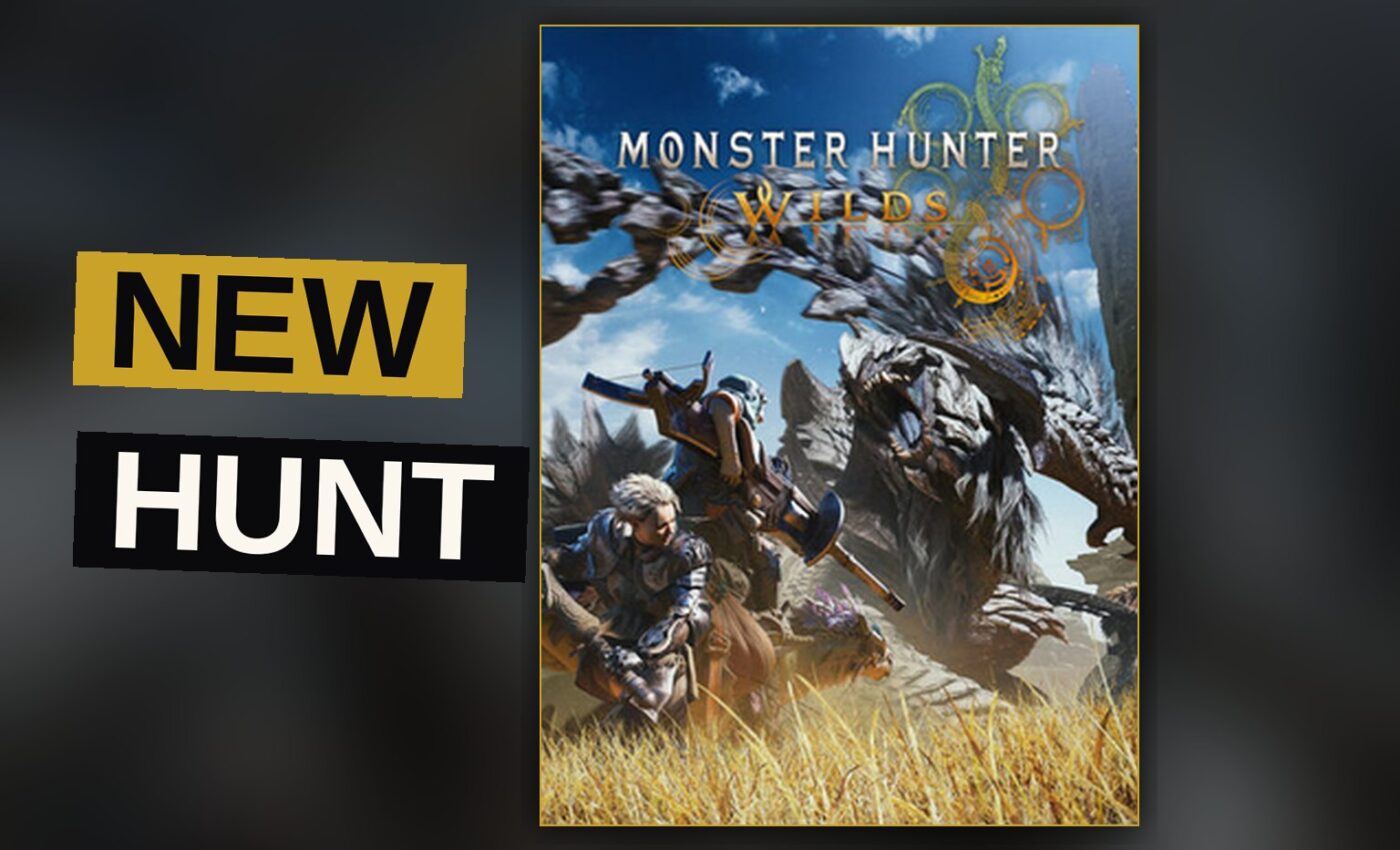
Monster Hunter Wilds takes the series somewhere it has never gone: an open world that fights back. Capcom’s 2025 action role-playing game puts the player on a Seikret mount and drops them into the Forbidden Lands, a region of shifting biomes and violent weather where the ground itself rearranges between hunts. It launched February 28, 2025 on PlayStation 5, Windows and Xbox Series X/S with cross-platform play, and a Nintendo Switch 2 version is in development for December 4, 2026. The result is the most ambitious entry in the franchise, and the best.
Trailer, via PlayStation.
The Forbidden Lands and the Landspine
The story opens in the wasteland, where a group of explorers led by former hunter Fabius finds a lone boy named Nata. Nata comes from the Forbidden Lands, a harsh, uncharted region long believed to be uninhabited. His people, the Keepers, were driven from home by the White Wraith, a monster thought extinct. Fabius summons a recently promoted hunter and their feline palico to investigate and escort the boy back.
The hunter is joined by Alma, a guild handler, and Gemma, a blacksmith. Together they form the Avis Unit. A second group, the Astrum Unit, includes veteran hunter Olivia, her palico Athos, botanist Erik and guild engineer Werner. The expedition aids native peoples against ferocious monsters and unnatural weather while tracking the creature at the heart of the mystery.
That mystery pays off. The White Wraith is Arkveld, an albino wyvern with chain-like appendages that kills apex predators by absorbing their life energy. The lands are connected by the Landspine, a damaged structure leaking a white crystalline substance called wyvern milk, or wylk, tied to the weather in each biome. The trail leads to Wyveria, the ruined capital of an ancient civilization that built the Dragontorch, an infinite energy source, and the Guardian Monsters that defend it. Arkveld is one of those Guardians, now out of control and threatening the ecosystem. The hunter has to kill it.
Two Weapons, One Seikret
Wilds keeps the bones of Monster Hunter: World and rebuilds the joints. The game plays from a third-person perspective. The hunter tracks and fights monsters, capturing or slaying them, then collects parts and resources to craft armor, weapons and consumables that unlock harder fights. Fourteen weapon types return from World, each with new moves and actions.
The additions matter more than the roster. A Seikret mount carries the hunter and a second weapon into the field, so a great sword and a bowgun can travel together. Armor still changes only in the village. Pop-up camps can be set up inside the open world, making the loop between hunt and resupply nearly seamless. The Slinger returns with new features, grabbing items from a distance and triggering environmental hazards.
Focus mode is the sharpest change. It lets the player aim attacks at specific body parts, and wounds created by repeated strikes can be exploited for extra damage. The system gives every fight a second layer: not just when to swing, but where.
The unbridled force of nature runs wild and relentless, with environments transforming drastically from one moment to the next.
A World That Rearranges Itself
The biomes are large and open, and the weather is not decoration. Environments transform from one moment to the next, and the abnormal conditions in the Forbidden Lands are part of the plot, not just a hazard. The Landspine and its leaking wylk tie the weather in each region to a single damaged structure, which gives the open world a reason to exist beyond size.
Quests start whenever the player locates a target in the wilds. That sounds like a small convenience. It is not. It removes the loading screen between deciding to hunt and hunting, and it changes how the game feels to play for an hour.
The seamlessness is the point. Wilds can be played solo or online with up to three additional players during quests, and cross-platform play means the hunting party is not split by hardware.
What Wilds Gets Right
Capcom has been building toward this since World, and Wilds is the version where the pieces fit. The wound system rewards attention over brute force. The Seikret solves a problem the series has had for years — the dead time between deciding on a loadout and reaching the monster. The story, for once, is worth following: Arkveld is a real antagonist with a real reason to exist, and the Wyveria reveal reframes the whole map.
The weaker parts are inherited. Fourteen weapon types is a lot of surface area, and the gap between a mastered weapon and a new one remains wide. Armor locked to the village puts a small seam back into an otherwise seamless loop. These are quibbles, not cracks.
What matters is that Wilds commits to its own idea. The Forbidden Lands are not a backdrop for hunts; they are the hunt. Weather, wylk, the Landspine and the Guardians all feed the same machine, and the machine runs.
The Switch 2 version, due December 4, 2026, will test whether that machine scales down without losing what makes it work. Until then, this is the definitive version of a series finally willing to let nature run wild.
Get the Notebook.
The day's best stories and every fresh verdict, in plain English, in your inbox by seven. One email a day, no more.