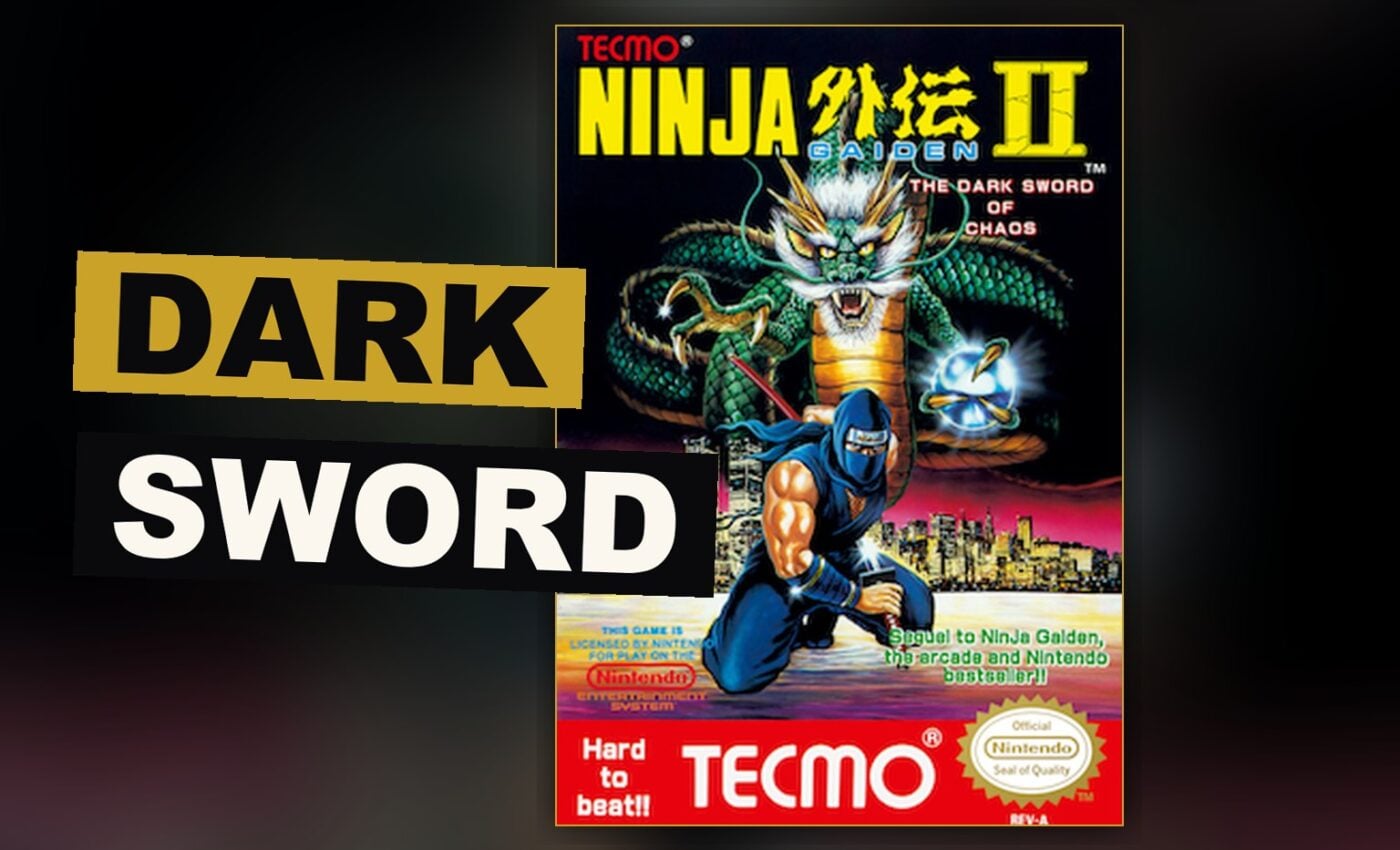
Ninja Gaiden II: The Dark Sword of Chaos arrived on the Nintendo Entertainment System in 1990 as the middle chapter of Tecmo’s ninja trilogy, and it carries a reputation that has outlasted most of its contemporaries. Ryu Hayabusa is back. Ashtar is the new threat. The Dragon Sword still does the work. What the game asks of a player has not softened with age, and that is both the point and the problem.
Ashtar and the Dark Sword of Chaos
The story picks up a year after the first Ninja Gaiden. Ashtar, the evil lord who secretly controlled Jaquio, learns of his subordinate’s defeat and devises a plan to rule Earth by opening the Gate of Darkness. A U.S. Army Special Intelligence unit member named Robert T. Sturgeon is sent to find Ryu. Robert tells him that Irene Lew has been captured and that he must go to the Tower of Lahja to save her.
Ryu hops a freight train, battles up the mountain where the tower stands, and is ambushed by a figure who calls himself a tribesman of the World of Chaos. At the top of the tower, Ryu finds Irene in Ashtar’s custody. Ashtar blasts Ryu with energy from his own sword. Before he can finish the job, Robert appears and shoots Ashtar in the back.
Robert orders Ashtar to hand over his sword and give up. Ashtar escapes with Irene instead, telling Ryu to follow him into the Maze of Darkness. Robert then explains the full plot: Ashtar intends to take over the world using the complete power of the Dark Sword of Chaos.
A Story That Goes Through the Motions
The plot moves. It does not surprise. Ninja Gaiden II was criticized at the time for being more generic and predictable than its predecessor, and playing it now, that judgment holds. Ashtar is a less interesting villain than Jaquio because he is a larger one. The first game’s antagonist had a specific, ugly plan. Ashtar has a sword and a gate and a world to engulf.
The cutscenes are still well drawn and well paced. Tecmo knew how to stage a scene between levels, and the tower sequence in particular earns its place. But the beats are familiar. A hostage. A rescue that fails. A villain who escapes to fight again. Robert T. Sturgeon exists mostly to explain things and then to shoot Ashtar in the back at the right moment.
What the story does have is momentum. It never sits still long enough to bore. That is a low bar, but it is one the game clears.
Wall Climbing and the Power Boosting Items
The gameplay is where Ninja Gaiden II earns its keep. The player controls Ryu through a series of platforming levels called “Acts.” He can jump, latch on and off walls and ladders, and — new to this installment — climb up and down walls.
Two additions matter most. Ryu can now climb vertically on walls, and he can attack with Power Boosting Items while hanging on walls and ladders. Both changes open up the level design and give the player more options in a fight.
Ryu has a strength meter at the top of the screen. It drops whenever he takes damage. The player loses a life if the meter runs out, if Ryu falls off the screen, or if the timer runs out. Lose all lives and the game ends, though players can continue from the beginning of the level where they died.
Enemies fall to the Dragon Sword or to Power Boosting Items, which consume Ryu’s ninja power. The items include:
- Shurikens
- “Windmill Throwing Stars” that move back and forth like a boomerang
- “The Art of the Fire Wheel,” which hurls fireballs diagonally upwards
- “Fire Dragon Balls,” which hurl fireballs diagonally downwards
- The “Invincible Fire Wheel,” a barrier of three fireballs that destroys any enemy that touches it
Items are found in crystal balls scattered through the levels and can be swapped by collecting another. Each Act ends with a boss that has its own strength meter, depleted the same way Ryu’s is.
The Difficulty Is the Point
Ninja Gaiden II is hard. Reviewers at the time said the visuals and controls were improved over the first game while the difficulty stayed high, and that is the correct read. The wall climbing makes Ryu more mobile, but the enemies punish every mistake. The knockback is severe. A single bad jump into a pit ends a life.
This is not a flaw in the design. It is the design. The game maintains lasting appeal among players for exactly this reason. One reviewer described Ninja Gaiden II as “a challenging experience the likes of which gamers in the 8-bit era lived and died for.” That line gets at something true. The game does not want to be finished quickly. It wants to be learned.
The controls are tighter than the first game’s. Ryu responds. The problem is rarely the input. It is the player’s judgment, and the game is built to punish bad judgment without mercy.
What the Score Says
Ninja Gaiden II: The Dark Sword of Chaos was nominated for several awards from Nintendo Power in 1991. It received praise in previews from Electronic Gaming Monthly and Nintendo Power and continued to draw high ratings and coverage after release. It was released in North America and Japan in 1990 and in Europe in 1994 under the title Shadow Warriors II. An arcade version went out on Nintendo’s PlayChoice-10 system in 1990.
- Platform: Nintendo Entertainment System
- Developer and publisher: Tecmo
- Release: North America and Japan, 1990; Europe, 1994
- Arcade release: PlayChoice-10, 1990
- Published critical score: 7.5/10
The game sits in an awkward place. It is the middle chapter of a trilogy, and it is remembered less for what it added than for what it repeated. The wall climbing and the expanded item set are real improvements. The story is not.
Ashtar is a bigger villain than Jaquio and a smaller character. The Dark Sword of Chaos is a weapon with a name and a plan attached, and the plan is to cover the world in darkness, which is the plan every villain in this era had. The Tower of Lahja and the Maze of Darkness are good settings. They are not good enough to carry a plot that telegraphs its turns.
Where the game holds up is in the playing. The Acts are well built. The bosses are readable. The strength meter and the ninja power meter create a constant, low-grade tension that never lets up. Every item you pick up is a decision about how you want to spend a limited resource. That is good design, and it is the reason people still return to this cartridge.
The difficulty is the other reason. Ninja Gaiden II does not respect your time. It respects your attention. There is a difference, and the game knows it.
This paper’s verdict: Ninja Gaiden II: The Dark Sword of Chaos is a strong action game with a weak story, and the balance lands slightly in its favor. The controls and visuals improved on the first game. The wall climbing is a genuine addition, not a gimmick. The plot is the weakest part of the package, and it is the part that has aged worst.
The 7.5/10 published score is fair. It is not a classic in the way the first game is. It is a well-made sequel that does the job, adds a few things worth keeping, and never quite finds a reason to exist beyond continuing the story. That is enough. It is not more than enough.
Get the Notebook.
The day's best stories and every fresh verdict, in plain English, in your inbox by seven. One email a day, no more.