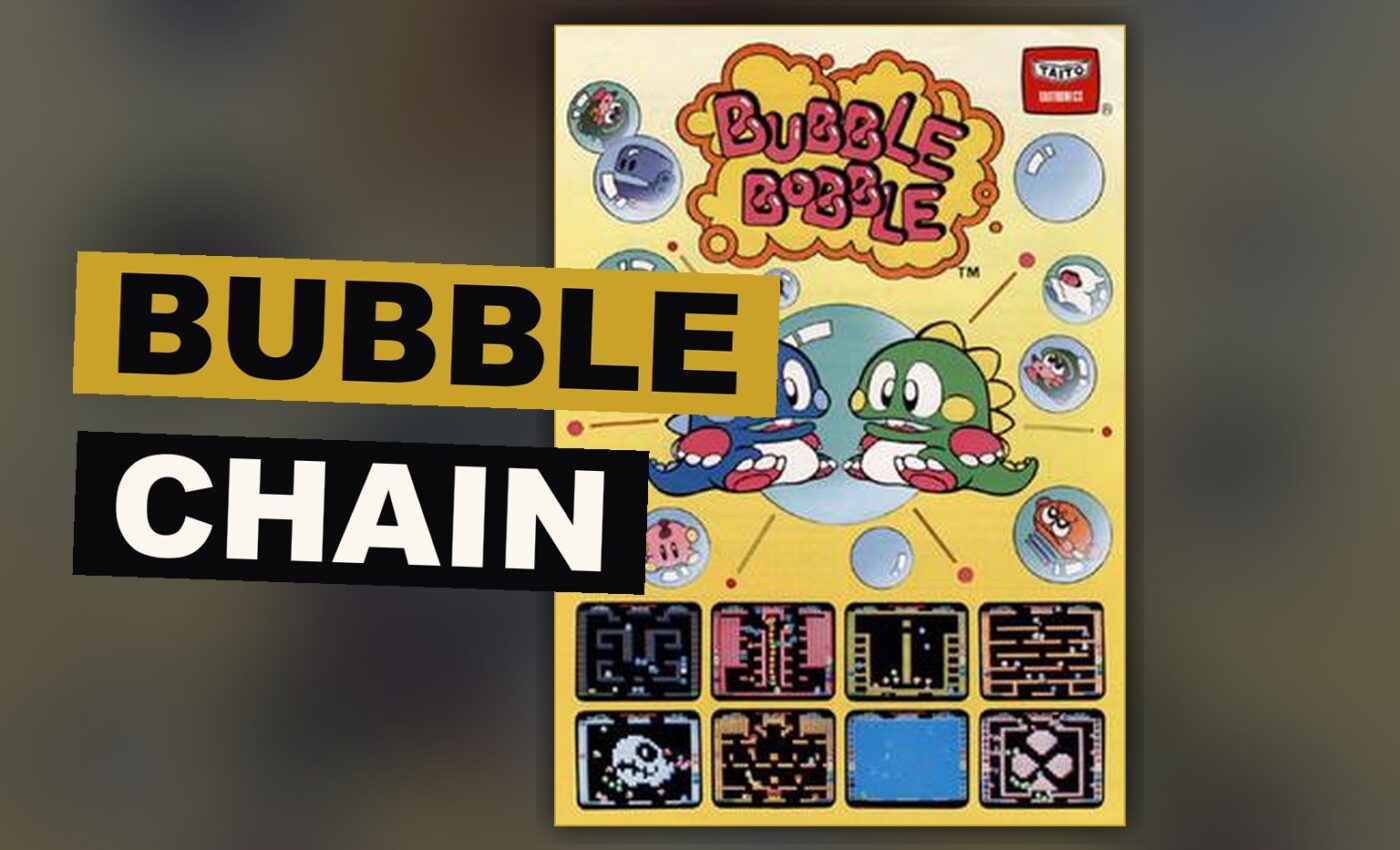
Bubble Bobble arrived in arcades in 1986, and it has never really left. Taito built a game about two dragons who trap enemies in bubbles and pop them, and that single idea turned into one of the company’s biggest arcade successes. It is the kind of design that looks simple until you play it, and then it looks like a machine for making arguments between two people sitting at the same cabinet.
Two Dragons in a Magical Forest
The setup is thin, and it knows it. Brothers Bub and Bob are two happy-go-lucky dragons living in a magical forest. “Baron Von Blubba” kidnaps their girlfriends, and the brothers have to finish 100 levels in the Cave of Monsters to get them back.
That is the whole premise, and it is enough. The dragons are not characters so much as a reason to move. The girlfriends are a destination, not people. Bubble Bobble does not pretend otherwise, and the restraint works in its favor.
Every Level Fits on One Screen
Every level fits on a single screen. There is no left-to-right scrolling. Players move along platforms, drop to lower ones, and jump to higher ones and over gaps. If a screen has gaps in its bottom edge, a player can fall through and reappear at the top.
That last rule is the game’s quiet genius. It turns the bottom of the screen into a door instead of a death sentence, and it makes every level feel like a closed box with a trick hidden in the floor. One hundred levels, each harder than the last, and none of them asking for more space than an arcade monitor can give.
Bubbles That Trap, Carry, and Expire
The core loop is trapping and popping. Players blow bubbles to catch enemies, then burst those bubbles by colliding with them. A defeated enemy turns into a food item that can be picked up for extra points. Burst several at once and the score jumps higher, with more valuable food appearing.
The bubbles are not just weapons. They float for a set time before bursting on their own, and players can jump on them and ride them to areas they could not otherwise reach. That is the difference between a game you clear and a game you learn. The same object is a trap, a platform, and a timer, and Bubble Bobble never explains any of that to you.
Magic items show up from time to time and grant special abilities. Special bubbles can be burst to attack with fire, water, or lightning. Collect letter bubbles spelling EXTEND, and a bonus life is earned and both players immediately advance to the next level.
He made bubbles the core mechanic as he thought they would be a fun element that girls would enjoy.
Enemies Turn Pink and Move Faster
Touching a free enemy or its projectiles, whether rocks, fireballs, lasers, or bottles, costs a life. Leave an enemy trapped too long and it escapes, turns pink, and moves faster. Spend too much time on a level and the same thing happens to everything.
Then a further time limit expires and an invincible enemy appears for each player, chasing them with only vertical and horizontal movement. These vanish once the level is cleared. It is a blunt instrument, and it is the right one. Bubble Bobble is a game about dawdling, and it punishes dawdling by sending something at you that cannot be beaten.
Lose a life and the enemies calm down and return to normal. That is a small mercy, and it is also a tell. The game wants you to keep moving, not to sit and plan.
Fukio Mitsuji Built It for Couples
Bubble Bobble was designed by Fukio “MTJ” Mitsuji. He joined Taito in 1986 and felt the company’s output was mediocre. He wanted to make something fun that could rejuvenate Taito’s standing in the industry.
His target was specific: women, and specifically couples who visited arcades. That is why the two-player co-operative mode is not a bonus feature but the point. Mitsuji made bubbles the core mechanic because he thought they would be a fun element that girls would enjoy.
Read that again and it sounds like a marketing calculation. Play it and it stops sounding like one. Two players on one screen, riding the same platforms, racing the same timer, is a different game from one player doing it alone.
Super Drunk and the Ending
Beat Super Drunk on level 100 in co-operative mode and the game tells you something it has kept quiet about for the entire run. Bub, Bob, and their girlfriends are humans transformed by magic. Bub and Bob’s parents were kidnapped too.
It is a strange ending for a game about dragons eating food items, and it lands because nothing before it hinted at a second story underneath. The game reveals it only at the end.
What Bubble Bobble Gets Right
Bubble Bobble is often listed among the greatest games of all time, and this paper’s view is that the reason is not nostalgia. It is that Mitsuji solved a design problem once and solved it completely. One screen, one mechanic, one hundred variations, and a co-operative mode that turns a solo puzzle into a conversation.
The weaknesses are real. The plot is a delivery mechanism. The girlfriends exist to be rescued and the parents exist to be mentioned at the end. The invincible chasers are a timer wearing a monster costume. None of that undoes what the game does when two people are playing it well.
What matters most is the bubble. It traps, it carries, it expires, it becomes a platform, and it becomes food. Very few games of this era, or any era, get that much out of one object. Bubble Bobble is credited with inspiring a run of screen-clear platform games that followed, and you can feel why every time a level clicks into place.
Get the Notebook.
The day's best stories and every fresh verdict, in plain English, in your inbox by seven. One email a day, no more.