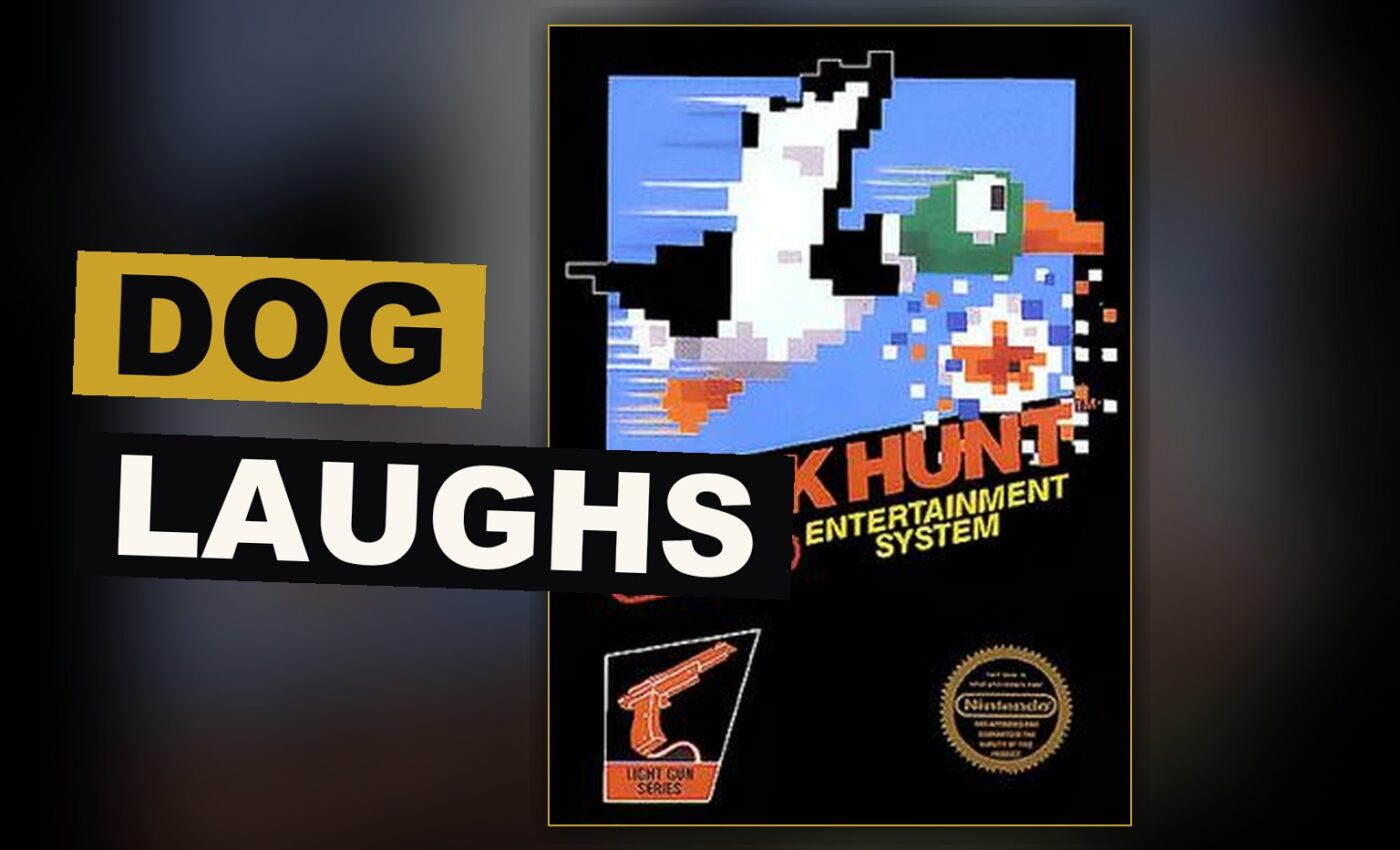
The NES Zapper needed a CRT television, and Duck Hunt gave it a reason to exist. Nintendo’s light gun shooter put a dog, a field and a flock of ducks in front of millions of players, and it did so with a mechanic simple enough to explain in one sentence: point the plastic gun, pull the trigger, hit the bird before it leaves the screen. Released in April 1984 in Japan for the Family Computer, Duck Hunt became a launch title for the NES in North America in October 1985 and eventually sold over 28 million copies worldwide.
Three Shots, Ten Targets
The rules are spare. The player picks a mode, one or two targets appear, and there are three attempts to hit them before they vanish. Each round holds ten targets. Hit enough and the next round starts; miss the minimum and the game ends. The targets get faster, and the minimum number climbs. Points come per target, with bonus points for clearing all ten in a round. High scores are tracked per session, which is a polite way of saying they disappear when the console powers off.
Three modes carry the whole game. Game A sends one duck at a time. Game B sends two. Game C swaps birds for clay pigeons launched into the distance. Game A also lets a second player grab a NES controller and steer the ducks, a small cruelty that turns a shooting gallery into a grudge.
Round 99 and the Kill Screen
Duck Hunt has a ceiling, and it is strange. Clear Round 99 in Game A and the game advances to Round 0, a kill screen where targets turn haphazard or fail to appear at all. Progress stops there. It is the kind of detail that reads as an accident rather than a design choice, and it gives the game an ending nobody was meant to reach.
The dog is the part everyone remembers. Miss too many ducks and the canine companion laughs at you. That laugh is the whole emotional register of Duck Hunt: mild humiliation, delivered by a sprite.
What the Zapper Got Right
Duck Hunt is not a deep game, and it never pretends to be. It is a reflex test with three inputs and a timer. The three-attempt limit per target creates real pressure without any complication, and the speed ramp in later rounds does the work that level design would do in a bigger game. Against the NES library, it holds up as a party trick that happens to be genuinely hard at the top end.
The hardware is the catch. The NES Zapper only works against a CRT television, which means the original experience is tied to equipment most players no longer own. Nintendo re-released Duck Hunt on Virtual Console for the Wii U in 2014, but the light gun itself did not make that trip in any meaningful form. The game’s central act is firing a plastic pistol at a glass tube, and that act is close to extinct.
Duck Hunt’s place in history is bigger than its design. It helped popularize light gun video games, and it rode into North American homes as a pack-in. The 1986 nationwide NES launch included the Deluxe Set with Duck Hunt and Gyromite. The later Action Set put Duck Hunt and Super Mario Bros. on one cartridge. The Power Set, the final Duck Hunt bundle, added World Class Track Meet alongside Super Mario Bros. and Duck Hunt.
| Bundle | Year | Pack-in games |
|---|---|---|
| Deluxe Set | 1986 | Duck Hunt, Gyromite |
| Action Set | Later | Duck Hunt, Super Mario Bros. |
| Power Set | Final | World Class Track Meet, Super Mario Bros., Duck Hunt |
| Virtual Console (Wii U) | 2014 | Duck Hunt |
A Pack-In That Earned Its Place
Retrospective reviews gave the game mild praise, and the initial mid-1980s reception was positive. Both reactions are fair. Duck Hunt is a thin game with a thick legacy. The three modes are variations on one idea, and the clay pigeons in Game C never feel as good as the ducks. But the core loop is clean, the difficulty curve is honest, and the dog has more personality than most mascots of the era.
That table is the whole game, and that is not a complaint. Duck Hunt knew exactly how much it had and spent it well. The Zapper is a museum piece now, and the CRT it needed is gone from most homes. What remains is a shooter that still works in memory, which is more than most launch titles manage.
Get the Notebook.
The day's best stories and every fresh verdict, in plain English, in your inbox by seven. One email a day, no more.