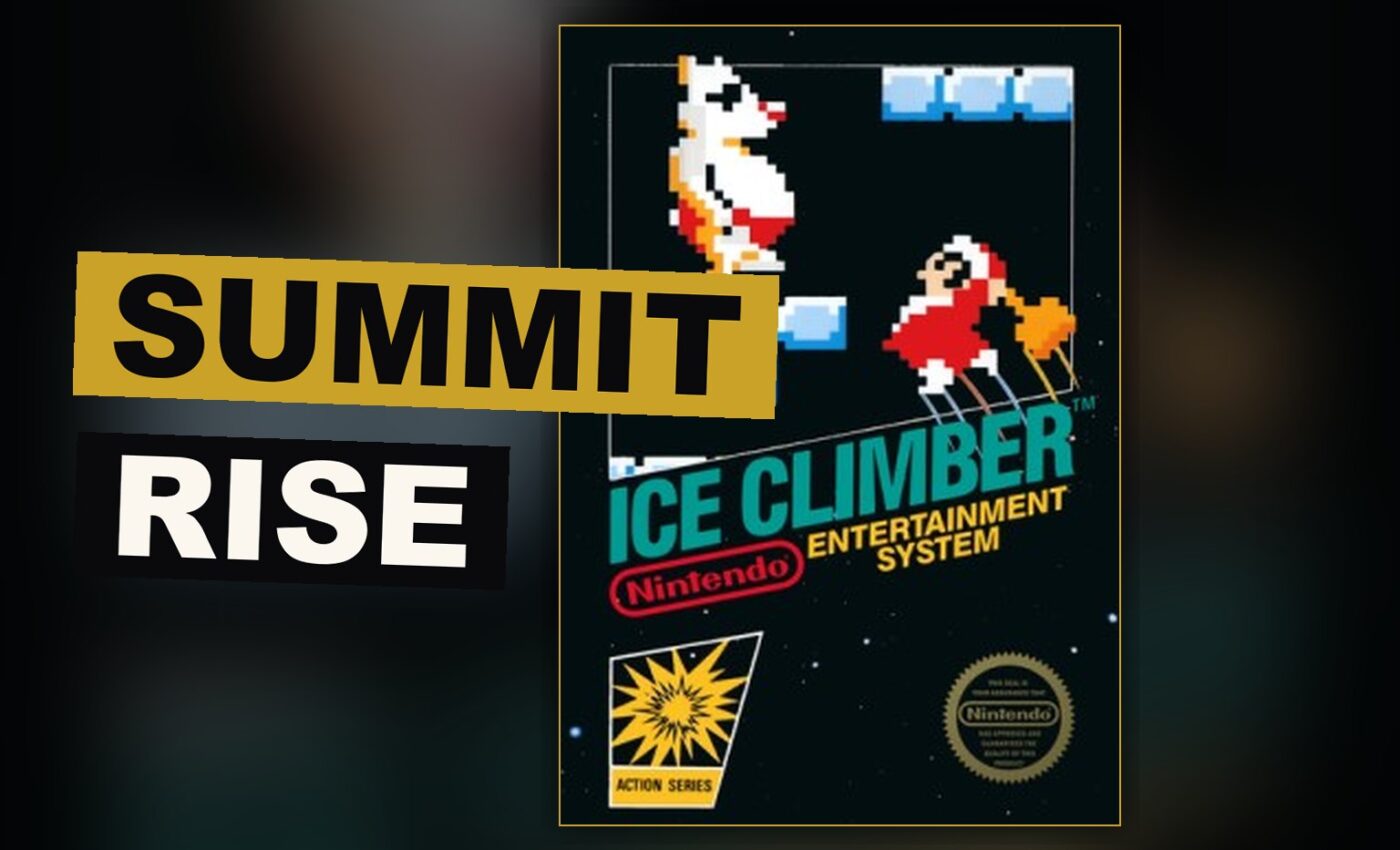
Ice Climber arrived on the Famicom and the arcade VS. System in 1985, and it asks two small people in parkas to climb 32 ice-covered mountains with nothing but a wooden mallet. Popo wears blue. Nana wears pink. A giant condor has stolen the vegetables, and the only way to get them back is straight up.
Popo, Nana, and the Condor
The setup is simple and it holds. You play as Popo, or as Nana if a second player takes the other controller. The two of them are the Ice Climbers. Their only tool is the mallet, used to carve openings in the ice above and to club whatever gets in the way. The goal on every mountain is the peak, where the condor flies overhead and the stolen vegetables wait.
That is the whole of it. No story, no cutscenes, no explanation of why a bird wants eggplants. Ice Climber does not care, and neither does the player after the first few jumps.
Eight Layers of Ice
Each mountain is eight layers of colorful ice stacked on top of one another, and each layer has its own rules. Standard, dull ice blocks break easily. They are a barrier and a platform and not much else. Square blocks with higher detail cannot be broken at all, so you go around them. Hatched ice slides Popo or Nana left or right like a conveyor belt. And many mountains include unbreakable moving platforms shaped like clouds.
The mix matters more than any single piece. A mountain that is all breakable ice is a straight climb. A mountain with unbreakable squares and sliding hatched blocks forces you to read the screen before you swing the mallet.
Topis, Nitpickers, and the White Bear
Three enemies live on the way up.
- The Topi, which comes in two varieties: the blue seal from the Japanese Famicom release, and the short Yeti-like creatures seen in Western versions and in VS. Ice Climber.
- The Nitpicker, a small mountain-dwelling bird that swoops down from icy caves on the edges of the levels.
- The White Bear.
The Topi is the one worth understanding. It scouts an opening in the floor, runs back to its cave, and reemerges pushing an icicle that fills in two blocks. It repeats this until no openings remain on its layer. A Topi is confined to one floor. The Nitpicker is not, and can cross over multiple floors to reach you.
That difference changes how you climb. A Topi is a problem you can outrun by moving up. A Nitpicker is a problem that follows.
Forty Seconds at the Peak
The bonus stage sits at the top of each mountain. There are no enemies. There is a 40-second time limit, trickier jumps, and multiple moving platforms. The peak is also the only place to recover stolen vegetables, eggplants most of all.
One detail stands out. Collecting a single piece of corn from the fifth bonus stage is the only way to gain an extra life. Not a vegetable, not an eggplant — corn, on the fifth one, and nowhere else. It is a strange rule to bury that deep, and it means most players will finish the game without ever seeing it.
VS. Ice Climber Adds More
The arcade expansion, VS. Ice Climber, is the fuller version of the same idea. It carries exclusive content the standard NES release does not have: an animated title screen, a stage select menu at the start and between levels, 16 more mountains, occasional blizzard and wind effects, more enemies and vegetables, and bonus multiplier items.
Sixteen more mountains is not a small addition. It is half again the length of the base climb, and the stage select menu changes the shape of a run entirely — you are no longer locked into whatever the game hands you next.
A Clone Arrives in 2009
Ice Climber has been copied. A 2009 release also called Ice Climber was developed and published by JungleTac for handheld electronic LCD devices. It is a clone of the NES game, single player only, side view, arcade. There is no second player, so there is no Nana.
The original has had a longer afterlife than most 1985 platformers. Popo and Nana became playable characters in the Super Smash Bros. series, starting with the 2001 GameCube game Super Smash Bros. Melee. Nintendo reissued the NES version for the Game Boy Advance through the Nintendo e-Reader in 2002. In some European countries, the NES game was bundled with the console itself.
What the Climb Is Worth
Ice Climber is a game about a single verb, and it commits to that verb completely. You jump and you swing. The mallet breaks ice above you and clubs what stands in front of you, and every mechanic in the game is built to complicate those two actions rather than add a third. Hatched ice moves you sideways. Unbreakable squares stop you. Clouds carry you. Topis refill the holes you made.
That focus is the game’s best quality and its ceiling. There is no variety to speak of beyond the layering. The mountains change, the enemies change, and the bonus stage interrupts, but the climb is the climb from the first screen to the thirty-second.
The controls are the part that decides whether you stay. Landing on a platform in Ice Climber is not generous, and a missed jump on a scrolling mountain costs you the ground you already gained. The hatched conveyor ice makes that worse by moving you while you are still deciding. It is a game that punishes hesitation more than it punishes mistakes.
Against that, the bonus stage is genuinely good. Forty seconds, no enemies, and a set of jumps harder than anything on the way up. It is the one place Ice Climber asks you to be precise rather than patient, and it arrives at the right moment every time.
The condor is the weakest link. It is the goal and the antagonist at once, and it does nothing. It flies overhead at the peak, you reach the top, and the mountain ends. For a game built entirely around a theft, the thief never puts up a fight.
VS. Ice Climber is the version to play if you can. The 16 extra mountains, the stage select, and the blizzard and wind effects are not decoration — they are the difference between a game you finish once and a game you return to. The NES release is the one most people know, and it is the thinner of the two.
The 2009 JungleTac clone is a curiosity and nothing more. A single-player handheld LCD version of a game whose second player was half the point is a strange thing to build. It strips Nana out and keeps the climbing.
Ice Climber earns its place in the history more than it earns a place in a modern rotation. Popo and Nana survived because Super Smash Bros. Melee put them back in front of people in 2001, not because the 1985 climb aged well. The mallet still works. The mountains still stack. But 32 of them, at this pace, with this landing, is a long afternoon.
Get the Notebook.
The day's best stories and every fresh verdict, in plain English, in your inbox by seven. One email a day, no more.