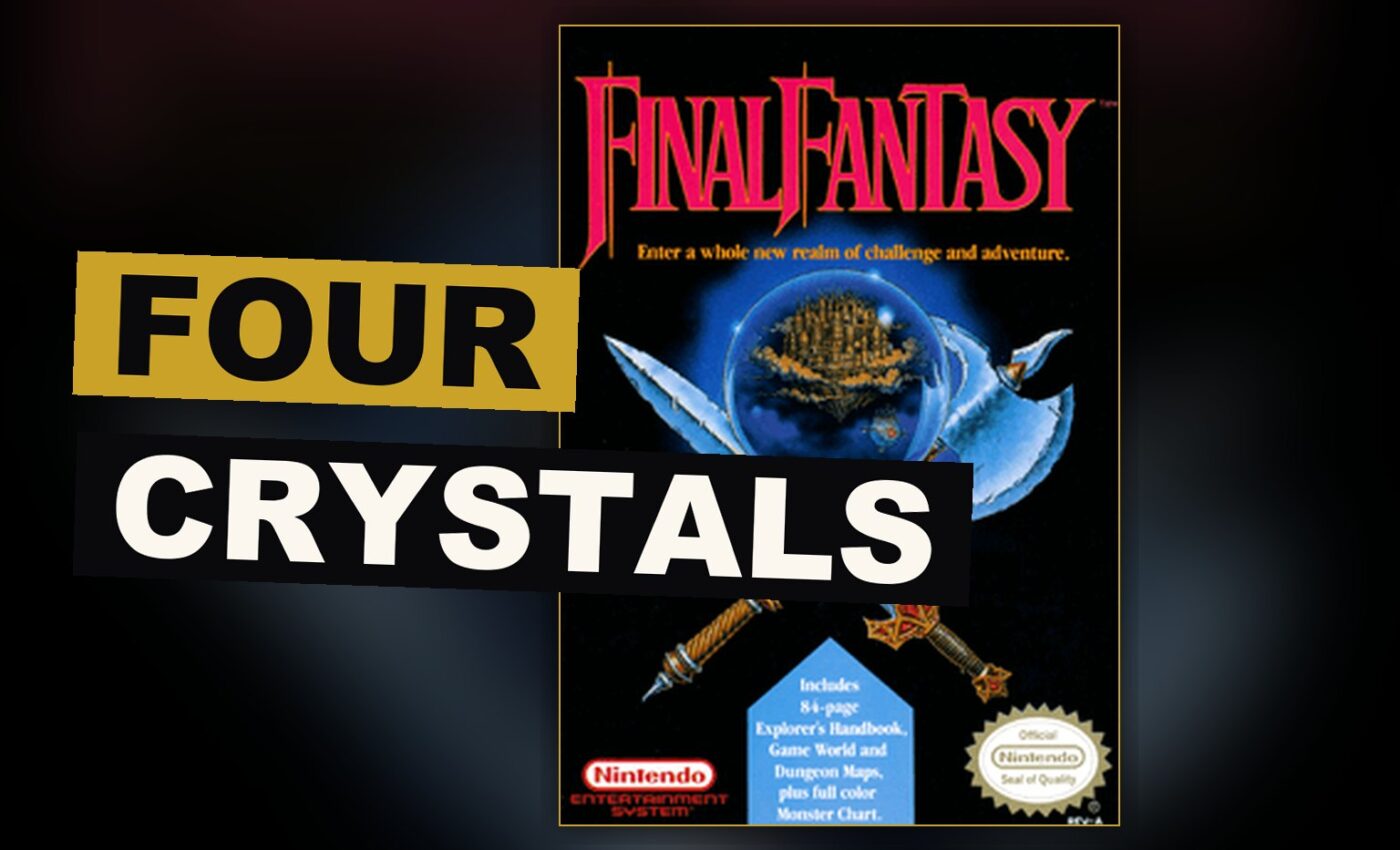
The 1987 Final Fantasy was built by Square for the Nintendo Entertainment System, created by Hironobu Sakaguchi, and it turned a struggling studio into the start of a franchise. The 2021 remake is a different project by different hands: developed by Tose and Square Enix Creative Business Unit IV, published by Square Enix, and sold as a remodeled 2D take with completely new graphics and audio.
That distinction matters, and it is the first thing worth getting straight.
Four Light Warriors and Four Darkened Orbs
The premise has aged well. Four youthful Light Warriors appear, each carrying one of the darkened Orbs. The world’s elemental powers are tied to four crystals governing earth, fire, water and wind.
Four hundred years before the game begins, the Lefeinish people used the Power of Wind to build airships and a giant space station called the Floating Castle, then watched their country decline as the Wind crystal went dark.
Two hundred years later, violent storms sank a massive shrine at the center of an ocean civilization, and the Water crystal went dark. The Earth and Fire crystals followed, bringing wildfires and ruining the agricultural town of Melmond as the plains and vegetation decayed. The sage Lukahn foretold that four Light Warriors would come in a time of darkness.
That is a lot of backstory for a game that opens with a bridge and a rescue. But it gives the quest a shape, and the shape is the point. You are not saving a kingdom. You are restoring light to a world that has been failing in stages for centuries.
Coneria, Pravoka and the Pirates’ Ship
The early game moves with real purpose. The Light Warriors start with access to the Kingdom of Coneria and the ruined Temple of Fiends. They rescue Princess Sara from the evil knight Garland, and the King of Coneria builds a bridge east to the town of Pravoka. There they liberate the town from Bikke and his band of pirates, then take the pirates’ ship for themselves.
From there the game becomes a chain of delivery quests along the shores of the Aldi Sea. The Warriors retrieve a stolen crown from the Marsh Cave for a king in a ruined castle, who turns out to be the dark elf Astos. Beating him yields the Crystal Eye, which they return to the blind witch Matoya in exchange for a herb needed to wake an elf prince cursed by Astos.
The prince hands over the Mystic Key, which unlocks any door. That key opens a storage room in Coneria Castle holding TNT. Nerrick, one of the dwarves of the Cave of Dwarf, uses the TNT to destroy a small isthmus, connecting the Aldi Sea to the outside world.
It is a fetch chain, plainly. But each link opens the map a little wider, and the map is the reward.
A World of Four Modes
Final Fantasy runs on four basic modes: an overworld map, town and dungeon maps, a battle screen, and a menu screen. The overworld is a scaled-down version of the fictional world, used to move characters between locations. Travel starts on foot. A ship, a canoe and an airship become available as you progress.
Enemies are randomly encountered on field maps and on the overworld when traveling by foot, canoe or ship, except for some battles in preset locations or with bosses. You fight or you flee.
Dungeons turn up in forests, caves, mountains, swamps, underwater caverns and buildings, and often hold treasure chests with rare items that most stores do not carry.
The menu screen tracks experience points and levels, sets equipment, and handles items and magic. A character’s level rises with experience. Gaining a level raises attributes like maximum hit points, which represent remaining health; a character dies at zero HP.
Combat is menu-based. You pick from options like Attack, Magic and Item. Battles are turn-based and run until one side flees or is defeated. Win, and each character gains experience.
The Grinding Question
Here is the qualifier, and it is our assessment rather than a claim from the source. Final Fantasy has always asked for patience, and in our view the remake does not visibly loosen the level curve beneath the new paint. Experience comes only from winning battles. Random encounters arrive whether you want them or not, on foot, by canoe, by ship. The criticism that dogged the original — the sheer amount of grinding — strikes us as just as applicable here.
The source describes the remake as featuring completely new graphics and audio and a remodeled 2D take on the first game. That is the pitch, and in our reading it is the strongest reason to return. Whether the timeless story survives the treatment is a judgment call, and ours is that it does.
What the remake does not appear to do, on our read, is fix a level curve we found tedious. That was a design choice in 1987. Whether the remake declined to revisit it is something the source does not say, and we will not pretend otherwise.
What the 1987 Release Got Right
It is worth remembering what the original did. Final Fantasy was conceived under the working title Fighting Fantasy before trademark issues and the dire circumstances surrounding Square and Sakaguchi forced a change. It became a commercial success, drew generally positive reviews, and produced sequels and supplementary titles that turned into one of the biggest series in the medium.
By March 2003, all versions had sold a combined two million copies worldwide.
Critical praise at the time focused on the graphics. Criticism targeted the grinding. In our view that split has not moved much in three decades, and this remake sits on it. The source does not compare the two releases’ visuals, so we will not claim the remake looks better — only that it looks different, and that the difference is the reason it exists.
The setting deserves credit too. The world holds humans, elves, dwarves, mermaids, dragons and robots. Most non-human races get a single town, though individuals turn up in human towns and elsewhere. It is thin by modern standards, but it establishes a fantasy world with rules rather than a backdrop. That is a fact about the original, and the remake carries it forward.
Where the Remake Lands
In our view, three things decide whether this release is worth your time, ranked by how much they matter to us:
- The completely new graphics and audio, which are the clearest reason to buy the game again.
- The story and map structure, which still move with purpose from Coneria to Pravoka to the Aldi Sea and beyond.
- The grinding, which we found untouched and which remains, in our reading, the biggest obstacle between a new player and the ending.
That order is ours, not the source’s. If the grind were the headline, we would call this a worse game. It is not the headline. It is the tax we paid.
Our view is that Final Fantasy earns its reputation, and that this remake does not damage it. The story of four youths, four crystals and a world whose decline began four hundred years before the game opens still works, and the new presentation makes a stronger case for it than a bare re-release would.
But the game asks for repetition to see the end, and in our experience that repetition is heavy. That is not a flaw we can pin on the remake’s design intent, because the source does not describe one. It is a flaw we think the remake carried over, and carrying it over looks like a choice.
A landmark, then, with a stubborn streak we wish had been addressed.
7.2 of 10, per MobyGames.
Key Facts
- Original release: 1987, developed and published by Square for the Nintendo Entertainment System
- Remake release: 2021, developed by Tose and Square Enix Creative Business Unit IV, published by Square Enix
- Platforms: Xbox Series X|S, PlayStation 4, Android, PC (Microsoft Windows), iOS, Nintendo Switch
- Genres: Role-playing (RPG), Adventure
- Themes: Fantasy
- Modes: Single player
- Combined worldwide sales across all versions by March 2003: two million copies
- Score: 7.2 of 10 (MobyGames)
Get the Notebook.
The day's best stories and every fresh verdict, in plain English, in your inbox by seven. One email a day, no more.