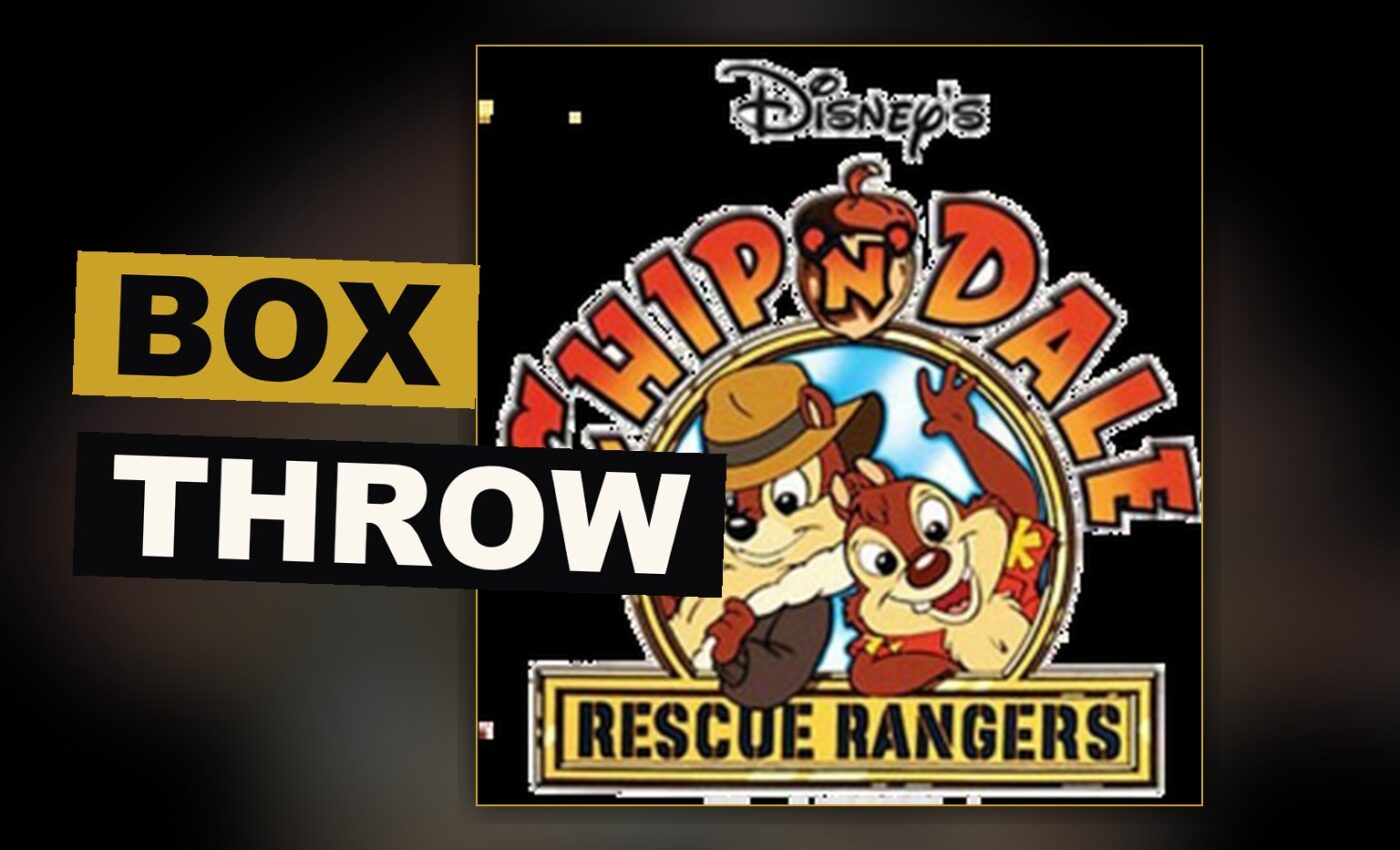
Chip ‘n Dale Rescue Rangers is a licensed platformer that had no business being this good. Capcom developed and published it, and it hit the Nintendo Entertainment System in Japan and North America in 1990, with Europe following the next year. It also ran on the Nintendo PlayChoice-10 arcade system. Roughly 1.2 million copies sold worldwide.
That number tells you something the licensed-game market usually doesn’t. Most cartoon tie-ins of that era were quick cash. This one plays like the people making it actually watched the show.
Fat Cat and the Missing Kitten
The setup is a bait-and-switch, and the game knows it. The Rescue Rangers set out to find a lost kitten for a girl named Mandy. Gadget goes ahead to scout. Monterey Jack takes Zipper to check reports of strange mechanical dogs. Chip and Dale work through the streets and into a laboratory, where a crazed robot jumps them.
Beat the robot, and Fat Cat shows up to explain the joke. “Mandy’s kitten” was a distraction. He wanted Gadget, and now he has her, and he intends to make her work for him.
It’s a clean villain move. Fat Cat doesn’t need a complicated plan. He needs the Rangers split up and one of them in a cage.
Gadget Builds a Phone
The middle act is where the game earns its structure. Gadget isn’t waiting to be rescued. She builds a wireless phone and sends a map to Chip and Dale by carrier pigeon. That map is the level path. The chipmunks navigate the landscape and reach Fat Cat’s casino, where she’s being held.
Rescue her, and Gadget hands over a rocket. It fires the chipmunks at Fat Cat’s hideout for the finish.
This is the part that separates the game from its licensed peers. Gadget is a captive who keeps working. The plot doesn’t stall while the player grinds through stages. It moves because she does something.
Two Chipmunks, One Screen
Chip ‘n Dale Rescue Rangers is a side-view platformer. It supports single player, multiplayer and co-operative play. The co-op is the reason people still talk about it.
Two players share one screen. You can pick up your partner and throw him. You can throw him at an enemy. You can throw him into a pit, which is funny exactly once per friendship.
The mechanic is simple and it’s the whole game. Cooperative play that also lets you sabotage your friend is a design choice Capcom didn’t have to make. It made it anyway.
Capcom’s Run on the System
Capcom was on a tear in this period, and Rescue Rangers sits in that run. The controls are tight. The sprites read clearly. The action and comedy themes from the show survive the trip to 8-bit.
The game is short. It’s not hard in the way that makes you throw a controller. It’s a weekend rental that you finish and then start again with a second player.
That’s not a knock. A licensed platformer that respects your time and gives you something to do with a friend is rarer than it sounds.
The Show Behind the Game
The game is based on the Disney animated series of the same name. Tad Stones and Alan Zaslove created it, and Walt Disney Television Animation produced it. Chip ‘n’ Dale were established Disney characters dropped into a new setting.
The episode “Catteries Not Included” aired August 27, 1988, as a preview. The series premiered on The Disney Channel on March 4, 1989. It went to syndication that September with a two-hour special, Rescue Rangers: To the Rescue, later split into five parts. National syndication began September 18, 1989. From September 10, 1990, it ran in The Disney Afternoon block. The final episode aired November 19, 1990.
The premise: Chip and Dale run a detective agency. Gadget Hackwrench, Monterey Jack and Zipper work with them. They take cases too small for the police, usually for animal clients. Their recurring villains are Fat Cat, a mafia-style tabby, and Norton Nimnul, a mad scientist.
The game pulls its villain and its cast straight from that. It doesn’t invent a new threat to sell cartridges.
What the Game Gets Right
The best thing about Chip ‘n Dale Rescue Rangers is that it understands its own scale. It’s a small story about small detectives. The levels are streets and labs and a casino, not a fortress at the end of the world.
The carrier pigeon map is a good example. It’s silly. It’s also exactly what the show would do. The game trusts the premise instead of apologizing for it.
The co-op is the other half. Throwing your partner is a joke that doubles as a tool. You can use it to reach a platform or to ruin someone’s run. Both are valid.
Where it falls short is length and challenge. The game doesn’t have much left after you’ve seen the robot and the casino. There’s no second layer, no reason to keep going once Fat Cat is done.
Chip ‘n Dale: Rescue Rangers is an American animated adventure comedy television series created by Tad Stones and Alan Zaslove and produced by Walt Disney Television Animation.
That’s the show, and the game is a faithful extension of it. Faithful isn’t the same as deep.
Hard Numbers
- Score: 7.4/10
- Developer: Capcom
- Publisher: Capcom, Playtronic
- Platforms: Arcade, Family Computer, Nintendo Entertainment System
- Release: 1990 (Japan, North America), 1991 (Europe)
- Sales: approximately 1.2 million copies worldwide
- Modes: Single player, Multiplayer, Co-operative
- Genres: Platform, Adventure
- Themes: Action, Comedy
- Perspective: Side view
Where It Lands
Chip ‘n Dale Rescue Rangers holds up better than most licensed games on the system because it does two things well. It respects the source material, and it gives two players a reason to sit on the same couch.
The story is thin but it’s the show’s story. Fat Cat uses a fake kitten to kidnap Gadget. Gadget builds a phone and sends a map. The Rangers rescue her and ride a rocket to the hideout. That’s a complete arc, and the game delivers it without padding.
The 1.2 million copies sold make sense. This was a game kids could finish, and then play again with a friend, and then trade. It didn’t need to be more than that.
What keeps it from a higher score is what it doesn’t do. There’s no difficulty curve worth the name. There’s no reason to return alone. The co-op throwing mechanic is a genuine idea, and the game never builds a level that demands it.
A 7.4 is the right number for a game that’s better than its category and smaller than its best idea. Capcom made a licensed platformer that plays clean, looks right and gives you someone to blame when you fall in a pit. That’s a real achievement for 1990. It’s just not a big one.
Get the Notebook.
The day's best stories and every fresh verdict, in plain English, in your inbox by seven. One email a day, no more.