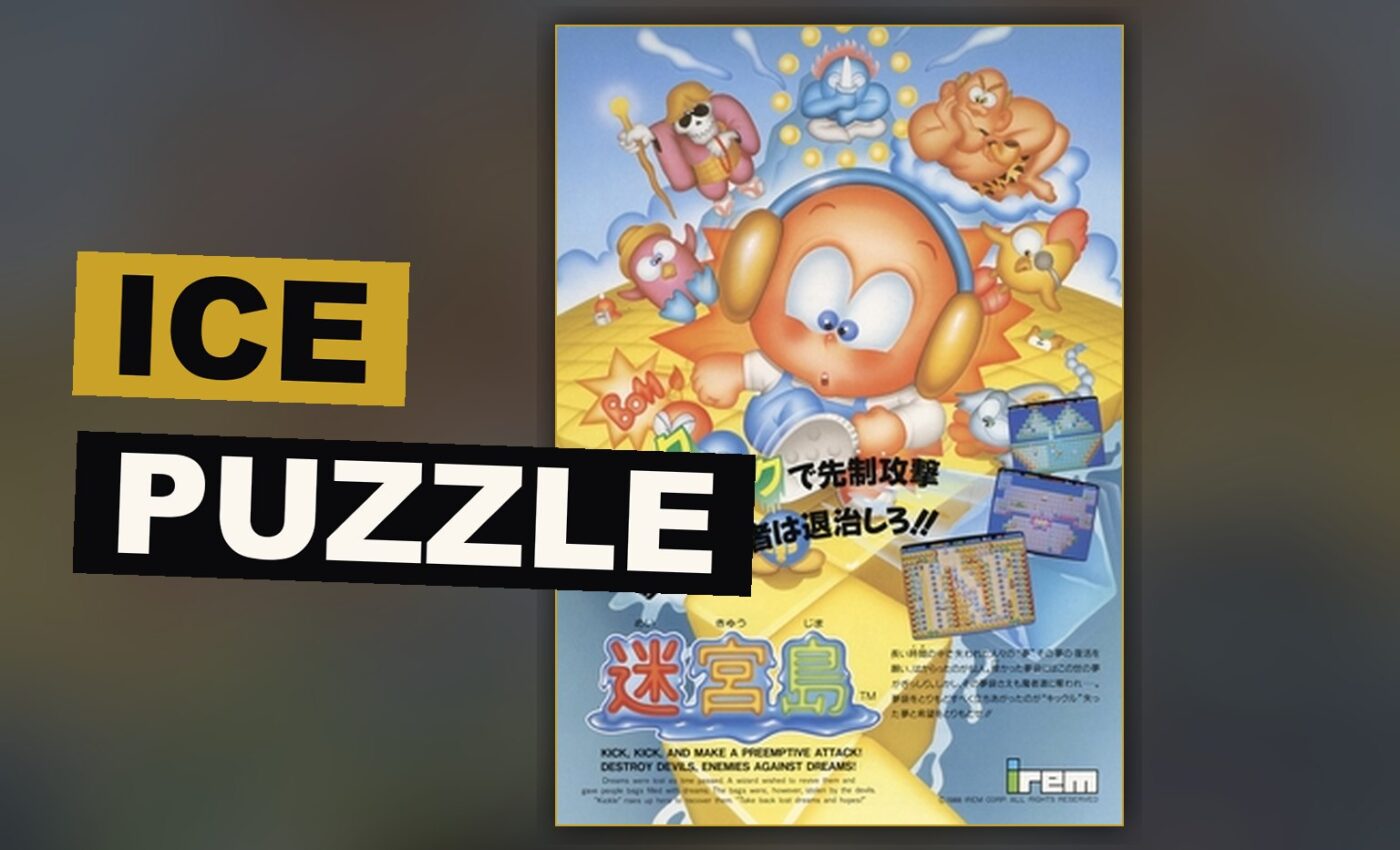
Kickle Cubicle asks players to turn enemies to ice and push the frozen shapes across small rooms, one puzzle at a time. It is an NES puzzle game, and even now it plays like a tight, patient puzzle box. It will not burden anyone with a heavy story. It will test patience with shape and space.
The Setup
The hero, Kickle, walks through a frozen kingdom turning monsters to ice with a gust of cold breath. Each room stands whole on its own, built around working out how the frozen enemies can be moved and placed to open a way through. There is no fighting in the usual sense. There is only where things sit, when they move, and the odd ice piece that will not go where you want it to.
The game is built in short spans, which suits the NES titles of its time. A single room rarely takes more than a couple of minutes to work out once the trick is seen. Finding that trick is the whole point.
Level Design
Kickle Cubicle lays out its puzzles across a series of stages, each adding something new on top of the idea of ice and push at its core. Some stages bring in enemies that act in a new way once turned to ice. Others rest on close timing that forces new thinking about approaches that worked earlier in the game.
| Stage of Game | General Focus |
|---|---|
| Early rooms | Learning to turn enemies to ice and push them |
| Middle rooms | Combining the idea of ice and push with new obstacles |
| Later rooms | Puzzles built on close timing and familiar rules |
The later stages ask more of the player without changing the core rules, which is either a strength or a weakness depending on taste for change. Anyone hoping for new tricks late in the game will be let down. Anyone who enjoys mastering one system deeply will find plenty to think about.
What Works
The puzzle logic is careful. Every failure feels like the result of a wrong read, not a careless trick from the game itself. That difference matters in a kind of game where poor design often covers itself as difficulty.
A few things stand out as particular strengths:
- The core idea is simple to learn but hard to master fully
- Puzzle rooms are short, so failure rarely costs much time
- Clear to the eye: it is always plain where ice pieces and enemies sit
- The music stays pleasant without growing dull
Those four points carry the game through its weaker parts.
Where It Drags
Kickle Cubicle does not change much once its rules are set. The middle part of the game repeats ideas from earlier stages with only surface changes, and some rooms rest on close timing that feels more like trial and error than true puzzle work. Those new to this kind of game may find a few of the later rooms trying rather than clever.
The game also gives little reason beyond the puzzles themselves to keep pushing forward. There is a kingdom to save, but it barely matters against the puzzle content itself.
The Verdict
Kickle Cubicle holds up as a sound puzzle game from the NES library, built with care for a patient player over one looking for fast action or spectacle. Its central idea stays satisfying from the first room to the last, even where the other parts grow weak.
Kickle Cubicle earns a score of 7.5 of 10, a mark that places it among the finer, less noticed puzzle titles the NES left behind.