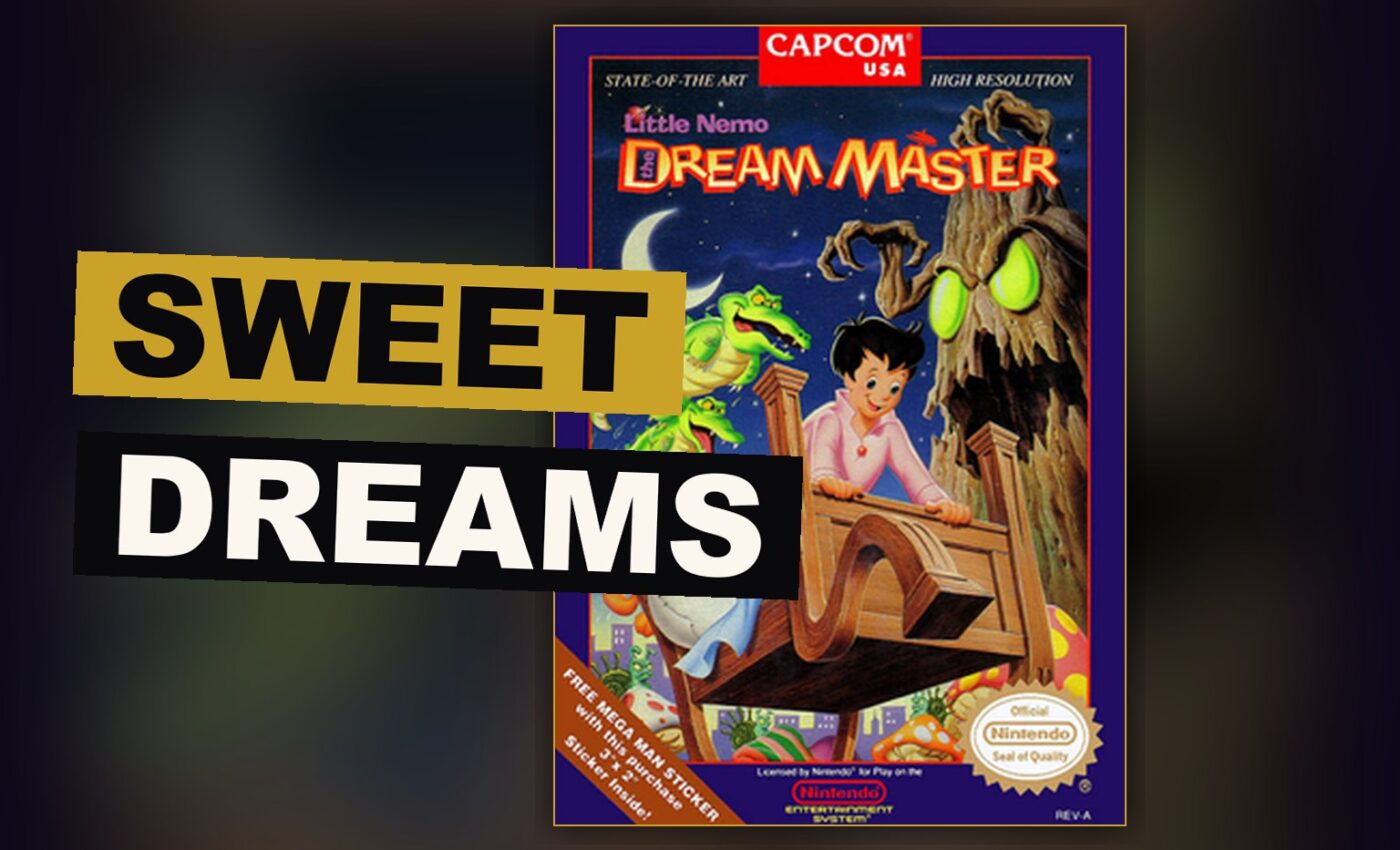
Capcom’s 1990 platformer Little Nemo: The Dream Master is a beautiful, maddening thing. It takes Winsor McCay’s dreamscape and the 1989 animated film Little Nemo: Adventures in Slumberland and builds a side-scrolling game that looks like nothing else on its console. It also refuses to hold your hand for a single second.
A Royal Invitation to the Castle
The setup is simple. Little Nemo gets an invitation to visit the castle in Slumberland. The princess, it seems, wants a new playmate. When he arrives, he learns King Morpheus has been kidnapped. Nemo sets off to rescue the good king and restore peace, traveling to Nightmare land to face the Nightmare King.
That is the whole frame. The game is based on the animated film, which is itself based on McCay’s Little Nemo in Slumberland comic strip. The music was composed by Junko Tamiya, credited in the game as “Gonzou.”
Feeding Candy to a Frog
Here is the hook that makes Little Nemo: The Dream Master worth your time. Nemo can ride animals — a frog, a gorilla, a mole — by feeding them candy. Each animal has its own skills, and those skills are needed to finish each level. Some powers are necessary. Others just make the game easier.
The lifebars differ, too. Some animals carry extra health beyond Nemo’s own. That matters, because enemies are virtually infinite and the obstacles are punishing. The mechanic would show up again three years later in Kirby’s Adventure. Capcom got there first.
Keys, Locks and No Answers
Each level hands you a job: collect a specific number of keys. The keys are scattered across large, sprawling stages. The game does not tell you how many you need until you reach the exit, which has a matching number of locks.
So you wander. Left to right, up and down, hunting. The levels are big and the game is quiet about what it wants. This is where Little Nemo: The Dream Master earns its reputation as a very difficult game.
| Stage of play | What the game asks |
|---|---|
| Level start | Find keys, no count given |
| Mid-level | Feed candy to animals, borrow their powers |
| Obstacles | Use animal skills to pass rough sections |
| Exit | Locks reveal the number of keys required |
How It Compares
The animal-riding idea is the differentiator. Stack it against the standard platformer of its day and the difference is clear.
| Element | Little Nemo: The Dream Master | Typical platformer |
|---|---|---|
| Core gimmick | Feed candy, ride animals | Jump on enemies |
| Level goal | Collect hidden keys | Reach the flag |
| Enemy supply | Virtually infinite | Fixed spawns |
| Difficulty signal | Not indicated until exit | Usually visible |
Spectacular Graphics, Cruel Patience
The pitch material promises spectacular graphics that bring a dreamworld to life, a candy attack against the scarier creatures, and a rescue of the King of good dreams. All of that holds up. The dreamworld is the best thing here — surreal, colorful, genuinely unlike the rest of the library.
But the game’s cruelty is not a bug in the design. It is the design. Hiding the key count until the exit turns exploration into guesswork, and guesswork into repetition. The animal powers soften that. They do not fix it.
What the Nightmare King Costs You
Little Nemo: The Dream Master is a game you admire more than you enjoy, and then you keep playing anyway. The candy-and-animals system is genuinely inventive, and Capcom’s willingness to build whole levels around borrowed abilities gives the game an identity most platformers never find.
The difficulty is the cost. Infinite enemies plus unmarked key quotas equals a game that punishes patience as much as skill. Junko Tamiya’s score and the dreamworld art carry you through the parts that feel like work.
It is not a classic on the level of the best platformers of its era. It is something stranger: a gorgeous, hostile dream you keep returning to.
Get the Notebook.
The day's best stories and every fresh verdict, in plain English, in your inbox by seven. One email a day, no more.