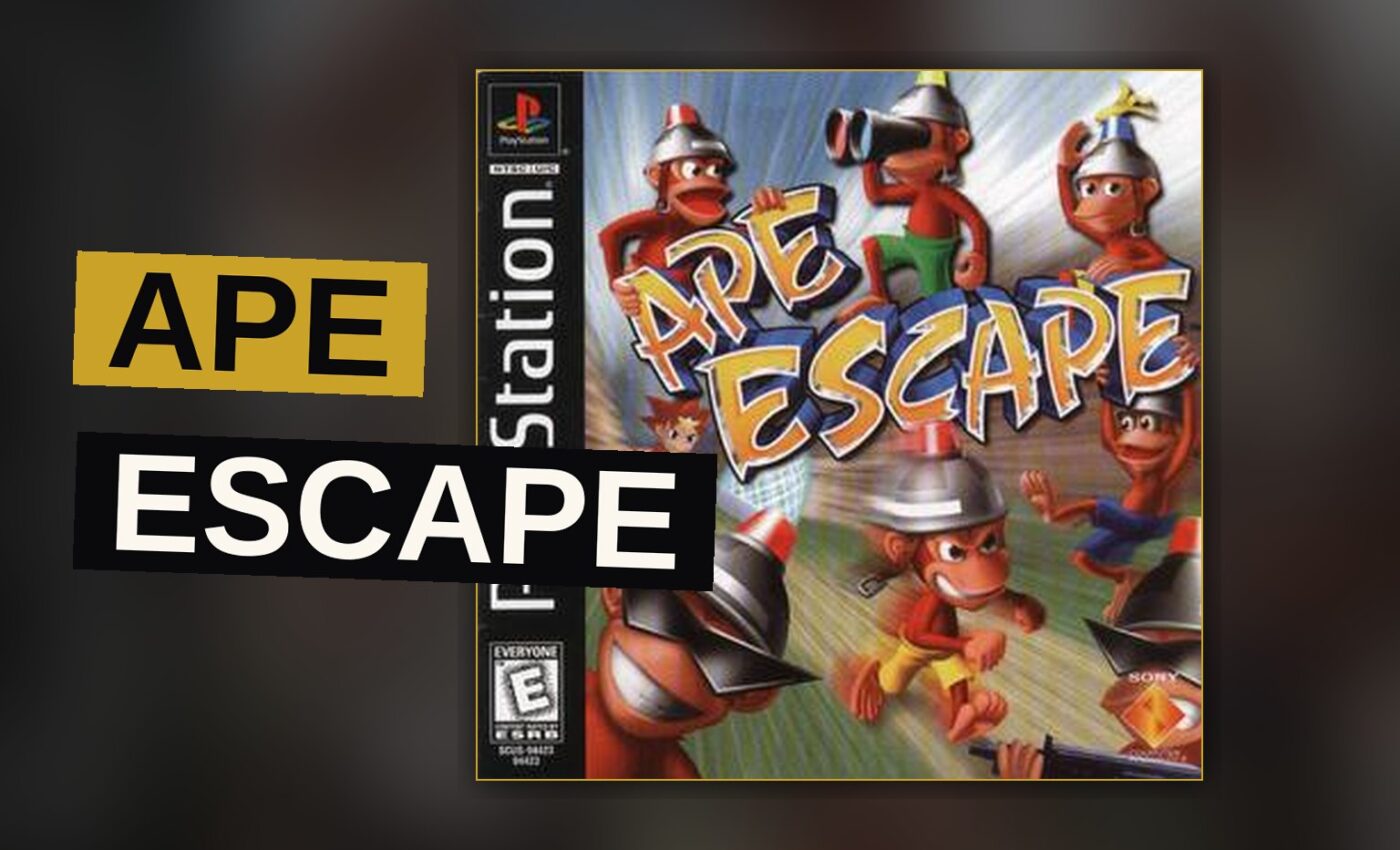
Ape Escape is the first game that required the DualShock, and that fact is the whole story. Sony Computer Entertainment’s 1999 platformer asked players to abandon the D-pad and learn the analog stick, and it built every gadget, every chase and every capture around that demand. It worked well enough to spawn a series. It also shows its age in ways that are hard to forgive now.
Spike and the Time Net
You play as Spike, a boy chasing apes scattered across history. Specter, a white-haired monkey, puts on a prototype Monkey Helmet built by a Professor. The helmet boosts his intelligence past a normal monkey’s and, because it is a prototype, twists his mind. He hands out helmets to the park’s monkeys, takes over the lab, and sends the whole troop through a time machine. Spike and his friend Buzz arrive, get flung through time too, and the Professor gives Spike one job: bring every ape back before history breaks.
The premise is thin, but it moves. You traverse the age of the dinosaurs, medieval times and the present day, capturing apes with the Time Net and batting enemies with the Stun Club. More gadgets unlock as you go. You also steer a rubber raft across water and use a water net underwater.
Reading the Apes
The apes are the best part. Each wears a helmet with a siren that signals alarm level, and each ape’s shorts tell you what you are dealing with.
| Signal | Meaning | Behavior |
|---|---|---|
| Blue helmet | Relaxed | Unaware of you |
| Yellow helmet | Alert | Suspicious |
| Red helmet | Fully alarmed | Flees or turns hostile |
| Yellow shorts | Standard | Ordinary ape |
| Light blue shorts | Timid | Skittish |
| Red shorts | Aggressive | Fights back |
Some apes carry weapons. Some carry binoculars and spot you from a distance. You need a set number of captures to clear a level, and you can return later for the rest. Take damage and you lose a life; collect cookies to heal. Hidden Specter Coins unlock three bonus games:
- Ski Kidz Racing, a skiing race
- Galaxy Monkey, a shoot ’em up against aliens
- Specter Boxing, a punch-and-dodge match
What the Analog Stick Bought
Development ran over two years, mostly spent adapting to the controller. That focus paid off. The left stick moves Spike, the right aims gadgets, and the split is the reason the game feels unlike anything before it. The music and graphics drew praise at the time, and the voice acting drew minor criticism. The game got re-releases, a 2002 sequel, and a 2005 PlayStation Portable remake, Ape Escape: On the Loose, that landed with mixed reviews.
A Landmark That Has Aged
Ape Escape earns its place in the PlayStation canon for one reason: it proved the analog stick could carry a whole game. The ape alarm system still reads cleanly, and the short-sighted apes remain a smart design choice.
But the camera and the gadget switching are clumsy by modern standards, and the story is barely there. This is a 6.3 of 10 — a historically important game that is more interesting to study than to play today.
Get the Notebook.
The day's best stories and every fresh verdict, in plain English, in your inbox by seven. One email a day, no more.