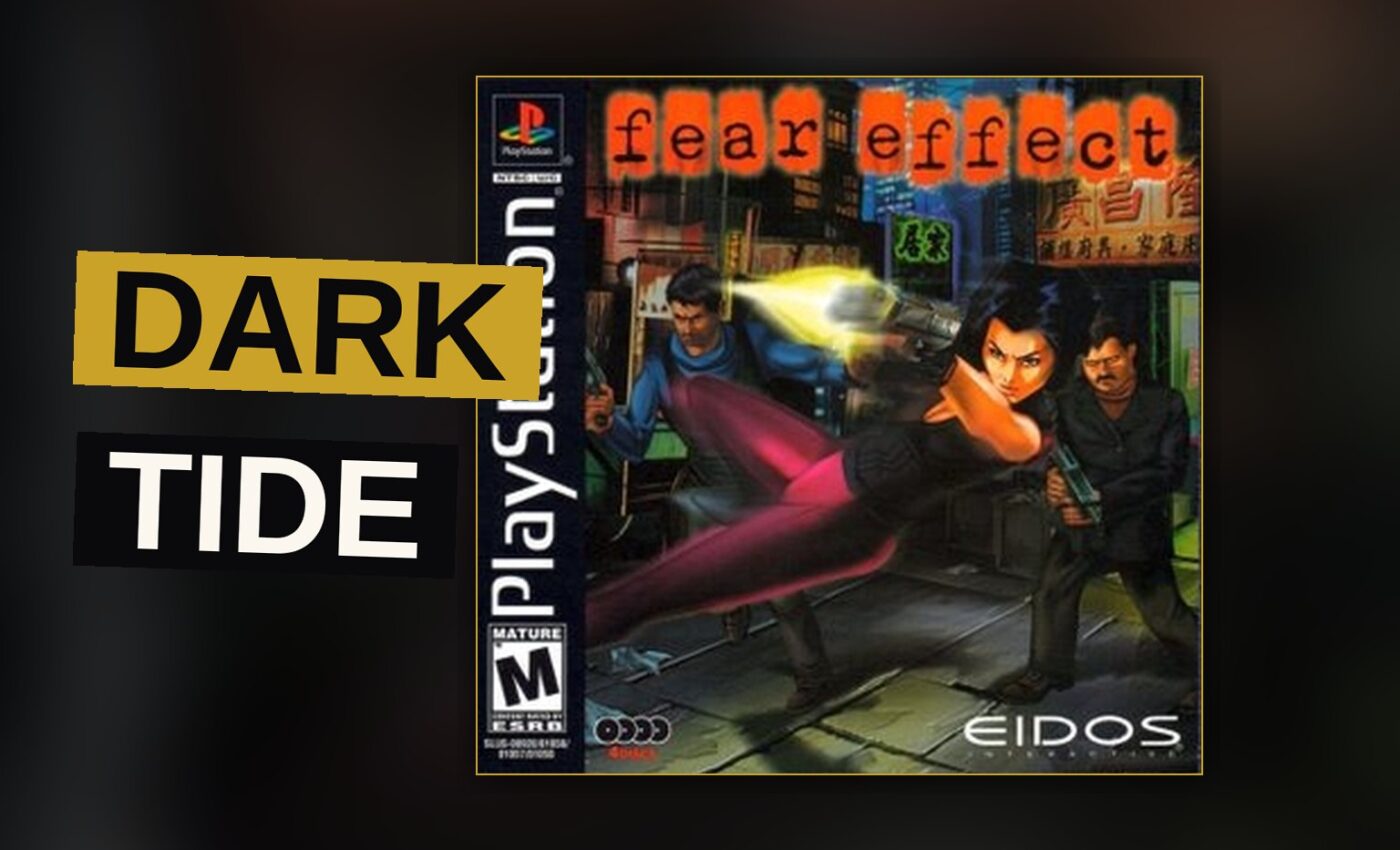
Fear Effect is a game about a snatch-and-grab that goes wrong, and in 2000 Kronos Digital Entertainment built it on a visual trick that had barely been tried: characters rendered unshaded to mimic cel-shading, moving through environments made of streaming full-motion video instead of painted backdrops. Eidos Interactive published it for the PlayStation. The trick is the reason to remember the game. It is not enough of a reason to enjoy it.
Three Mercenaries and a Paper Doll
The premise has a real pull. Wee Ming Lam vanishes days before her 18th birthday. Hana Tsu-Vachel, Royce Glas and Jacob “Deke” DeCourt are not hired to find her — they plan to grab her first and ransom her to her father, Mr. Lam, a Triad boss in Hong Kong. It is 2050. The job is extortion, and it becomes a lesson in survival.
Then the story turns. Mr. Lam’s fortune comes from a pact with demons, Wee Ming is a paper doll given life, and she is scheduled as a sacrifice to Yim Lau Wong, the “King of Hell.” Hana’s contact Jin is tortured and left with a bomb strapped to his chest; she frees him, and he dies anyway. Glas is attacked by a VTOL jet. Hana is captured and beaten. The trio are forced off a bridge, swim to a junk, and get separated by undead villagers.
It keeps going like that.
- Glas loses his left arm to Mr. Lam in Madam Chen’s brothel.
- Deke is murdered infiltrating the same brothel.
- Wee Ming’s powers activate when Deke’s blood splashes her, turning the working girls and Chen’s thugs into demons.
- Chen turns out to be a demon in disguise.
- Mr. Lam escapes into a portal to Hell with his daughter, and Hana follows.
A Choice That Decides the Ending
The back third moves into Hell, where Hana meets the Black and White Guards of Impermanence and Glas fights Deke’s reanimated corpse, now a grotesque demon. Yim Lau Wong explains the scheme: Hell is overburdened with guilty souls, and returning Wee Ming to the netherworld lets him expand Hell’s reach and consume Earth. Hana was picked as Wee Ming’s guardian because Yim Lau Wong wanted someone “ruthless.”
That sets up the game’s best idea. Glas tries to kill Wee Ming, and the standoff hands the player a choice about which of them dies. That choice sets the final boss and the ending. On “Hard,” a third option appears: spare them both. In that ending the pair crawl out of the burning brothel and find Deke alive on a toilet, with no memory of dying and a question about the “deal.” Glas discovers his left arm has grown back. The three walk off into the sunrise.
| Element | What Fear Effect does |
|---|---|
| Visuals | Unshaded characters textured to resemble cel-shading |
| Backgrounds | Streaming or looping full-motion video |
| Discs | Four |
| Combat | Tank controls, but characters run and shoot at once |
| Dual wield | Two guns, one per hand, firing at multiple enemies |
| Evasion | Duck and roll to avoid armed foes |
The Fear Meter and the Four Discs
The title refers to the life bar, a meter shaped like a pulsing EKG. That is the whole of the game’s identity: a survival horror shell with puzzles between the action, three playable mercenaries, and a health readout that looks like a heartbeat.
The source’s critical reception notes praise for the game’s cinematic presentation and unique visuals, and criticism of its difficulty. Both points are worth taking seriously, and the difficulty is the one that decides whether you finish. Fear Effect wants to be cinematic, and the full-motion video backgrounds are the reason it needs four discs — a cost the game pays every time you change location, and a cost the player pays at the console.
What Fear Effect Actually Amounts To
The cel-shading claim is the part that matters. Fear Effect was one of the first games to attempt the technique, and that is a genuine piece of history. The rest is a game that mistakes complication for depth. A plot about a paper doll, a Triad pact and the King of Hell should be strange and quick; here it is a chain of abductions, betrayals and rescues that keeps the three mercenaries apart more than it keeps them together. Splitting Hana, Glas and Deke across a train wreck, a brothel and a meat locker spreads the story thin.
The branching ending is the sharpest thing in it. Making the player choose who lives, then hiding a third path behind “Hard,” is a real decision with a real consequence, and the reward — Deke on a toilet, Glas’s arm restored, the trio walking into the sunrise — is the only moment where Fear Effect sounds like it is having fun.
Everything around that moment is a slog. The tank controls are traditional for the genre, and the run-and-shoot exception helps, but four discs of streaming video and a pulsing EKG do not make a game feel dangerous. They make it feel expensive.
A prequel, Fear Effect 2: Retro Helix, arrived a year later. Fear Effect Sedna followed in 2018. Neither changes what the original is: a striking experiment wrapped around a story that never earns its own weirdness.
The IGDB critic aggregate puts it at 4.2 out of 10 from 6 outlets.
Get the Notebook.
The day's best stories and every fresh verdict, in plain English, in your inbox by seven. One email a day, no more.