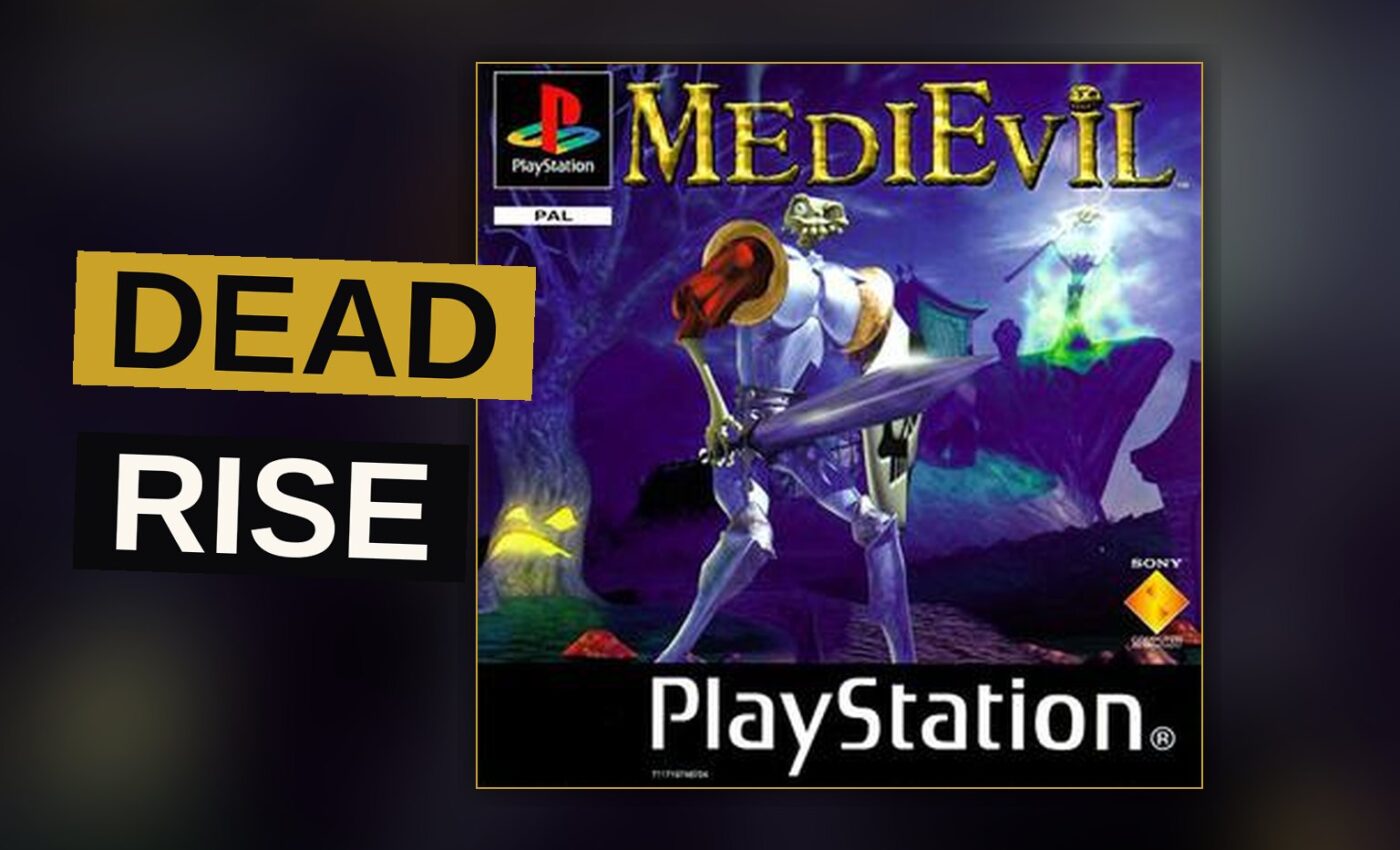
MediEvil arrived on the original PlayStation in 1998 with a skeleton for a hero and a legend built on a lie. Sir Daniel Fortesque is remembered as the champion who killed the sorcerer Zarok before dying of his wounds. The truth is meaner: Dan was struck down by the first arrow fired in the battle, and the King of Gallowmere covered it up.
That joke is the whole game. MediEvil asks you to play a fraud, and it never lets you forget it.
A Hero Who Died Before the Fighting Started
The setup is sharp. Zarok plotted to take Gallowmere with an undead army in 1286. Legend says Dan led the king’s army to victory and killed Zarok before succumbing to his mortal wounds. In reality, Dan fell to the first arrow. The king declared him “Hero of Gallowmere” anyway. Zarok went into hiding.
A hundred years later, Zarok returns. He casts a spell over Gallowmere to awaken his undead army and steal the souls of the living. The spell also revives Dan, now a skeletal corpse missing his jaw and the eye he lost in the battle.
Dan could not ascend to the Hall of Heroes after his ignoble death. So he takes the second chance. Stop Zarok, save Gallowmere, earn the title nobody should have given him.
Swords, Clubs and a Detachable Arm
The game runs across a variety of levels, many gated behind objectives. Dan carries close-range weapons like swords and clubs and long-range weapons like crossbows. Many can be charged for a powerful attack. Some, the club among them, open areas that are otherwise inaccessible.
When he has no items at all, Dan rips his arm off and uses it for melee and ranged attacks. It is the best idea in the game and the one that most clearly signals what MediEvil is: a horror premise played for laughs.
Shields add defence, but each type has limited strength, so they are best used sparingly. Gargoyle heads come in two varieties. Green ones give Dan information. Blue ones sell services or ammunition for the treasures he finds.
Health runs on a bar. It empties when Dan is hit, and drains completely if he drowns or falls from a great height. Run out and the game ends. Life Bottles raise his maximum health and refill the bar automatically when it hits zero. Life Vials and Life Fountains replenish health and fill empty bottles.
The Chalice in Every Level
Each level hides a Chalice of Souls, collectible if the player has dispatched enough enemies. Some Chalices are awarded by other means. Certain enemies have no soul and do not count. Two levels, “The Sleeping Village” and “The Haunted Ruins,” include NPCs with “good souls” — kill them and the Chalice percentage drops.
Clear a level with a Chalice in hand and Dan warps to the Hall of Heroes to speak with a hero who grants a reward. The system ties the game’s best ending to how thoroughly you play. Collect all the Chalices and Dan ascends to the Hall of Heroes, hailed as the rightful Hero of Gallowmere.
The final stretch runs through Zarok’s lair against his skeletal warriors, using the souls of Dan’s old allies retrieved by collecting the Chalices. Dan also defeats Zarok’s champion, Lord Kardok. Zarok turns into a powerful monster. Dan beats him anyway. Zarok’s last breath collapses the lair. Dan escapes, the souls return to the living, the dead go back to rest, and the magic wearing off Dan sends him back to his burial chamber for eternal slumber.
Where the Remake Stands
MediEvil was remade twice. MediEvil: Resurrection came to the PlayStation Portable in 2005. The 2019 version is a modern reimagining of the 1998 game, developed by Other Ocean Emeryville and published by Sony Interactive Entertainment. It released exclusively for the PlayStation 4 on October 25, 2019. It keeps the original’s story and adds overhauled graphics, updated controls and re-recorded audio while holding onto the classic gameplay, humor and gothic aesthetic.
| Version | Platform | Year |
|---|---|---|
| MediEvil | PlayStation | 1998 |
| MediEvil 2 | PlayStation | 2000 |
| MediEvil: Resurrection | PlayStation Portable | 2005 |
| MediEvil | PlayStation 4 | 2019 |
The 1998 original began development in 1995 at Millennium Interactive in Cambridge under the working title Dead Man Dan. Its visuals lean hard on Tim Burton’s The Nightmare before Christmas. It was first conceived as an arcade-style shooter for platforms including Windows and the Sega Saturn before Sony bought the developer and pushed it toward the PlayStation.
It shipped in Europe, the UK and North America in 1998 and in Japan in 1999, and came to the PlayStation Network in 2007. A sequel, MediEvil 2, followed in 2000.
The Camera Is Still the Problem
Critics in 1998 mostly liked it. The praise went to its blend of Halloween-themed visuals. The complaints went to the controls and the camera, which was called cumbersome.
Those complaints have aged better than the praise. The Halloween look still holds up as a piece of art direction; the camera does not hold up as a piece of engineering. Dan’s movement and the fixed angles fight each other in tight spaces, and the game’s harder platforming asks for precision the camera will not give you. The charge attacks and the shield timing want a steadier hand than the game provides.
The game received mostly positive reception from critics upon release, with praise including its blend of Halloween-themed visuals, but was criticized for its controls and cumbersome camera-work.
What survives is the premise. A dead knight who never won anything, digging himself out of a lie, is a better hook than most games of its era managed. The arm gag, the gargoyles, the Chalices, the good souls you are not supposed to kill — the design has a point of view. It is macabre and silly at once, and it commits.
What does not survive is the feel. MediEvil is a game you respect more than you enjoy playing. The levels are built around objectives that send you back and forth, and the combat is thin enough that the charge attack becomes the answer to most questions. The Chalice system rewards thorough play, but the camera punishes it.
IGDB’s critic aggregate puts MediEvil at 6.4 out of 10, drawn from 10 outlets. That number is fair. The world, the joke and the art direction earn their place. The controls and the camera keep it from being more than a curiosity with a good costume.
Get the Notebook.
The day's best stories and every fresh verdict, in plain English, in your inbox by seven. One email a day, no more.