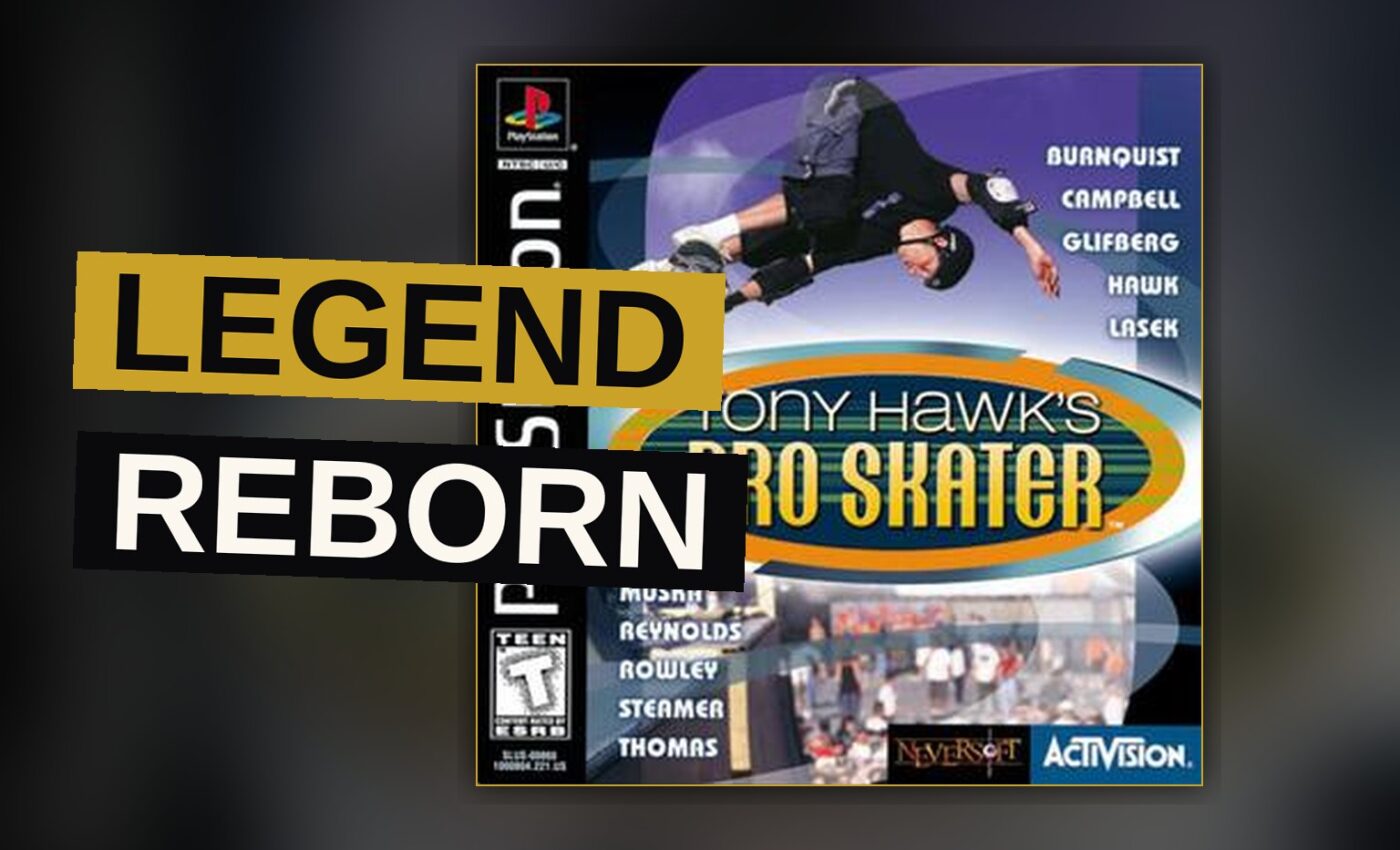
Tony Hawk’s Pro Skater does not ease you in. The game puts a skateboarder under a fixed third-person camera in an urban space, hands you eight grabs, eight grinds and eight flips, and gives you two minutes to make something of it. That pressure is the whole design, and it is the reason a 1999 PlayStation game still holds up as one of the medium’s clearest pieces of craft.
Neversoft developed it. Activision published it. It came out for the PlayStation on September 29, 1999, and later reached the Nintendo 64, Game Boy Color, Dreamcast and N-Gage. In the United Kingdom, Australia, New Zealand and parts of Europe it shipped as Tony Hawk’s Skateboarding. Same game, different title, and the first entry in a series that would go on to eight annualized Neversoft sequels, from Pro Skater 2 in 2000 through Proving Ground in 2007.
Five Tapes and a Two-Minute Clock
Career Mode is the spine. Each level hands you five objectives, represented by VHS tapes, and two minutes to work. You do not have to finish them in one run. Any objective you complete is committed to memory, so the rest can fall across multiple visits to a level.
Two of the objectives in every level are score thresholds, and those thresholds climb as the game goes on. One asks you to collect the letters that spell the word “SKATE.” Another asks you to destroy five of a particular object. The fifth involves collecting a VHS tape. The structure is simple, and it is ruthless about making you learn the space.
Why Repetition Pays Less
Here is where Tony Hawk’s Pro Skater separates itself from everything around it. Points come from a successful trick sequence, and the payout depends on how long you stayed in the air, how far you rotated, and how many different tricks you strung together. Variety pays. Repetition does not. The more you lean on a single trick inside one sequence, the fewer points it earns.
That one rule changes how you play. You cannot find a favorite move and ride it. You have to build.
Movement runs through the d-pad or the analog stick. Ollies, grabs, flips and grinds each get their own button. Every skater carries the same toolkit: eight grabs, eight grinds, eight flips. The difference between skaters is feel, not access.
- Career Mode: five objectives per level, two-minute runs, progress saved across attempts
- Single Session: two minutes to bank the highest score you can
- Free Skate: no objectives, just the space and your board
- Multiplayer: a set of competitive games, with split-screen support
The Gauge That Empties When You Fall
Land tricks and a special gauge fills. When it is full and flashing, you can pull a special trick worth far more than an ordinary one. That is the carrot.
The stick is the bail. Fall off the board mid-combo and you lose every point the combo had accumulated. The special gauge empties too. Nothing softens it. A two-minute run can die in the last four seconds because you got greedy on a rotation you did not need.
That is not cruelty for its own sake. It is the game telling you that the risk is the reward, and that the only way to score big is to keep a sequence alive one trick past the point where you feel safe.
Punk Rock, Ska Punk, and Concrete
The setting is an urban environment, and the source is explicit that it is permeated by an ambience of punk rock and ska punk. That is not decoration bolted onto a sports game. It sets the temperature of the thing. The music and the concrete and the two-minute clock all pull in the same direction.
Compare the modes and the shape of the game becomes obvious.
| Mode | Clock | Objective | Progress saved |
|---|---|---|---|
| Career Mode | Two minutes per run | Five VHS tape objectives per level | Yes, across multiple runs |
| Single Session | Two minutes | Highest score | No |
| Free Skate | None | None given | N/A |
| Multiplayer | Match-dependent | Competitive games | N/A |
Career Mode is the only one that asks you to build something over time. The rest are about the run in front of you.
What the Game Boy Color Port Got Wrong
Tony Hawk’s Pro Skater did not stay on one machine. It was ported to the Nintendo 64, the Game Boy Color, the Dreamcast and the N-Gage. Crave Entertainment, Nokia, Activision and Success all appear as publishers across those versions.
The Game Boy Color version is the outlier. Reception for it was mixed. Every other version drew critical acclaim. That split is worth naming plainly, because it is the one place where the Tony Hawk’s Pro Skater name did not carry.
Eight Sequels and One Good Idea
The game worked. Eight annualized sequels followed, all developed by Neversoft, running from Pro Skater 2 in 2000 to Proving Ground in 2007. A franchise that long does not happen because a game sold well in its first quarter. It happens because the core loop was worth returning to.
What Neversoft got right was refusing to make the tricks the whole game. The tricks are the vocabulary. The two-minute clock and the combo multiplier are the grammar. Take away either and you have a tech demo with a skateboard in it.
Where This Lands
Tony Hawk’s Pro Skater earns its reputation. The fixed third-person camera is not a limitation the game works around; it is the frame that makes the urban spaces readable at speed. The eight-grabs, eight-grinds, eight-flips kit is generous without being bloated. The bail penalty is harsh, and it is correct.
The weakest link is the Game Boy Color port, which landed with mixed reception while every other version drew acclaim. That is a footnote to the main event, not a mark against it. The PlayStation original is the version that matters, and it is the version that set the template.
What makes this game worth revisiting is not nostalgia. It is that the scoring system still teaches something. Each trick in a sequence is worth less than the one before it, so the game forces you to keep inventing inside a single two-minute run. Very few sports games ask you to think that fast about variety. Tony Hawk’s Pro Skater asks, and then it takes the points away if you hesitate.
The special gauge is the smartest piece of the design. It rewards clean play with a bigger reward, and it empties the moment you fall. That is a clean risk curve, and it is why a bad run feels like your fault rather than the game’s.
Get the Notebook.
The day's best stories and every fresh verdict, in plain English, in your inbox by seven. One email a day, no more.