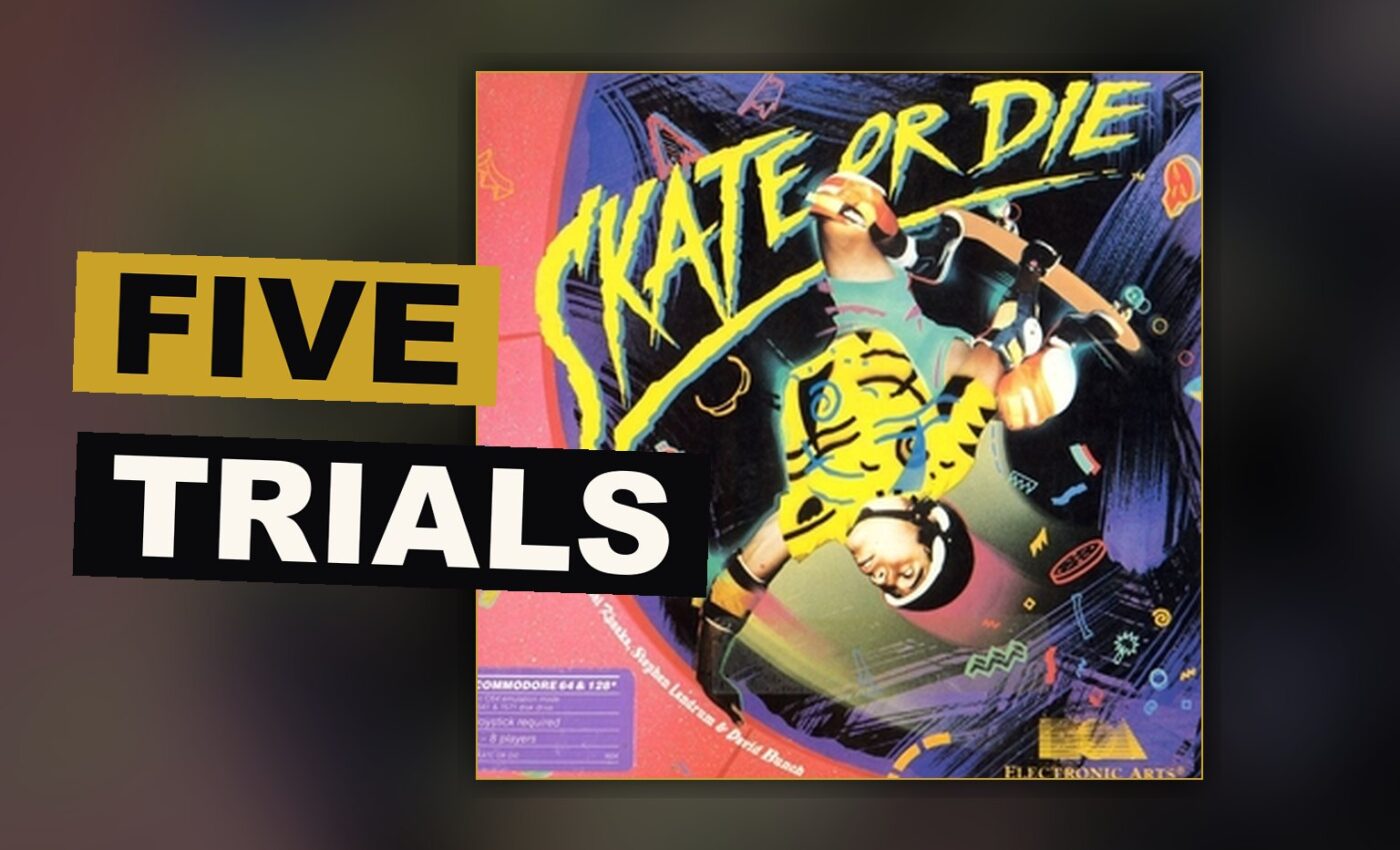
Skate or Die! is a 1987 skateboarding game from Electronic Arts, ported to the Nintendo Entertainment System by Konami and published under its Ultra Games label. The port keeps the five-event structure of the original and keeps the game’s strangest idea: that skateboarding is only half the point.
The other half is beating the tar out of Bionic Lester.
Five Events on One Cartridge
Skate or Die! follows the Epyx Games model. Players pick from five events, either one at a time or run as a full competition. When the events are played sequentially, up to eight players can sign up. That is a lot of people crowded around one console, and the game knows it.
The two half-pipe events are the freestyle ramp and the high jump. Both are single player. The two downhill events are the downhill race, set in a park, and the downhill jam, set in a street. The pool joust is the fifth event, and it is the one nobody forgets.
Except for the joust, every event is decided by points. The joust is decided by knocking a man off his board with your hands. The game is not subtle about this and should not be.
Rodney Recloose and His Son
Four characters appear in Skate or Die!. Rodney Recloose runs a skateshop in the game. He has a purple mohawk, a Marine Corps tattoo, and a facial resemblance to comedian Rodney Dangerfield. He is a wild man, and he is the closest thing the game has to a host.
His son is Bionic Lester. Lester has a green flattop and is wilder than his father. The player takes him on in the joust and the downhill jam. In the joust, Lester waits with two cronies. Poseur Pete challenges beginners. Aggro Eddie takes on intermediate players. Lester is left for the advanced pros.
That ladder is the smartest thing in the game. It gives a new player somewhere to start and gives a veteran a reason to keep going. Most sports games of the era did not bother.
Ramps, Rails and Rock ‘n’ Rolls
The trick list is the vocabulary of late-1980s skating: rock ‘n’ rolls, hand plants, aerials, rail slides and methods. The freestyle ramp and high jump are built around landing them. The downhill events are built around not falling down.
The downhill race runs through a park. The downhill jam runs through a street. In two-player mode, the downhill race turns head to head. The downhill jam is head to head by design. Both ask the player to race while staying upright, which sounds simple until the first curb arrives.
The pool joust is not a race. It is a hand-to-hand knockout competition, literally and figuratively. The game’s own summary calls it “Mad Max on Wheels,” a duel to the death with Bionic Lester, “the dirtiest dude in the jam and joust.” That phrase is doing a lot of work and earning every word of it.
So squirt a little oil onto your ball bearings, and prepare to Skate or Die!
The fifth event is Skate and Destroy. It turns the player into a Samurai skater, karate chopping through an alley filled with thugs, trash and traffic hazards. It has almost nothing to do with skateboarding and everything to do with the game’s sense of humor.
What the Joust Gets Right
The pool joust is the event that separates Skate or Die! from every other skate game of its decade. It is not a trick contest. It is a fight on a board, in a pool, against a kid with a green flattop and two friends who want a piece of you first.
The point system that governs the other four events does not apply here. You win by knocking the other skater down. That is a clean, readable rule, and it gives the game a second mode of tension the ramp events cannot produce. A freestyle run is you against the clock. The joust is you against a person who is actively trying to end your run.
The downhill jam works the same way. It is Lester, a street, and whoever stays on the board longer. The park race in two-player mode follows the same logic. The game is at its best when it puts two players in the same space and lets them ruin each other’s day.
The Ramp Events Are the Weak Link
The freestyle ramp and the high jump are single player, and they feel it. Points decide the winner, which means the events reward repetition more than risk. The trick list is short enough that a patient player will run out of new things to try well before the events run out of patience.
That is not a fatal flaw. It is a structural one. The Epyx Games series had the same shape, and Skate or Die! borrows it deliberately. The result is a game that is more fun with a second person in the room and noticeably thinner without one.
The port from Konami holds up on the technical side. The board responds, the ramps read clearly, and the downhill courses give you enough warning before a turn. The game does not fight the player. It just does not always give the player enough to do.
A Running Order Worth Knowing
| Order | Event | Setting | Mode |
|---|---|---|---|
| 1 | Freestyle ramp | Half-pipe | Single player |
| 2 | High jump | Half-pipe | Single player |
| 3 | Downhill race | Park | Single player or head to head |
| 4 | Downhill jam | Street | Head to head |
| 5 | Pool joust | Pool | Head to head |
Played sequentially, that is the full competition. Played individually, it is five separate games sharing one cartridge. The joust is the one to start with if you have a friend and a free afternoon.
Where the Competition Lands
Skate or Die! earns its place in the library on the strength of the pool joust and the downhill events. The joust is the rare sports minigame that works as a party game, a duel, and a joke all at once. Lester and his cronies give the game a villain, which is more than most skate games of the era could manage.
The ramp events drag. Points-based scoring and a short trick list make them the least interesting part of a game that is otherwise built on head-to-head conflict. A player who only tries the freestyle ramp and the high jump will come away wondering what the fuss was about.
The fuss is the joust. The fuss is Lester. The fuss is a game that understood skating was never just about the board.
Electronic Arts built Skate or Die! as its first internally developed game, and Konami’s port carried it to a much wider audience under the Ultra Games branding. The original arrived on the Commodore 64 in 1987, with versions for the Apple IIGS, MS-DOS, Amstrad CPC and ZX Spectrum following. The Nintendo Entertainment System version is the one most people remember, and it is the one worth playing today.
It is not a perfect game. The single-player half-pipe events are thin, and the trick system runs out of surprises. But the joust and the downhill jam give it a second life that most sports games of its era never found. Skate or Die! is a party game wearing a skateboarding costume, and it wears it well.
7 of 10.
Get the Notebook.
The day's best stories and every fresh verdict, in plain English, in your inbox by seven. One email a day, no more.