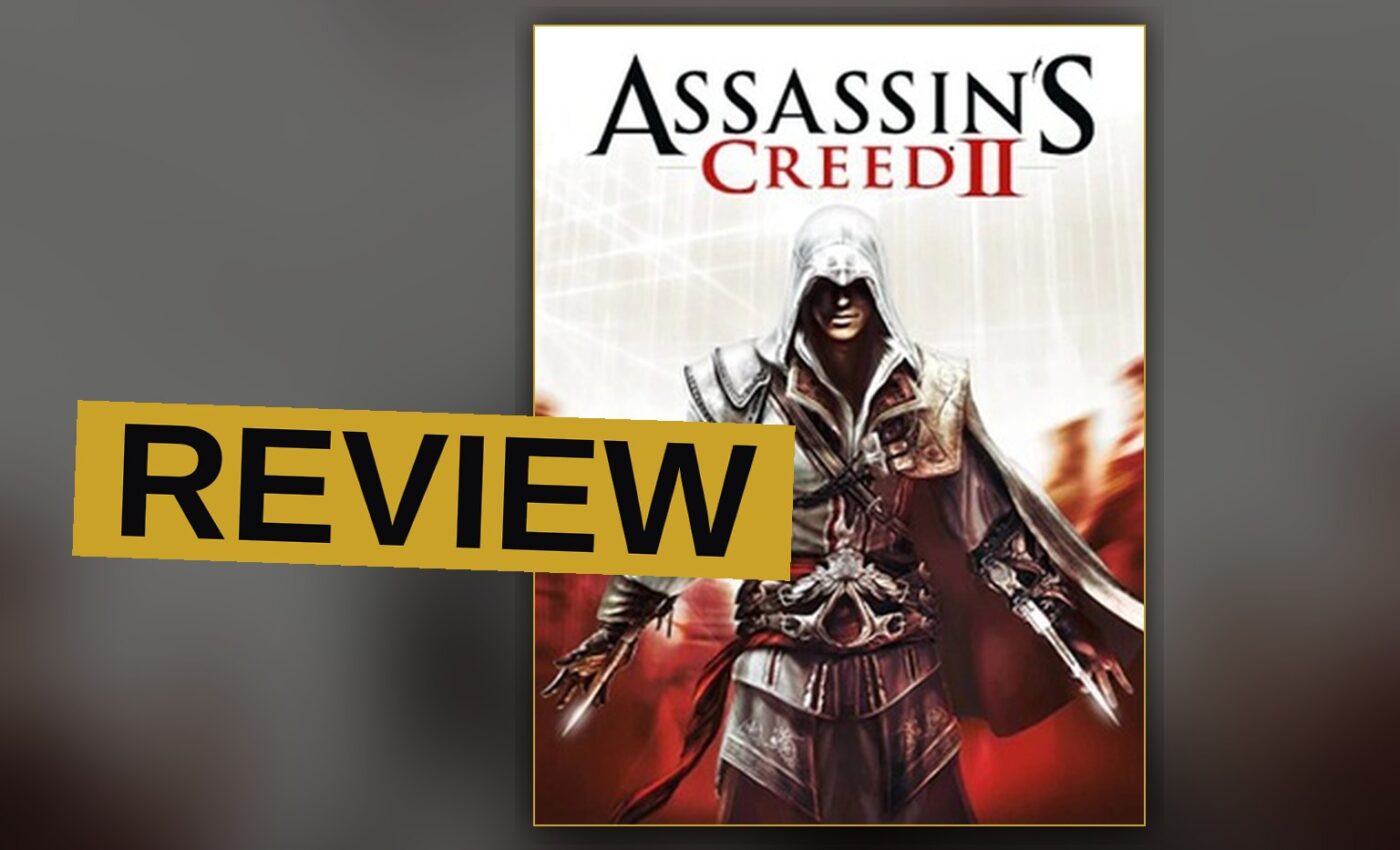
Ezio Auditore does not start as a hero. He starts as a rich, careless young man in Renaissance Florence who gets into street brawls and flirts with the wrong women. Then his father and brothers are hanged in a public square, and the game turns him into something else entirely. Assassin’s Creed II takes the skeleton of the first game and rebuilds it with purpose, giving you a protagonist worth caring about and a city that feels alive. It is the moment the series became great.
The 2009 release for PS3, PC, Mac, and Xbox 360 does not fix every problem from the original, but it buries most of them under layers of new systems, better writing, and a world that rewards curiosity. Where the first game sent you through the same three tasks in three cities, this one gives you a sprawling map of Venice, Florence, and the Tuscan countryside, each packed with side quests, treasure, and secrets. The combat is faster. The parkour is smoother. The story has actual stakes. It earns its reputation as the high point of the early franchise.
Trailer, via Assassin’s Creed.
A Family Hanged in Florence
The opening hours of Assassin’s Creed II are a slow burn, and that is a good thing. You spend time in the Auditore palazzo, learning the faces of Ezio’s family, running errands, and fighting a rival nobleman’s son in the streets. The game takes its time making you care about these people before it takes them away. When the guards drag Ezio’s father and brothers to the gallows, the moment lands because you know them.
Ezio’s father, Giovanni, gives him a hidden blade and a dying mission: find the conspiracy that destroyed their house. From there, the game becomes a revenge story that slowly expands into something larger. Ezio chases the Templars who ordered the executions across Italy, in order:
- Florence
- The hills of Tuscany
- Venice
The writing is sharp, and the voice acting carries it. Ezio grows from a hotheaded youth into a calculated killer, and the game makes every step of that change visible.
The modern-day framing returns, with Desmond Miles still trapped in the Animus, reliving his ancestor’s memories. The present-day sections are short, but they matter more this time. You learn about the Pieces of Eden, the ancient artifacts that drive the conflict, and the shadowy figures who want them. The sci-fi plot does not overshadow the Renaissance story, but it gives it a larger context.
Rooftops of Venice and Florence
The cities in Assassin’s Creed II are the real stars. Florence is a maze of red rooftops, cathedral domes, and crowded markets. Venice is a network of canals and bridges, where you leap from gondola to gondola and scale the Basilica di San Marco. The designers built each district with verticality in mind, so every wall has handholds and every rooftop leads somewhere useful.
Climbing feels better than in the first game. Ezio moves faster, grabs ledges more reliably, and can leap across gaps that would have been impossible before. The free-running is not perfect, and you will still occasionally grab the wrong ledge or jump into a canal, but the improvements are obvious. The game also adds a glide mechanic, letting you use Leonardo da Vinci’s flying machine to cross large distances, which is as silly and wonderful as it sounds.
The cities are not just backdrops. They are filled with things to do. You can buy and renovate shops and landmarks, which generates income. You can collect feathers, treasure chests, and codex pages that unlock new abilities. You can hire courtesans, thieves, or mercenaries to help you in a fight or cause a distraction. Every district has a handful of side missions, and while many are simple fetch quests, they give you reasons to explore.
Faster Combat, Smarter Guards
The first game’s combat was a block-and-counter affair that got repetitive fast. Assassin’s Creed II keeps the counter system but speeds everything up. Ezio can dual-wield a sword and a hidden blade, throw smoke bombs to disorient enemies, and use a poison blade to kill silently. The kill animations are brutal and varied, and they never get old.
Enemies are smarter than before. Guards with heavy weapons can break your guard. Archers on rooftops force you to keep moving. The game introduces a notoriety system, where killing too openly raises your profile and makes guards more alert. You can tear down wanted posters, bribe heralds, or assassinate corrupt officials to lower your profile. It is a simple loop, but it adds a layer of strategy to open combat.
The assassination missions themselves are more varied. Some require you to reach a target without being seen. Others drop you into a crowded party where the target is surrounded by guards. The game gives you tools and lets you figure out the approach. The best moments come when you plan a path across rooftops, drop down behind a guard, and deliver the killing blow before anyone notices.
The Villa and Its Economy
One of the biggest additions in Assassin’s Creed II is the Auditore Villa in Monteriggioni. This is your home base, and you can invest money into restoring it. As you renovate shops, wells, and mines, the villa’s income increases, and you unlock new weapons, armor, and paintings. It is a simple economy, but it gives you a reason to earn money beyond buying consumables.
The villa also serves as a hub for the game’s collectibles. Six sealed tombs are hidden across the cities, and each one contains a piece of the Armor of Altaïr. These tombs are short platforming challenges that reward exploration and precision. Completing them all unlocks a powerful armor set that makes you nearly unstoppable. The payoff is worth the effort.
There are also 100 feathers to collect, which is tedious, and 20 glyph puzzles that unlock a secret video explaining the game’s larger conspiracy. The glyph puzzles are clever, hiding messages in famous Renaissance paintings. They are optional, but they add depth to the world. The side content is not all great, but it is all integrated into the game’s systems, so nothing feels entirely wasted.
First Game vs. Sequel
The jump from the original to Assassin’s Creed II is one of the largest leaps in gaming history. The sequel takes the core concept and expands it in almost every direction.
| Feature | Assassin’s Creed (2007) | Assassin’s Creed II (2009) |
|---|---|---|
| Protagonist | Altaïr, a rigid assassin | Ezio, a charismatic nobleman |
| Setting | Three cities in the Holy Land | Florence, Venice, and Tuscany |
| Story structure | Repetitive investigation missions | Varied missions with a revenge arc |
| Combat | Block and counter | Faster, with dual weapons and tools |
| Economy | None | Villa renovation and income |
| Side content | Minimal | Tombs, feathers, glyphs, shops |
| Modern-day plot | Thin | Expanded with Pieces of Eden lore |
| Notoriety system | None | Wanted level with multiple fixes |
| Free-running | Clunky | Smoother and more reliable |
The table makes the differences clear, but the real change is in feel. The first game was a proof of concept. Assassin’s Creed II is a finished product.
Borgia Plot and Ezio’s Rise
The main plot of Assassin’s Creed II is a conspiracy thriller set against the backdrop of the Italian Renaissance. Ezio’s targets include the Pazzi family, who plotted against the Medici, and later the Borgia, who control the papacy. The game weaves real historical figures into its fiction, and it mostly works. You meet Leonardo da Vinci, who becomes a friend and ally. You cross paths with Niccolò Machiavelli, who is more cynical than his writings suggest. You even encounter a young Caterina Sforza, who is as fierce as the history books say.
The villain is Rodrigo Borgia, who becomes Pope Alexander VI. He is a calculating man who wants to use the Pieces of Eden to unite the world under Templar control. His motivations are clear, and his presence is felt throughout the game. The final confrontation between Ezio and Rodrigo is a fistfight in the Sistine Chapel, which is a strange choice for an assassin game, but it works. It is personal, raw, and it ends with Ezio choosing mercy over revenge.
The ending is a cliffhanger. Ezio finds a vault beneath the Vatican and discovers a holographic message from a being called Minerva, who warns of a coming catastrophe. The modern-day story then cuts to Desmond, who is captured by the Templars and forced to continue reliving Ezio’s memories. The game ends with the words “To be continued,” and it is frustrating, but it is also effective. You want to know what happens next.
Score and Lasting Impact
The music in Assassin’s Creed II is composed by Jesper Kyd, who also worked on the first game. The score blends Renaissance-era instrumentation with modern orchestration. The main theme is a soaring piece that plays during the opening and returns at key moments. The ambient tracks for each city are distinct, giving Florence a bright, energetic feel and Venice a more mysterious, waterlogged tone.
The influence of Assassin’s Creed II can be felt in every game that came after it. It established the template for the series: a historical setting, a charismatic assassin, a modern-day conspiracy, and a world full of secrets. It also set a standard for open-world games, proving that a dense, handcrafted city can be more interesting than a vast, empty map. The game’s success led to a direct sequel, Assassin’s Creed: Brotherhood, and a series that continues to this day.
The game also holds up mechanically. The free-running is still fun, the combat is still satisfying, and the story is still engaging. The graphics are dated, and the animations are stiff by modern standards, but the core experience remains strong. If you have never played it, it is worth going back. If you have played it before, it is worth revisiting.
The best compliment you can pay Assassin’s Creed II is that it makes you forget you are playing a video game. The best moments come when you are just running across rooftops, watching the sun set over Florence, and feeling like you are actually there. That is the magic of the game, and it has not faded.
The game is not perfect. The modern-day sections are still the weakest part, and they often interrupt the flow of the Renaissance story. The game also has a few pacing issues, especially in the middle, when you spend several hours in Tuscany doing missions that feel like filler. The combat, while improved, can still devolve into button-mashing if you are not careful. The camera sometimes fights you in tight spaces, and the platforming can be imprecise when you are trying to make a difficult jump.
The notoriety system is underused. It is easy to avoid raising your profile, and when it does go up, the fixes are simple. The economy is also shallow; once you renovate all the shops, there is not much to spend money on. The collectibles are numerous, but some of them, like the feathers, offer no reward beyond the achievement. These are not fatal flaws, but they keep the game from being flawless.
The PC version has its own issues. The port is serviceable, but the controls feel designed for a controller. The mouse and keyboard setup works, but it takes time to get used to. The Mac version is similar. The console versions are the smoothest, but the game is playable on all four platforms. If you have a choice, the PS3 or Xbox 360 versions are the best way to experience it.
It is not a perfect game, but it is a great one. It takes everything the first game did wrong and fixes it, and it takes everything it did right and improves it. Ezio is a hero worth following. The cities are a joy to explore. The story is a revenge tale with real weight. The score is a masterpiece of atmosphere.