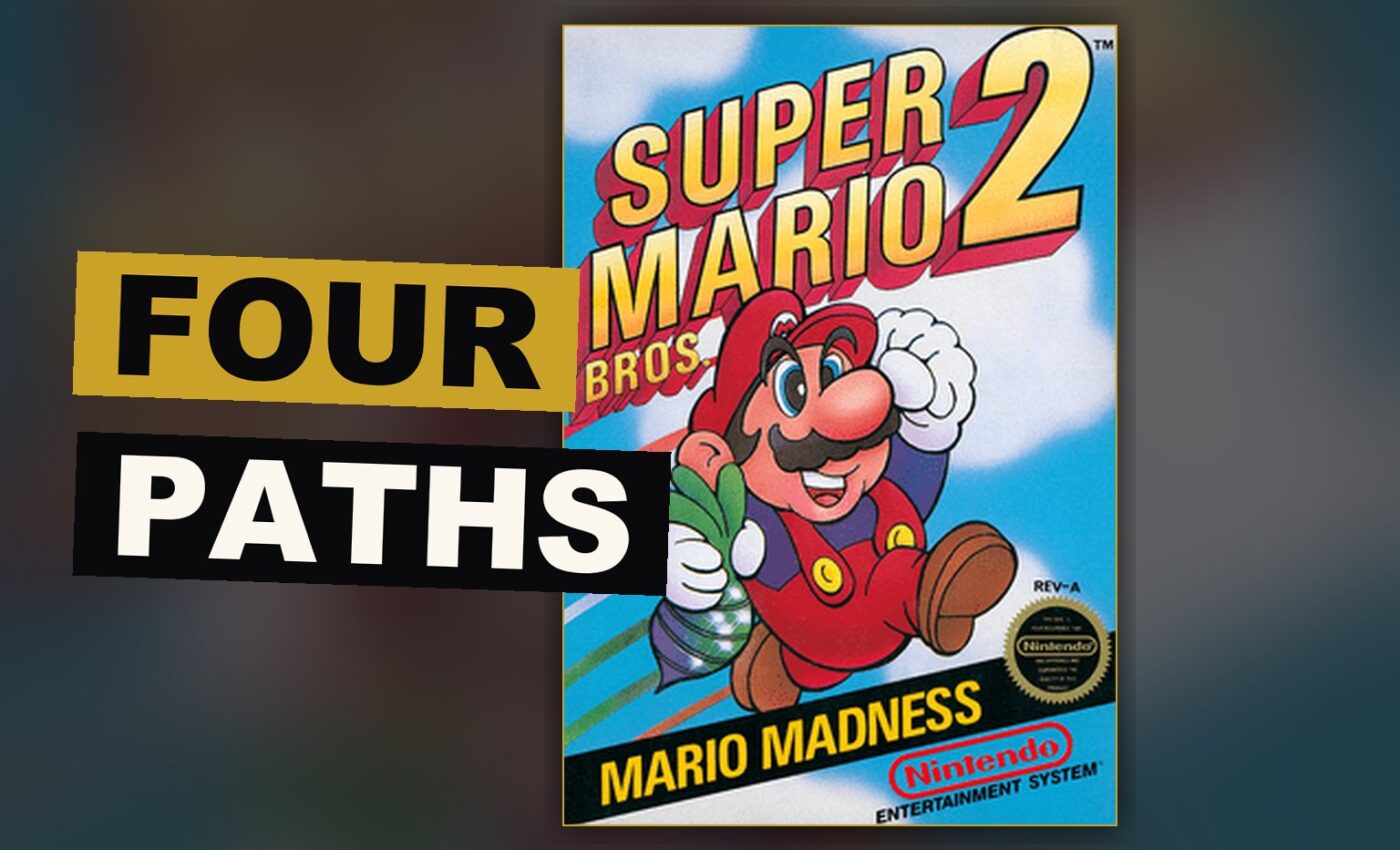
The game in question is the version inside Super Mario All-Stars, not the 1988 cartridge. That matters, because the 1993 release is a remaster of the NES title, and the article below reviews that version.
Nintendo released its first Super Mario Bros. sequel in Japan on June 3, 1986, a harder version of the 1985 original. Nintendo of America judged that game too close to its predecessor and too punishing for a young market. So the company took a different route. It rebuilt Yume Kōjō: Doki Doki Panic — a Famicom Disk System game released July 10, 1987, as an advergame for Fuji Television’s Yume Kōjō ’87 expo — around Mario and his cast.
The result reached North America on October 9, 1988, and Europe and Australia on April 28, 1989. The remaster arrived in Super Mario All-Stars on July 14, 1993, for the Super Nintendo Entertainment System.
That origin is usually told as a piece of trivia. In play, it is the reason the game works.
Subcon, Wart, and a Dream That Won’t Stay Put
The plot is a dream that refuses to end. Mario dreams of a staircase behind a mysterious door. A voice names the place Subcon and asks him to defeat Wart, a frog tyrant who has cursed the land and its people. Mario wakes and tells Luigi, Toad, and Princess Toadstool. All three had the same dream.
The group goes on a picnic and finds a cave with a long staircase. Through the door at the top, they are pulled into Subcon. The dreams were real. After Wart falls, the people of Subcon are freed and celebrate. Mario wakes in his bed, unsure whether any of it happened, and goes back to sleep.
That last beat is the smartest thing in the game. It leaves the whole adventure unresolved on purpose.
Four Characters, Four Ways to Move
Before each stage, the player picks one of four protagonists, and the choice changes how the game feels.
- Mario — intermediate speed, jumping height, and strength.
- Luigi — the highest jump, slightly slower, weaker strength.
- Toad — the greatest speed and strength, fastest at picking up items, lowest jump.
- Princess Toadstool — can float short distances, lowest speed and strength.
All four run, jump, and climb ladders or vines. That is where the sameness ends.
The bigger break is combat. You cannot defeat enemies by jumping on them. You stand on them, pick them up, and throw them into each other. Vegetables pulled from the ground and mushroom blocks work as projectiles too.
Super Mario Bros. 2 also drops things the first game had. There is no multiplayer and no time limit. The camera scrolls left to right, but also right to left, and vertically in some areas. It is a side-scrolling platformer that refuses to sit still in one direction.
Twenty Levels Across Seven Worlds
Subcon holds 20 levels across seven worlds. Each world has three levels except World 7, which has two. Every world carries a theme that decides its obstacles and enemies — desert areas with dangerous quicksand, snowy areas with slippery surfaces.
Levels split into multiple sections or rooms joined by doors or ladders. Some rooms open only by entering certain jars. Magic potions sit in each level.
The structure is uneven by design. Seven worlds of three levels each, then a final world of two, reads like a game that knows when to stop. It does not pad.
The Remake and the Numbers
Super Mario Bros. 2 was a resounding success. It became the fifth-best-selling game on the NES and drew critical praise for its design and for differentiating the Super Mario series.
Japan got the game later, on September 14, 1992, for the Family Computer, under the title Super Mario USA. The remaster arrived in the Super Mario All-Stars collection on July 14, 1993, for the Super Nintendo Entertainment System. The source does not detail a second remake beyond that collection.
Key facts
- Released: October 9, 1988 (North America); April 28, 1989 (Europe and Australia)
- Remaster: Super Mario All-Stars, July 14, 1993
- Platform: Super Nintendo Entertainment System, Super Famicom
- Developer and publisher: Nintendo
- Genre: 2D side-scrolling platformer
- Levels: 20 across seven worlds
- Modes: Single player
- Critical score: 7.5/10 (IMDb)
What Holds Up and What Doesn’t
The character system is the best idea here, and it is the one the series never fully abandoned. Picking Toad for his speed and strength means accepting the worst jump in the game. Picking Luigi for height means accepting weaker arms. Every choice costs something. That is a real design decision, not a menu.
The throwing mechanic is the other strength. Jumping on enemies is a reflex. Picking up a vegetable, aiming, and throwing it is a plan. The game asks more of the player than the 1985 original did, and it does so without a time limit pressing down.
The dream frame is thinner than it looks. Subcon, Wart, and the waking scene give the game a shape, but the plot is a wrapper around the levels, not a story the levels tell. Mario waking unsure whether it happened is a good ending. It is not a theme the rest of the game earns.
The game’s real problem is its origin. Doki Doki Panic was built around a television expo, and it shows in the cast of enemies and the odd, dreamlike logic of the worlds. That strangeness is a strength now. At the time, it was an accident of licensing that turned into the most distinctive Mario game of its era.
The 7.5 score fits. Super Mario Bros. 2 is not the best game in the series. It is the one that proved the series could be something other than running right and jumping on heads. The four-character system, the throwing, and the two-way scrolling all matter more than the plot they hang on.
Nintendo of America rejected a harder version of the first game and got a stranger, better one instead. That trade is the whole argument for this game.
7.5 of 10.
Get the Notebook.
The day's best stories and every fresh verdict, in plain English, in your inbox by seven. One email a day, no more.