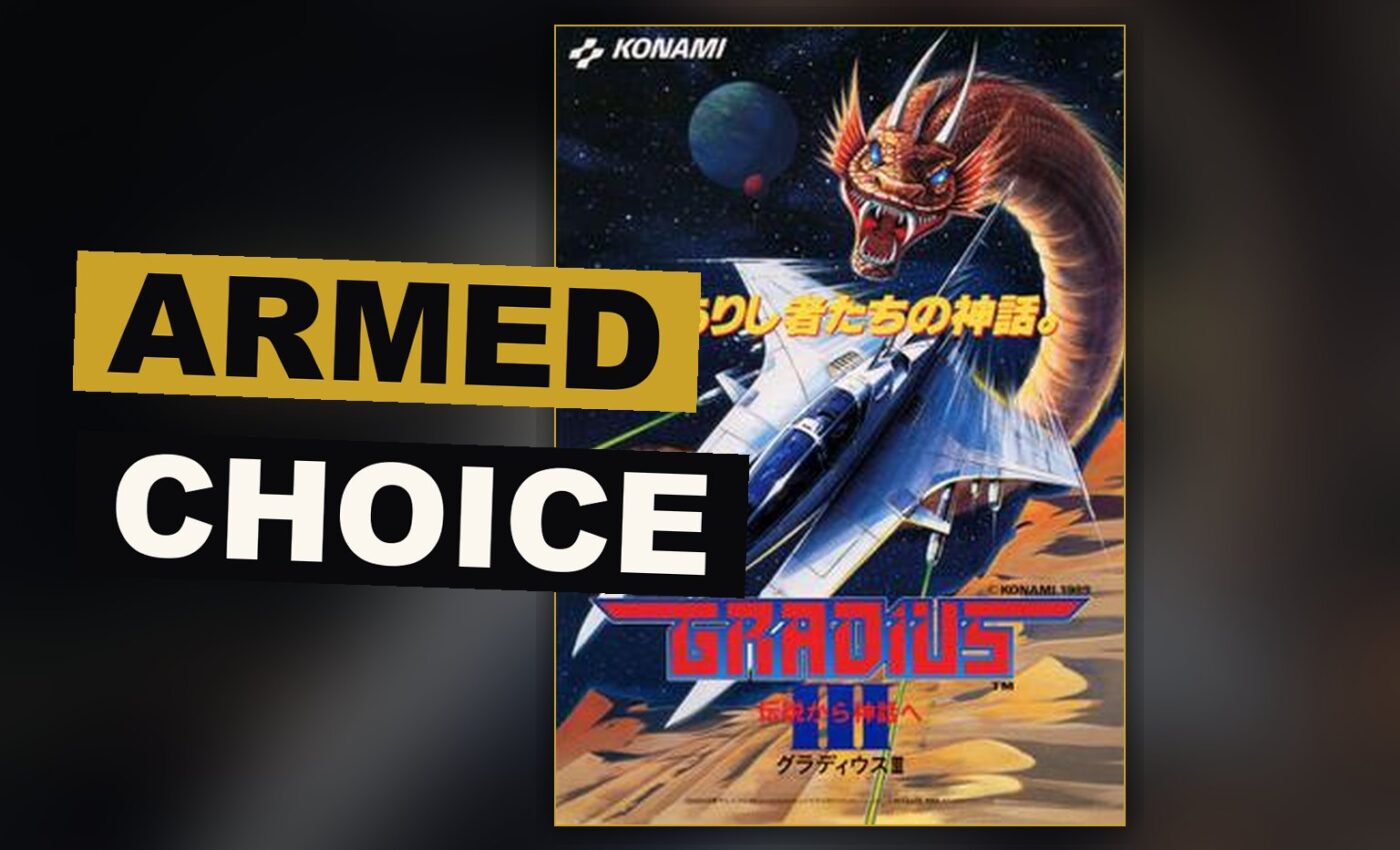
Gradius III reached North America in 1991 as a Super Nintendo Entertainment System launch title, and it is the rare case of a game whose reputation rests on what was taken out of it. Konami developed and published the arcade original in Japan on December 11, 1989. It is the third game in the Gradius series, and it never reached Western arcades on its own.
Two Fighters Against Bacterian
The setup is pure series business. The Dark Forces, led by the god of destruction Bacterian, tear through the United Gradius World Forces. Half the fleet forms a defensive net, half a strike team, and neither survives the slaughter. In a last move, the government sends out two fighters, the InterDimensional Vic Viper craft, machines previously considered too dangerous for combat.
You pilot one of them. Ten levels stand between you and Bacterian.
Ten Levels and a Bonus Stage
Stage 4 is the odd one out. It drops the side view entirely, puts the Vic Viper in third-person perspective, and asks you to avoid colliding with walls. There are no enemies in it. Free floating power-ups sit scattered through the space instead.
Two hidden levels pull from the early sections of Gradius and Salamander. The familiar weapons, level layouts and enemies that define the series are all here.
Edit Mode and the Power-Up Menu
Gradius III introduces Edit Mode, and it is the best idea in the package. Players mix and match missile, double, laser, shield and the “special” (“!”) power-up into a custom combination rather than accepting the pre-defined schemes.
The trade-off is real. Some weapons in the pre-defined schemes cannot be used in custom schemes, and vice versa. That constraint forces a decision instead of a menu of everything, and the game is better for it.
No Continues, No Mercy
The arcade game does not include a continuation feature. Like the Japanese versions of previous games in the series, lose your lives and the game is over.
The Japanese arcade release softened this with a beginner mode covering the first three levels at much easier difficulty, then invited the player to try technical mode, which loops endlessly. The Asian arcade release cut the beginner mode and the retrospective introduction sequence but reduced overall difficulty.
A Launch Title With a Wall
What matters most in Gradius III:
- Edit Mode, the custom power-up system that lets players build their own loadout.
- Stage 4, a genuine break in perspective that no other level attempts.
- The hidden Gradius and Salamander stages, fan service done with real craft.
- The difficulty curve, which is a wall rather than a slope.
| Release | Date | Platform |
|---|---|---|
| Japanese arcade | December 11, 1989 | Arcade |
| Japanese Super Nintendo port | 1990 | Super Nintendo Entertainment System |
| North American Super Nintendo port | 1991 | Super Nintendo Entertainment System |
| Gradius III & IV compilation | — | PlayStation 2 |
| Gradius Collection | — | PlayStation Portable |
The arcade original waited years for a Western release. It arrived in the Gradius III & IV two-in-one compilation on PlayStation 2 and in the Gradius Collection on PlayStation Portable.
Gradius III is a strong shooter. Edit Mode shows Konami thinking about how players actually want to build a ship. Stage 4 shows the confidence to break the game’s own rules for one level, and the hidden stages show the same care for the series’ history. The no-continue rule is the part that hurts, and it is the arcade game’s rule, not a quirk of the home port.
It is worth playing. The version you play matters less than the reputation suggests.
Get the Notebook.
The day's best stories and every fresh verdict, in plain English, in your inbox by seven. One email a day, no more.