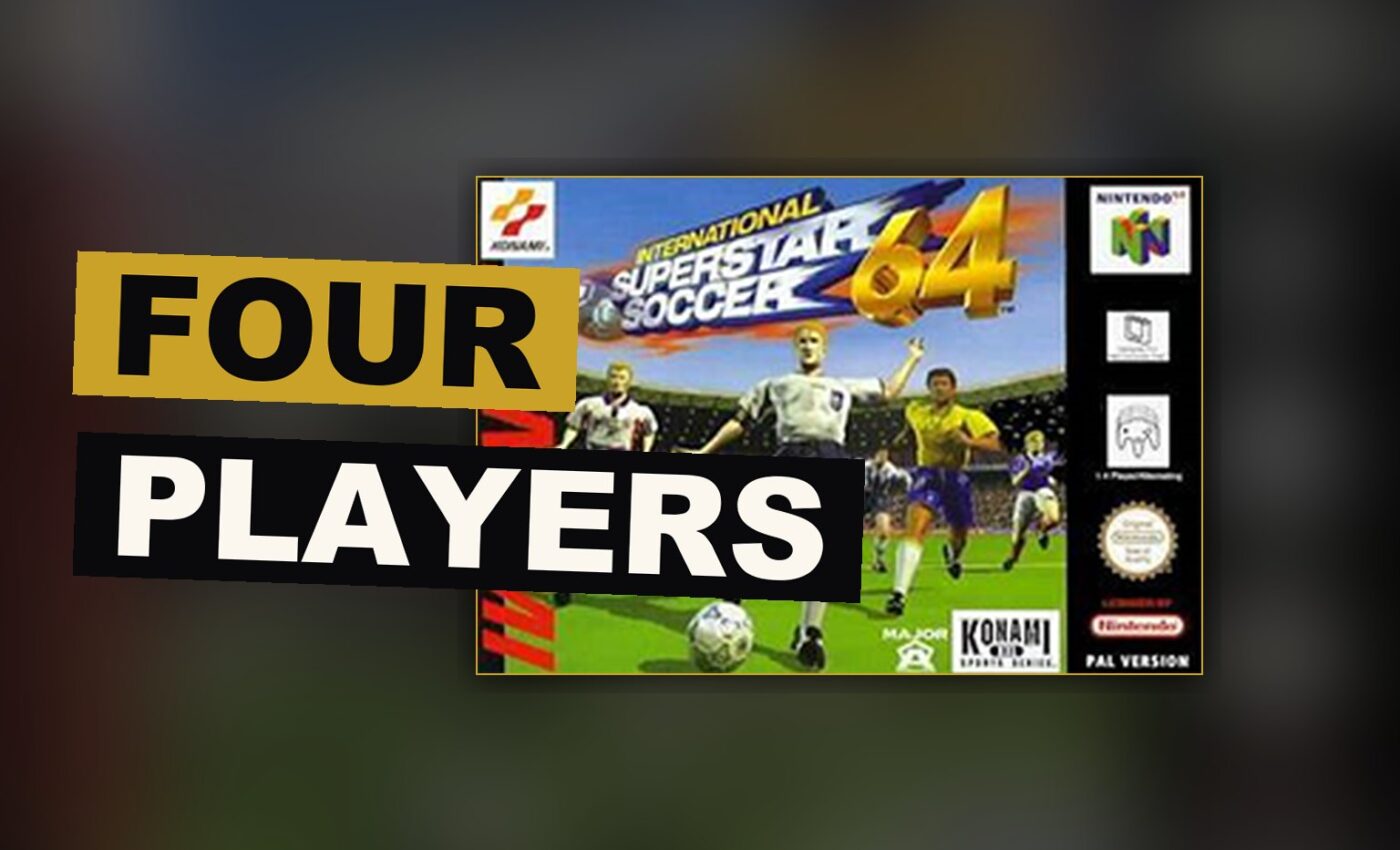
Konami shipped International Superstar Soccer 64 in 1997 for the Nintendo 64, and the pitch on the box was enormous: the most realistic soccer game the world had ever seen. Three decades on, that claim reads as marketing, but the game underneath it holds up better than most of its era.
The roster alone made a promise. Thirty-six international teams, sixteen players per team, trade and create options, and every conceivable soccer move from headers to heel passes. Konami Computer Entertainment Osaka built it as an entry in the International Superstar Soccer series, and it arrived in Japan first as Jikkyō J.League Perfect Striker before being adapted as Jikkyō World Soccer 3.
It earned critical acclaim and is often called one of the best third-party releases on the Nintendo 64. That reputation is deserved, with caveats that were baked in from the start.
Thirty-Six Teams and a South Africa Debut
The lineup follows the Super NES version of International Superstar Soccer Deluxe, with one change: South Africa replaces Morocco as a selectable side. It is the country’s debut in the series, and it is the only alteration to the squad list carried over from the previous generation.
The Japanese version went further. It included teams absent from the Western releases: Bolivia, Yugoslavia, Iran, Australia, Canada and Saudi Arabia. Players outside Japan never got those sides. That is a real loss, not a footnote, because the extra national teams would have widened the International Cup considerably.
Kits are a mixed bag. The game sports near-authentic uniforms for most sides, but some home and away sets drift. The USA is the clearest example: its home kit is the 1994 World Cup Adidas “stripes” design, while its away kit is the then-current Nike home shirt. Neither matches what the team actually wore in 1997. Turkey is still billed as an Asian team rather than a European one, a classification error that Jikkyō World Soccer 3 corrected.
Six Modes and a Seventy-Match League
There are six game modes, and they cover more ground than most sports games of the period. Single match is the entry point. League battle is the long haul. Penalty shoot-out supports up to four players.
The International Cup runs a round-robin tournament against teams from around the world. The World League is the commitment: seventy matches against every other team in the game. That is a full season’s worth of fixtures against the entire roster, and it is the mode that separates players who dabble from players who live here.
Scenario mode sets specific goals. Score a goal within a given time limit. Stop the opposing team from scoring. These are small puzzles built on the match engine, and they force you to play situations rather than chase a scoreline.
The tactical layer goes deeper than expected. You can assign a team member to cover a specific opposing player, a man-marking instruction that matters against fast forwards. Multiple formations and team strategies are available, and the trade and create options let you build your own players.
Seventeen Thousand Animations and a Bird’s-Eye View
The presentation is where ISS 64 separates itself from the Super NES predecessor. Gameplay is similar to International Superstar Soccer Deluxe, upgraded for the Nintendo 64 with 3D animation. The perspective is bird’s-eye and isometric, which keeps the whole pitch readable and the passing lanes visible.
Konami’s marketing counted over 17,000 motion-captured animations. That figure is the game’s signature boast, and on the pitch it shows in the small things: heel passes, headers, the way a player shifts weight before a shot. Live, intelligent commentary runs over the top. Seamless game control was the other promise, and the controls are responsive enough that the animation count never becomes a hindrance.
The game is similar to the PlayStation version, sharing the same player names with a few exceptions: Japan, England and a handful of American players. That cross-platform consistency mattered in 1997, when the same title could feel like a different game depending on the console.
The Kits Are Wrong and It Barely Matters
Here is the honest verdict on the presentation details. The USA wearing a 1994 Adidas stripes kit as its home shirt and a Nike kit as its away shirt is a genuine error, and Turkey listed as Asian is another. These are the kind of mistakes that get noticed by fans who care about kits, and they were noticed.
They also do not touch the football. ISS 64 plays well because the passing, the marking and the shooting are readable and responsive. A wrong shirt does not change a through ball. A wrong confederation does not change a penalty shoot-out.
The Japanese-exclusive teams are a different matter. Bolivia, Yugoslavia, Iran, Australia, Canada and Saudi Arabia are absent from the Western release, and that shrinks the International Cup and the World League for everyone outside Japan. Seventy matches against a reduced roster is still seventy matches, but the variety is thinner than it should be.
Why the Nintendo 64 Needed This
The Nintendo 64’s third-party library was not deep. Nintendo carried the console with its own titles, and outside publishers often struggled to justify the cartridge format. A soccer game that could stand next to the PlayStation version, share its player names and add 3D animation was a genuine asset.
ISS 64 is often called one of the best third-party releases on the system, and the case is easy to make. It is not the most realistic soccer game the world has ever seen, whatever the box said. It is a well-built, deep, responsive sports game with six modes, a seventy-match league and a marking system that rewards attention.
The acclaim it received was not generous. It was accurate.
What Holds Up and What Does Not
The World League is the strongest argument for the game. Seventy matches against every other team is a structure that respects the player’s time and the sport’s rhythm. The scenario mode is the sharpest small idea, because it turns the match engine into a set of specific problems.
The penalty shoot-out with up to four players is the best local multiplayer option, and split-screen support means it works on a couch. Single player and multiplayer are both covered, which was not a given in 1997.
The weaknesses are the roster gaps and the kit errors. South Africa replacing Morocco is a fine swap on its own, but losing six national teams in the West is not. Turkey’s misclassification is a small thing that speaks to a larger sloppiness in the research.
The commentary is described as live and intelligent. It is a period piece now, but it does the job of filling dead air without getting in the way.
The Score
International Superstar Soccer 64 earns its reputation. The 17,000-plus motion-captured animations, the six modes, the thirty-six teams and the seventy-match World League add up to a sports game with real depth, and the bird’s-eye isometric view keeps it readable. The kit errors and the missing Japanese-exclusive teams are real flaws, but they sit at the edges of a game that gets the football right.
KEY FACTS
– Release year: 1997
– Developer: Konami Computer Entertainment Osaka
– Publisher: Konami, Gradiente
– Platform: Nintendo 64
– Teams: 36 international sides, 16 players per team
– Animations: over 17,000 motion-captured
– Modes: 6, including World League (70 matches)
– Japanese title: Jikkyō J.League Perfect Striker, later Jikkyō World Soccer 3
– Published critical score: 8.2/10
Get the Notebook.
The day's best stories and every fresh verdict, in plain English, in your inbox by seven. One email a day, no more.