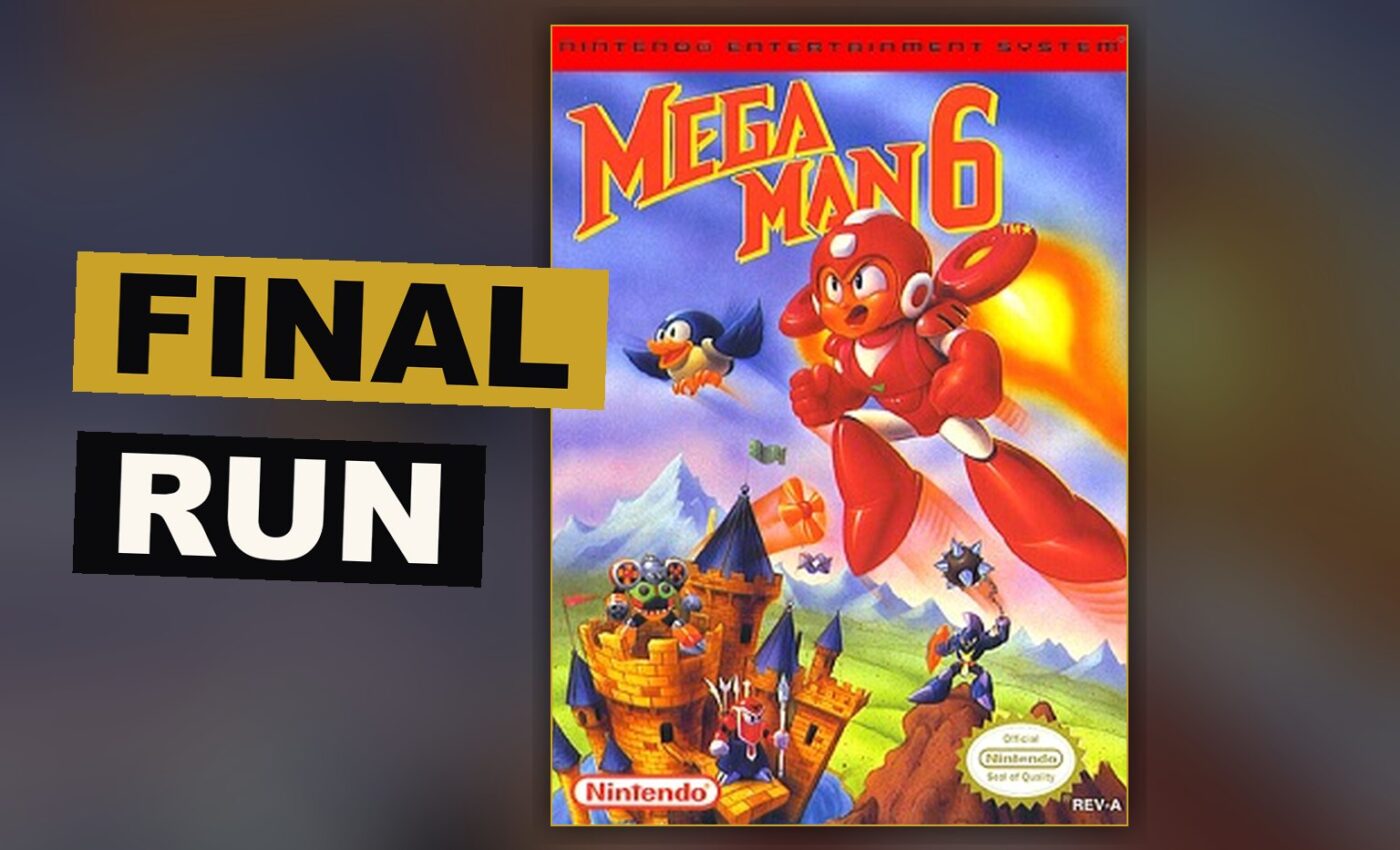
Mega Man 6 landed in 1993, the sixth game in Capcom’s original series, and it holds a strange distinction. It was the last Mega Man game built for the Nintendo Entertainment System, and the last in the series with 8-bit graphics until Mega Man 9 in 2008. Capcom released it in Japan in 1993; Nintendo brought it to North America in 1994.
A Tournament Hosted by a Man Called Mr. X
The story picks up about a year after Mega Man 5. To counter Dr. Wily’s repeated attacks, the Global Robot Alliance formed, and a year later the First Annual Robot Tournament is held to crown the world’s strongest peacekeeping robot. The host is a man known only as Mr. X, leader of the mysterious X Foundation.
Dr. Light, a pacifist, sits the competition out and sends Mega Man to supervise instead. Before the event can begin, Mr. X announces he has reprogrammed eight of the strongest contestants to do his bidding in taking over the world. He names them: Blizzard Man, Centaur Man, Flame Man, Knight Man, Plant Man, Tomahawk Man, Wind Man and Yamato Man. He also claims he had been manipulating Dr. Wily from the beginning.
Eight Robot Masters and a Rerun of a Twist
Mega Man and Rush set out to stop him. You destroy the eight Robot Masters, then fight through Mr. X’s fortress. The villain is beaten and quickly reveals himself as Dr. Wily in disguise. Wily flees to a new stronghold, Mega Man pursues and defeats him again, and the game ends with Dr. Wily brought to justice and sent to prison.
That reveal is the weakest thing in the game. The series has pulled the disguise before, and it lands with a shrug rather than a shock. The eight Robot Masters, at least, are a strong batch.
The Energy Balancer and the Rush Adaptors
Play is largely identical to the five NES predecessors. You take Mega Man through side-scrolling platform stages full of smaller robot enemies and occasional larger mini-bosses. Your main attack is the Mega Buster cannon, which charges for more powerful shots. Each of the first eight stages ends in a boss battle, and a win hands you that Robot Master’s unique Master Weapon.
Those eight levels can be finished in any order, though every Robot Master is weak to one specific Master Weapon. That adds real strategy to the order you pick. Health is a gauge refilled by energy pellets. Extra lives, reserve energy tanks and pellets that refill Master Weapon power are scattered through each level.
Mega Man 6 adds the Energy Balancer, which automatically refills the weapon with the lowest energy when you pick up Master Weapon power. It is a small fix, and it is the best one here.
Flying, Punching, and No Sliding
Earlier games let you call on the transformable dog Rush or use support items to cross difficult parts of a stage. Mega Man 6 swaps that for two Rush Adaptors that fuse Mega Man and Rush into special forms. Jet Mega Man flies upward or hovers briefly, but blocks charge shots. Power Mega Man throws a powerful short-range punch for destroying large blocks.
You cannot slide while using either adaptor. That is a real cost, and it makes the adaptors a trade rather than a straight upgrade. The game also opens up its stage design. Four of the eight stages have two pathways leading to the boss room, less linear than previous entries.
A Late NES Game With Nowhere to Go
Mega Man 6 is the first game in the series to take character design input from fans outside Japan. It is also a game released into a dying market. The NES was losing support, and newer, more powerful hardware had taken over. Capcom built a competent sequel for a console the audience had already left.
That context explains the game’s odd position. It is not a bad Mega Man game. It is a very safe one. The Energy Balancer and the alternate paths are genuine improvements, and the Rush Adaptors at least ask you to give something up. But the structure, the eight bosses, the weakness chain, the fortress run, all of it is the same shape the series has used five times before.
A Solid Farewell to 8-Bit Mega Man
The game later appeared in the Mega Man Anniversary Collection in 2004. Europe and the PAL region did not get it until June 11, 2013, when it hit the Virtual Console on the Nintendo 3DS, nearly twenty years after the original release. That gap tells you how the series was handled outside Japan and North America.
What holds up is the craft. The Robot Master lineup is varied, the Master Weapon weakness system still rewards planning, and the Energy Balancer removes a genuine annoyance without dumbing anything down. What does not hold up is the ambition. The Dr. Wily disguise is a rerun, and the game never takes a risk the previous five had not already taken.
Mega Man 6 is the series saying goodbye to the NES without quite admitting it. It is worth playing for the adaptors and the branching stages. It is not the one to start with.
The Numbers
- Score: 7.2/10
- Released: 1993 in Japan by Capcom; 1994 in North America by Nintendo
- Platform: Nintendo Entertainment System
- Series: Sixth installment in the original Mega Man series
- PAL Virtual Console release: June 11, 2013, on Nintendo 3DS
- Included in: Mega Man Anniversary Collection, 2004
- Modes: Single player
Get the Notebook.
The day's best stories and every fresh verdict, in plain English, in your inbox by seven. One email a day, no more.