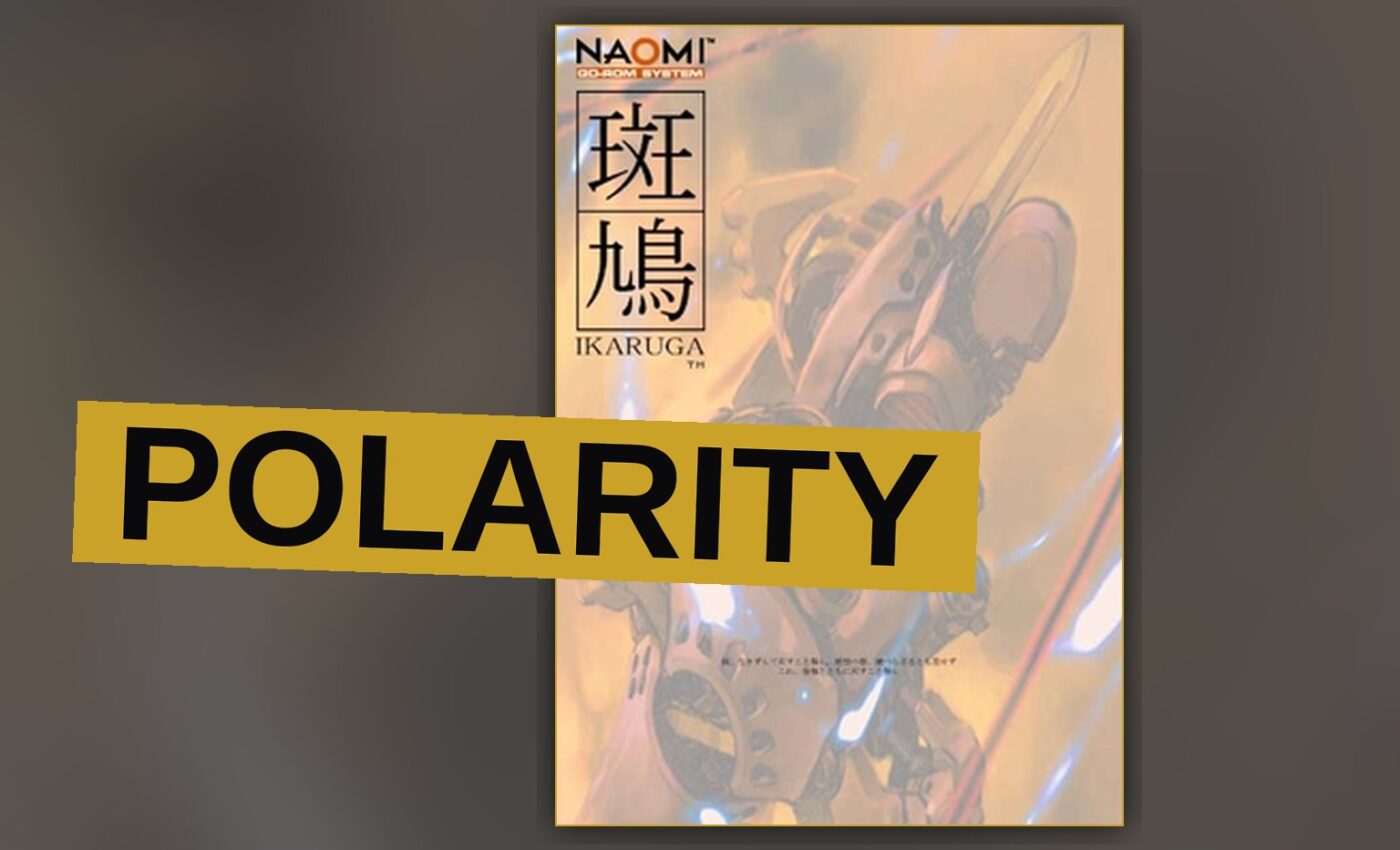
Ikaruga asks one question, over and over, for five stages: are you the same color as the thing flying at your face? Answer wrong and you die. Answer right and you eat the bullet, store it, and spend it later as a homing laser.
Treasure released Ikaruga in Japanese arcades in December 2001. It is a vertical scrolling shooter and the spiritual sequel to Radiant Silvergun (1998). The polarity switch is the whole design, and it carries the game on its own. It holds an 8.9/10 from the IGDB critic aggregate, across 6 outlets.
The polarity switch
The Ikaruga fighter flips between black and white at the press of a button. White ship, white bullets: absorbed, stored, harmless. White ship, black bullets: dead. The reverse holds when you switch. Enemy fighters carry the same two colors, and shooting an opposite-color enemy does double damage.
That is the whole game. There are no pick-ups and no power-ups. Your only tools are a standard shot and a homing laser, and the laser is built entirely from bullets you absorbed. Every ten enemy bullets absorbed raises the homing laser one level, up to a maximum of 12 stored. One homing laser hits ten times harder than a standard shot.
So the game punishes cowardice and rewards nerve. You cannot hang back and plink. You have to fly into the fire of your own color to build the weapon that kills everything else.
Chaining, and the cost of a mistake
Ikaruga’s scoring runs on chains. Destroy three enemy fighters of the same color in a row and you earn a chain bonus. The first bonus is 100 points, and each one after doubles. The multiplier climbs to a maximum of 25,600.
That number is where the game gets its teeth. A chain is fragile. Break the color sequence, or switch polarity a beat too fast, and the energy a dying ship expels can kill you instead of feeding you. The game does not offer a soft landing. It offers a decision, then charges you for it.
The structure is tight:
- Five stages
- Three difficulty levels
- Single-player and two-player co-op
Difficulty settings change how polarized points behave and how they appear, which means the game is not simply harder or easier at the top end. It is a different problem.
Shinra and the island of Horai
The story is thinner than the system, and that is fine. Shinra is a rebel pilot, the lone survivor of a freedom federation called The Tenkaku, which was nearly wiped out fighting the island nation of Horai. Villagers who had been exiled by Horai’s conquests pulled him from his wreckage and nursed him back.
They also handed him the Ikaruga, a fighter built by the engineer Amanai with help from the village leader Kazamori. It is the first ship designed with both energy polarities and the ability to switch between them. It launches from a hidden bunker by way of a device called The Sword of Acala.
Shinra fights across the five stages and eventually faces Tenro Horai, the leader who dug the Ubusunagami Okinokai — the Power of the Gods — out of the ground and used it to conquer nation after nation in the name of peace. He destroys her ship and kills her. The octahedron inside is released, and it looks a great deal like the Stone-Like from Radiant Silvergun.
That is the whole plot, and it is enough. The polarity mechanic is the argument. The story is the label on the box.
What Treasure actually built
Development started as “Project RS2” during director Hiroshi Iuchi’s off-hours, while Treasure was busy with Sin and Punishment (2000). The polarity idea was borrowed from Treasure’s own Silhouette Mirage (1997). Iuchi directed Ikaruga and composed its soundtrack.
During the prototype stages, the player’s ammo was limited, and bullet absorption existed as a means to refill it. That was found to be weak, because it created too many breaks in the action. Absorption was later added as an additional mode in the home ports, while the absorption loop became the point of the main game. That is the rare case of a studio finding the better game inside the worse one and having the sense to follow it.
Treasure built Ikaruga to challenge the conventions of standard game design, and the result is a shooter with no fat on it. Nothing here is decorative. The color of a bullet is a rule, not a look.
Where it stands
Ikaruga does something most shooters never attempt: it makes the player’s own ammunition the reward for correct positioning, then makes correct positioning a live gamble rather than a safe habit. Absorbing a screen full of white bullets while flying a white ship is not a defensive act. It is the most aggressive thing you can do.
The games in this lineage sit in a clear order of ambition:
- Radiant Silvergun — the larger, looser predecessor
- Silhouette Mirage — the source of the polarity mechanic
- Ikaruga — the game that made the mechanic the whole design
Ikaruga compresses where Radiant Silvergun sprawls. Five stages, three difficulties, one button that changes everything, and a scoring ceiling at 25,600 that most players will never reach.
The weakness is real and worth naming: the story never rises to the level of the system. That flaw does not touch the core. The polarity switch is the entire design.
Get the Notebook.
The day's best stories and every fresh verdict, in plain English, in your inbox by seven. One email a day, no more.