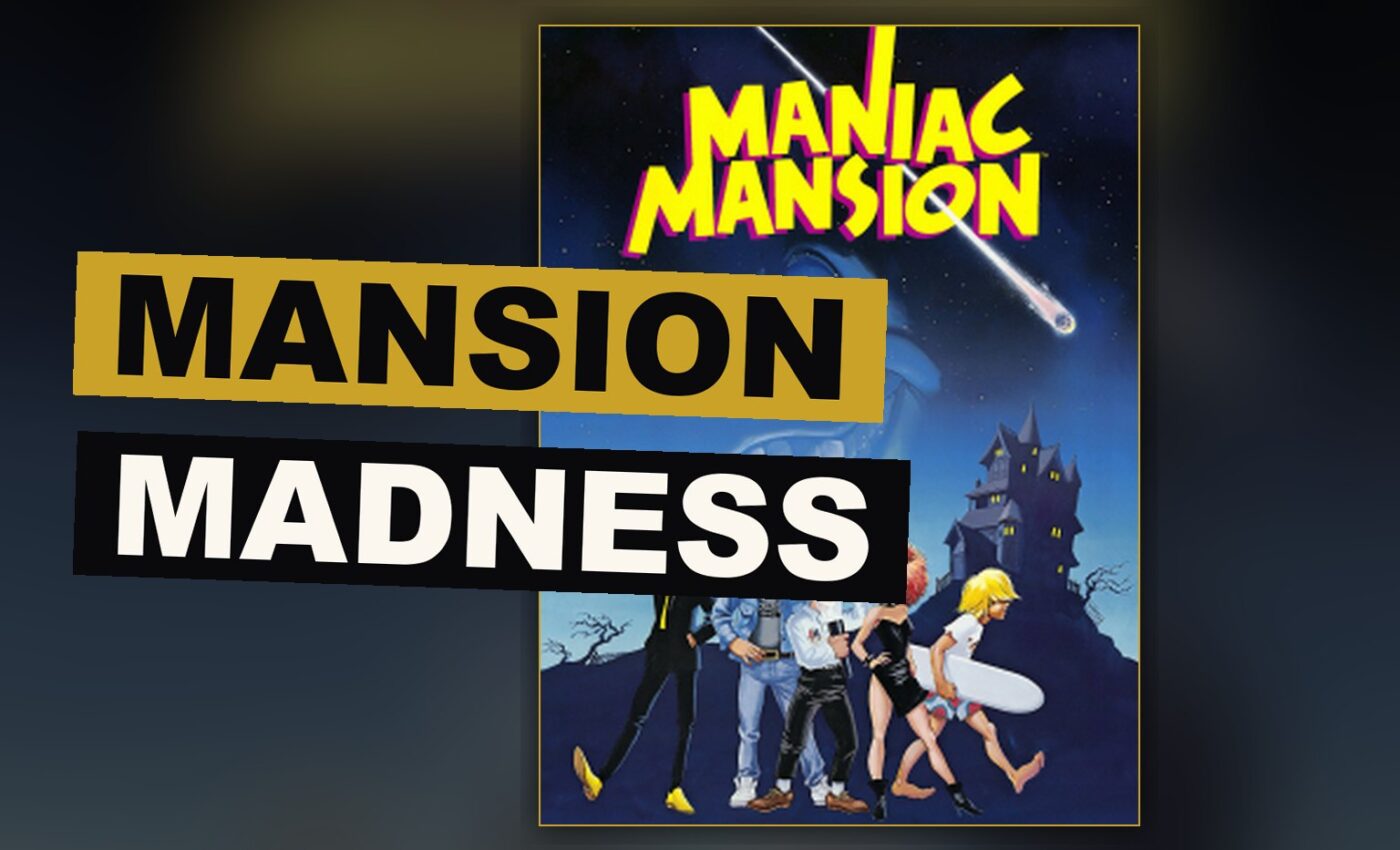
Maniac Mansion arrived on the Nintendo Entertainment System as a game that had already been through the wringer. Lucasfilm Games first released it in 1987 for the Commodore 64 and Apple II, and it became the studio’s first self-published product. After that release, it was ported to several platforms, among them the Atari ST, PC (Microsoft Windows), Mac, DOS, and Amiga. A port for the Nintendo Entertainment System had to be reworked heavily, in response to Nintendo of America’s concerns that the game was inappropriate for children. That tension — a horror-comedy about brain harvesting squeezed onto a family console — is the whole story of that port.
A Meteor, a Mad Scientist, and Sandy Pantz
The setup is pure B-movie. A sentient meteor crashed near the Edison mansion twenty years before the game begins. It brainwashed the Edison family and directed Dr. Fred, a mad scientist, to collect human brains for experiments. Dave Miller, the teenage protagonist, enters the mansion to rescue his girlfriend, Sandy Pantz, who Dr. Fred has kidnapped.
Living with the Edisons are Nurse Edna, Dr. Fred’s wife, their son Weird Ed, and two large disembodied tentacles, one purple and one green. Every inhabitant except the green tentacle is hostile. If they see a player character, they throw the character into the dungeon or, in some situations, kill them outright. When a character dies, the player must choose a replacement from the unselected characters. If all characters die, the game ends.
That structure — death as a roster problem rather than a game-over screen — is the smartest thing Maniac Mansion does. It keeps the pressure on without punishing the player into a restart.
Six Kids, Fifteen Verbs, One Mansion
The player picks two of six characters to accompany Dave: Bernard, Jeff, Michael, Razor, Syd, and Wendy. Each has unique abilities. Syd and Razor can play musical instruments. Bernard can repair appliances. The game can be finished with any combination, but many puzzles are solvable only by certain characters, so different paths open based on who the player brings.
The interface is a point-and-click system with fifteen action commands, including “Walk To” and “Unlock,” selected from a menu on the lower half of the screen. Ron Gilbert developed this as a replacement for the command-line systems earlier adventure titles relied on. He disliked those systems, and the simpler interface is the reason Maniac Mansion still feels playable decades later.
Gilbert conceived the game in 1985 with Gary Winnick. The two wanted a comedic story built on horror film and B-movie clichés. They mapped the project out as a paper-and-pencil game before coding began. To speed production, Gilbert built a game engine called SCUMM, which was used in many later LucasArts titles.
Maniac Mansion features cutscenes, a word coined by Ron Gilbert, that interrupt gameplay to advance the story and inform the player about offscreen events.
What the Rework Changes
The rework for Nintendo of America is the part that matters most for anyone picking up that version specifically. Nintendo was worried the game was inappropriate for children, and the port was changed heavily in response. What survives is still recognizably Maniac Mansion — the Edisons, the tentacles, the meteor, the brain experiments — but the edges have been sanded.
That sanding cuts against the game’s best instincts. Maniac Mansion works because it is a little mean. The mansion’s residents are hostile by default. Characters die. The player has to manage a shrinking roster and pick replacements on the fly. A version softened for a younger audience loses some of that friction, and friction is where the comedy and the tension both live.
The reworked port also asks the player to accept the game’s logic on its own terms. This is a two-dimensional world viewed from the side, and the fifteen-command menu is doing a lot of work. It is not a fast game. It is a game about walking to things and unlocking things and figuring out which of your two chosen kids is the one who can actually solve the problem in front of you.
Five Endings and a Reason to Replay
Maniac Mansion has five possible endings, determined by which characters are chosen, which survive, and what the characters accomplish. That is a lot of outcome for a 1987 adventure game, and it is the clearest argument for the game’s lasting reputation.
Nonlinear design was not the norm for the genre at the time. Maniac Mansion builds a mansion full of puzzles and lets the player’s roster decisions determine which ones are even reachable. Pick Bernard and you can repair appliances. Pick Syd or Razor and you can play instruments. Pick the wrong pair and you may find a puzzle you cannot solve, which forces a different route through the house.
The cutscenes interrupt play to advance the story and tell the player about things happening offscreen. Gilbert coined the word. The technique is standard now. In 1987 it was a way to keep a nonlinear game coherent, and it works.
The Edison House Holds Up
The mansion itself is the game’s real achievement. Dr. Fred, Nurse Edna, and Weird Ed are broad sketches, but they are specific broad sketches. The purple tentacle and the green tentacle give the house a lived-in weirdness. The green tentacle’s refusal to be hostile stands out against the rest of the house, and the contrast makes the other residents land harder.
The game’s themes run across fantasy, science fiction, horror, and comedy at once. That mix is not a marketing line. It is the actual texture of the thing. A sentient meteor enslaving a family and demanding human brains is a horror premise. The execution — a mad scientist, his nurse wife, his weird son, two tentacles — is comedy. Maniac Mansion never resolves that tension. It just keeps both running.
The single-player, side-view structure keeps the focus tight. There is no second player to blame. There is a house, a menu of verbs, and the constant risk that one of your characters gets seen.
Why the Score Lands at 8.3
Maniac Mansion earns its reputation on design, not polish. The point-and-click interface that Gilbert built to replace command lines became the template for a generation of adventure games. SCUMM was used in many later LucasArts titles. The five endings and the character-dependent puzzle paths gave players a reason to come back that most 1987 releases could not match.
The reworked port, in this paper’s view, is the weakest way to play it. The heavy changes made for Nintendo of America sand off some of the edge that makes the original work, and the console’s limits do the mansion no favors. But the bones are intact. Dave Miller still walks into that house. Sandy Pantz still needs rescuing. Dr. Fred still wants brains, and the meteor is still pulling the strings.
The menu-driven interface is elegant for its time but slow in practice. The nonlinear structure can strand a player who picked the wrong pair of kids, and the replacement-character system, while clever, does not fully solve that problem. Maniac Mansion is a game you admire as much as you enjoy.
Still, the admiration is earned. This is Lucasfilm Games’ first self-published product, and SCUMM went on to power many later LucasArts titles. The horror-comedy blend is specific and confident. The Edison family, the tentacles, the meteor, the brains — it all coheres into something no one else was making in 1987.
For anyone who wants to understand where the point-and-click adventure came from, Maniac Mansion is required reading. For everyone else, it is a strange, funny, occasionally cruel house that is still worth walking into.
Get the Notebook.
The day's best stories and every fresh verdict, in plain English, in your inbox by seven. One email a day, no more.