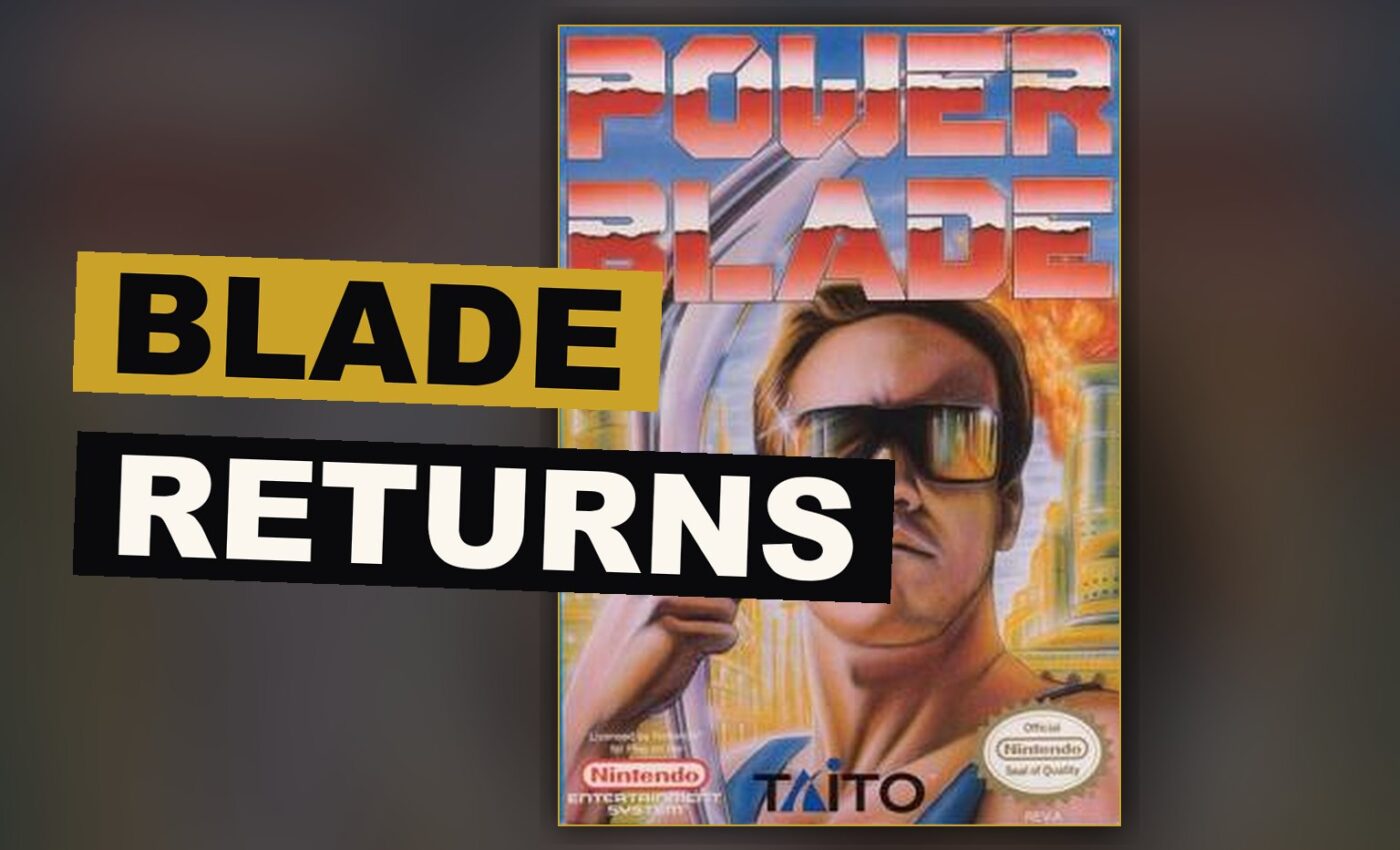
Power Blade is a game about a man with a boomerang, and it is better than that sounds. Taito published it for the Nintendo Entertainment System, and it landed in North America in March 1991 after a Japanese release on April 20, 1990 under the name Power Blazer. Europe got it on January 23, 1992. A sequel, Power Blade 2, followed in 1992.
Nova Reports for Duty in 2191
The setting is the colony of New Earth in the year 2191. The planet is recovering from revolts that cost millions of casualties, and it runs on a supercomputer called the Master Computer. That machine holds a secret database of the colony’s functioning — data that would prove fatal to the whole planet in the wrong hands.
Aliens attack the Master Computer and make its control program malfunction. Nova, described as the Chief Security Officer of the Master Computer and a lord of the ancient Power Blade, is summoned to fix it. His weapon is the Power Blade itself, a glowing energy boomerang he uses to defend himself.
The setup is thin, but it does the job. It gives the player a reason to move left to right and a reason to care about the six things he has to collect.
Six Tapes, Six Sectors
To reach the Master Computer’s Control Center, Nova has to pull tape units out of the six sectors surrounding it. Each sector is heavily guarded by aliens. In each one, Nova must first find and contact an agent, who gives him an ID card. That card gets him into the sector’s security room. There he fights a security guard — the boss — and only after beating that guard does he get the tape unit and disarm the sector.
Once all six sectors are disarmed, the Control Center opens. Nova fights through it, destroys the alien overlord, and restores the Master Computer.
That structure is the whole game, and it is a good one. The six sectors can be played in any order through a stage select screen. That freedom is the same hook the Mega Man series built its reputation on, and Power Blade uses it well. You pick a sector, you learn its layout, you find the agent, you beat the guard, you take the tape.
A Boomerang That Fires in Eight Directions
The player controls Nova in a two-dimensional platforming environment. The boomerang fires in all eight directions, and that is a rarity for NES and Famicom platform games of the era. Most games in the genre ask you to aim forward, or forward and up. Power Blade asks you to aim everywhere.
Throughout each sector, power-ups upgrade the boomerang’s power, its range, and how many of them you can throw. Nova also has a life meter. It drops every time an enemy hits him. He loses a life when the meter runs out, when he falls into a pit, or when the timer runs out. Lose all your lives and the game ends — but there is a continue feature that restarts you at the beginning of the level where you died.
There is also a password feature. It lets you restart at a specific checkpoint at any time, which matters more than it sounds for a game built on six separate stages.
The Helmet That Changes the Game
The game’s name comes from an item hidden in several levels. The Power Suit looks like a helmet. Pick it up and Nova automatically equips the metal suit. In the suit, he can shoot energy blasts called Power Blades in any of the eight directions, and through most surfaces.
This is the best idea in Power Blade. The suit changes the game from careful positioning to something closer to a shooter. It turns the boomerang’s arc into a straight line that ignores walls. The item is not guaranteed, and that is the point — finding it feels like a reward rather than a checkpoint.
Fall Off the Screen and You Die
One mechanic separates Power Blade from both Power Blazer and Power Blade 2. In Power Blade, if you fall off the screen, you die. The other two games do not do this.
It is a small rule with a large effect. It makes the platforming mean something. It also makes the game harsher than its sequel, and harsher than the version it was built from. Whether that is a feature or a flaw depends on what you want from a 1991 platformer. This paper’s view: it is a flaw, but a defensible one. The punishment is consistent, and the levels are built to be read.
Where the Six Sectors Blur Together
The problems are the problems of the era, and Power Blade does not solve them.
The plot is delivered in a summary that reads like a manual, not a story. Nova is a lord of an ancient Power Blade and the Chief Security Officer of a supercomputer, and the game never explains how those two jobs fit together. The aliens are aliens. The Master Computer is a machine. There is no character here, only a mission statement.
The bigger issue is that the six sectors do not distinguish themselves enough. The stage select screen promises variety, and the game delivers six versions of the same idea: find the agent, find the security room, beat the guard, take the tape. The boomerang’s eight directions and the Power Suit are strong enough to carry a playthrough. They are not strong enough to make each sector feel like its own place.
What Power Blade Earns
Power Blade is a good NES platformer that never became a great one. Its best mechanic — a boomerang you can throw in any direction — was genuinely uncommon in 1991, and the Power Suit is a smart escalation on top of it. The six-sector structure gives players real choice, the password system respects their time, and the continue feature is generous.
Against that: a story with no people in it, six stages that blur together, and a pit-death rule that punishes harder than the sequel does. The game is remembered, when it is remembered, as a solid rental rather than a classic. That reputation is fair.
The 6.2 out of 10 is the right number. Power Blade sits just above average and just below memorable. Play it for the boomerang. Stay for the Power Suit. Do not expect the sectors to surprise you twice.
The Hard Numbers
- Title: Power Blade (Japan: Power Blazer)
- Developer/Publisher: Taito (published by Nintendo and Taito)
- Platforms: Arcade, Nintendo Entertainment System
- Genre: Action platformer, single player
- Release date, Japan: April 20, 1990
- Release date, North America: March 1991
- Release date, Europe: January 23, 1992
- Sequel: Power Blade 2, released 1992
- Setting: New Earth, year 2191
- Protagonist: Nova, Chief Security Officer of the Master Computer
- Structure: Six sectors, playable in any order
- Critical score: 6.2/10 (IMDb)
The boomerang is the reason to load this cartridge. Everything around it — the six tapes, the agents, the security guards, the alien overlord waiting in the Control Center — is scaffolding for a weapon that lets you aim in eight directions when most games of its day let you aim in one. That is the whole case for Power Blade, and it is a decent case. It is not a strong enough case to lift the game above its 6.2, and nothing in the six sectors tries to make it one.
Get the Notebook.
The day's best stories and every fresh verdict, in plain English, in your inbox by seven. One email a day, no more.