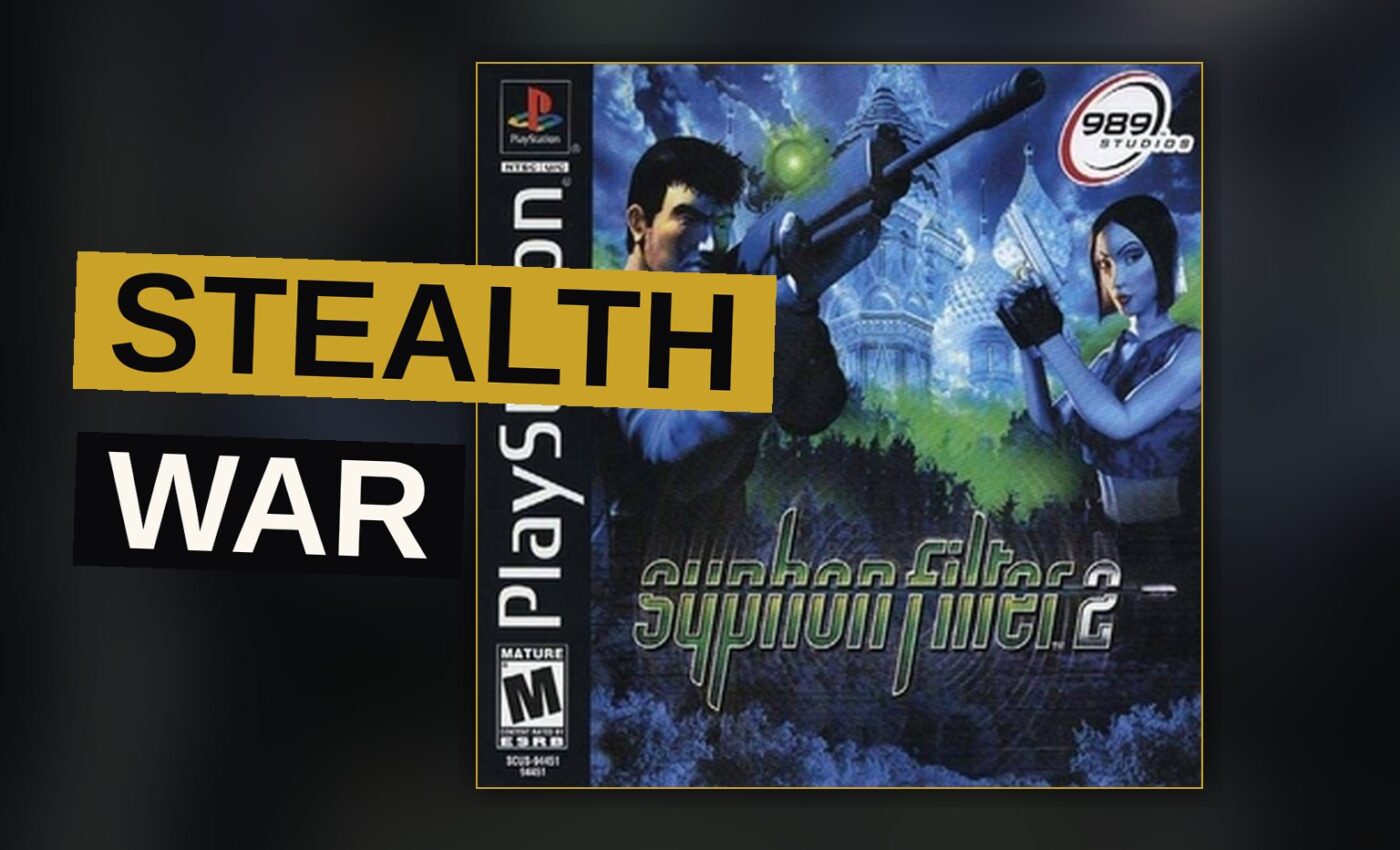
Syphon Filter 2 drops Nathan Hale into a war zone, and it does not waste time doing it. The sequel to the original PlayStation stealth hit picks up Hale’s story after his escape from the terrorist group Sceptron, and it hands him a new mission: stop a global conspiracy before it destroys the world. The game was released in 1998, and it remains one of the strongest entries in the stealth genre on the platform.
The setup is simple on paper. Hale works for the CIA’s Special Activities Division, and he has a knack for getting into trouble that requires a sniper rifle and a silenced pistol to resolve. Syphon Filter 2 builds on that formula by widening the scope. The threat is no longer a single villain but a shadowy network pulling strings across multiple countries. The result is a game that asks players to move through crowded streets, avoid security cameras, and eliminate targets without being spotted.
Hale’s Tools
Nathan Hale moves through the game with a set of tools that feel natural from the start. He carries a silenced pistol for close encounters, a sniper rifle for distant ones, and a selection of grenades for clearing rooms. The weapons handle well, and the game rewards patience over brute force. Enemies react to sound, so a noisy approach can draw attention from nearby guards.
Stealth is the core of Syphon Filter 2, and the game understands that balance. Players can rush in and kill everything, but the game punishes that choice with alarms, reinforcements, and a higher risk of failure. The tension comes from choosing between a quick kill and a quiet approach. Hale can knock out enemies with a stun gun, pick locks with a small tool kit, and use his disguise to walk past checkpoints. Each level offers multiple paths, and the game rarely forces a single solution.
The disguise system deserves special note. Hale can switch between several outfits, each suited to a different setting. A business suit gets him through a corporate building. A construction worker outfit gets him past a construction site. A military uniform gets him past a checkpoint. Switching between these disguises mid-level is a clever way to solve puzzles, and it adds depth to missions that would otherwise be linear.
Levels That Matter
The levels in Syphon Filter 2 vary widely in tone and design, and they reward exploration. Some stages are open maps where players must find a hidden objective while avoiding detection. Others are tight corridors where a single mistake triggers an alarm. The best levels mix both elements, forcing players to weigh speed against stealth in real time.
The game’s pacing is strong. Missions rarely drag, and the difficulty curve stays fair. Early levels ease players into the mechanics, while later stages demand precise planning. Boss fights break up the pacing without feeling tacked on. They are set apart from standard levels and ask players to adapt tactics to a larger, more aggressive opponent.
The environments themselves are detailed for the time. Buildings have distinct textures, lighting changes with the time of day, and sound effects add weight to footsteps and gunfire. The game runs at a steady frame rate, and the camera rarely causes problems during fast movement.
Sound Design
Sound is a key part of Syphon Filter 2’s identity. Footsteps echo through empty hallways, alarms ring when players are discovered, and the crack of a silenced pistol carries weight. The score shifts between tense music and quieter ambient tracks, depending on the situation. This attention to audio detail makes the game feel alive even when the screen is mostly dark.
The voice acting is solid, particularly for a game from this era. Hale’s lines carry conviction, and the supporting cast delivers believable performances. The script leans on exposition to set up the plot, but it does not overstay its welcome. The story moves at a brisk pace, introducing new characters and locations without losing focus on the mission at hand.
Where It Falls Short
No game is perfect, and Syphon Filter 2 shows its age in a few areas. The enemy AI is competent but not revolutionary. Guards follow predictable patterns, and some scripted events feel dated. The game also lacks a multiplayer mode, which limits replay value for players who want to test their skills against others.
Some levels rely too heavily on scripted sequences. These sections remove player agency by forcing Hale to watch a cinematic event before proceeding. While these moments serve the story, they break the flow of a mission that otherwise encourages exploration. The game also does not offer much in the way of branching paths beyond the main route, which can frustrate players looking for a second playthrough.
These flaws are minor compared to the strengths. The core gameplay remains engaging, and the overall package holds up as a standout entry in the stealth genre.
The Final Mission
The campaign builds toward a finale that brings together the threads of Hale’s investigation. The final mission is tense, well-designed, and a fitting end to the story. It rewards players who have mastered the earlier levels, and it leaves the door open for future installments.
The ending ties the conspiracy together in a satisfying way, and it sets up a clear path forward for Hale’s character. It does not resolve every question, but it provides closure on the central conflict. The game ends on a note of anticipation, which is a rare quality in a sequel.
“Hale’s mission is not over.”
That line captures the spirit of the finale. It is a promise of more to come, and it leaves players wanting to know what happens next.
Legacy and Replay Value
Syphon Filter 2 was influential for its time. It raised the bar for stealth games on the PlayStation, and it influenced developers working on similar titles. The game’s success led to a series of sequels, each expanding on the ideas introduced here. Its influence can be seen in later stealth games that adopted similar disguise systems and level design.
The game holds up well as a standalone experience. Players who enjoyed the first Syphon Filter will find more of the same, improved in nearly every way. New players approaching the game for the first time will appreciate its pacing and design. The game is worth playing for anyone interested in stealth games, regardless of prior knowledge of the series.
Final Score
Syphon Filter 2 earns an 8.9 out of 10. It is a polished, confident sequel that improves on its predecessor in nearly every regard. The stealth gameplay is sharp, the levels are varied, and the presentation is strong. It is not a perfect game, but it is a very good one.
The game succeeds because it respects the player’s intelligence. It trusts players to think through situations, and it rewards careful planning. It does not hold the player’s hand, and it does not punish curiosity. That trust is rare in games from this era, and it makes Syphon Filter 2 stand out.
The game’s strengths outweigh its weaknesses. The disguise system, the level design, and the pacing all contribute to a rewarding experience. It is a game that rewards repeated playthroughs, and it remains a worthy addition to any collection.
Syphon Filter 2 is a strong entry in the stealth genre, and it deserves recognition for its lasting influence. It is a game that rewards patience, precision, and careful thought. It is a game that holds up as a classic of the PlayStation era. It is a game worth playing.