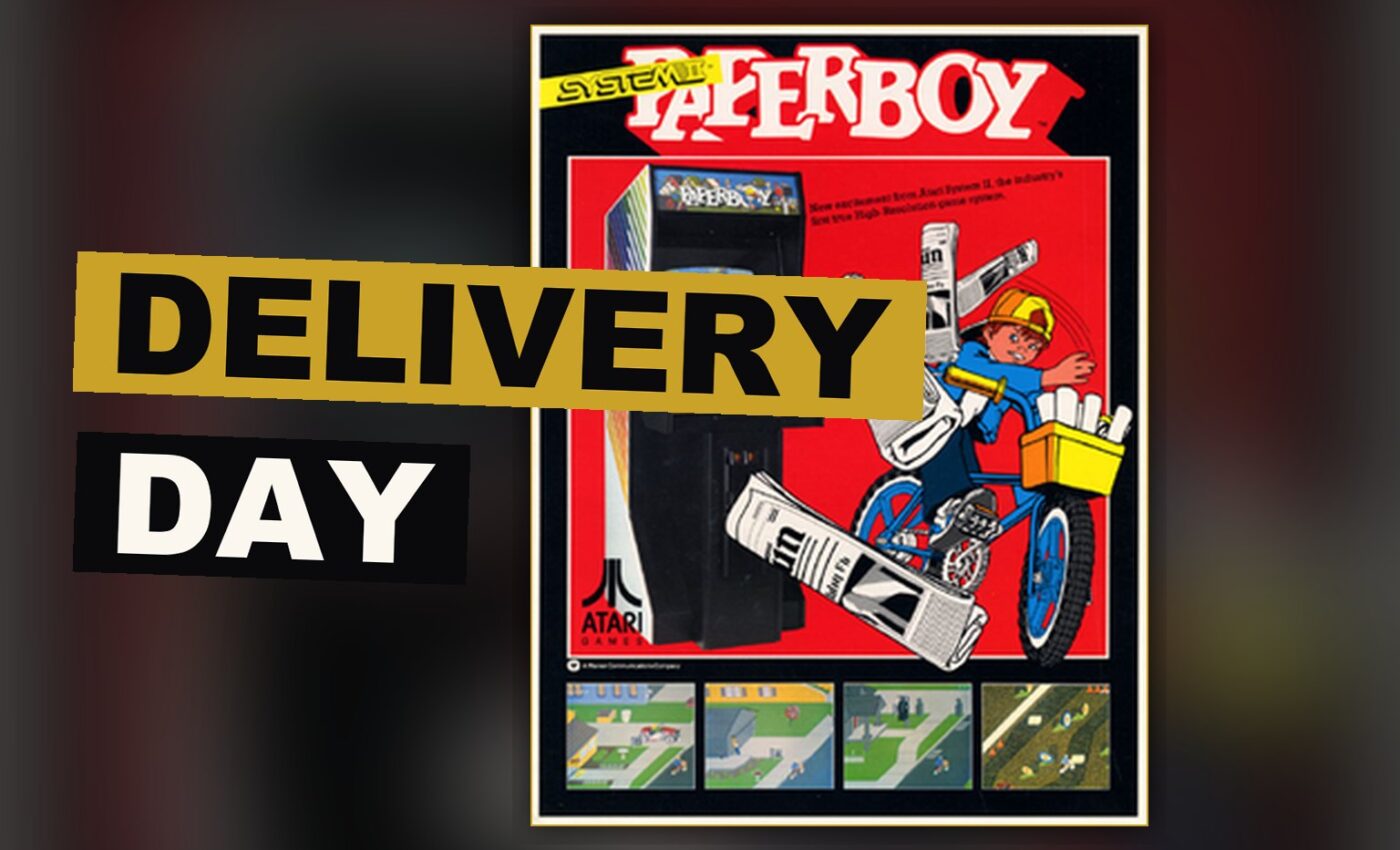
Paperboy for the Nintendo 64 is a strange beast. High Voltage Software built it, Midway published it, and it arrived in 1999 as a 3D remake of a 1985 arcade game that was itself a study in simple, punishing design. The original Atari Games cabinet put you behind a set of bike handlebars and asked you to throw newspapers at subscribers’ houses without hitting cars, skateboarders, or rolling tires. The N64 version keeps that premise and rebuilds it in three dimensions.
Easy Street, Middle Road, and Hard Way
The structure is lifted straight from the arcade game. You pick one of three difficulty settings before the route begins: Easy Street, Middle Road, or Hard Way. The last two double or triple every point value, so the game rewards you for choosing a harder route but punishes every mistake more severely.
The street holds 20 houses. Ten of them start out decorated in bright colors, and those are your subscribers. Your job is to get a paper onto the front porch or into the mailbox. Miss the house, or damage it, and that subscriber cancels.
That is the whole loop, and it has not aged badly. The N64 version renders the street in a bird’s-eye and isometric perspective, so you can see the houses, the obstacles, and the paper bundles lying on the ground ahead of you. The original arcade game used an oblique projection view. The shift to a fuller 3D space changes how you read the road, but the tension is the same: you are always running out of papers and always deciding which house deserves the throw.
Cars, Skateboarders, and Rolling Tires
The obstacles are the game’s real antagonist. Cars, skateboarders, and rolling tires all move through the street, and crashing into any of them costs you a life. The N64 version keeps that rule intact. What it adds is a clearer sense of space.
In the arcade original, a car could appear almost without warning because of the flat perspective. Here, you can see it coming, which makes the game fairer but also less frantic. That trade-off defines the whole remake. High Voltage Software did not simply port the arcade game. The studio rebuilt it as a 3D version of the arcade classic, and that decision cuts both ways.
The Daily Sun and the Training Course
After you finish the route, Paperboy sends you to a training course. There, you have an unlimited supply of papers and can earn points by hitting targets and using ramps to jump over walls, ditches, and holes. Crashing on the route costs a life. Crashing on the training course ends it immediately without penalty.
That distinction matters. The route is the test; the training course is the reward, a chance to cut loose without losing anything. The bonus structure ties the two halves together. After the training course, you earn bonus points for each successful delivery and move to the next level. Deliver every paper on a route and the bonus doubles, plus one new subscriber joins the route, up to a maximum of 10.
Let a subscriber go without a paper, or damage their house, and they cancel. The system is elegant. It gives you a reason to care about accuracy rather than just survival, and it scales the difficulty by adding subscribers rather than by simply speeding everything up.
Damaging Houses on Purpose
Here is where Paperboy gets interesting. The game awards bonus points for damaging non-subscribers’ houses. You can break windows. You can knock over tombstones. You can hit certain obstacles with papers and score for it.
The game is not just asking you to be accurate. It is asking you to be accurate toward the people who pay you and destructive toward the people who do not. That is a small, mean joke at the center of a game about a kid on a bicycle, and the N64 version keeps it. It is also the clearest sign that Paperboy understands its own tone.
Paperboy 2 and the Limits of the Remake
The original Paperboy was ported widely to home systems starting in 1986, and it got a sequel, Paperboy 2, in 1991. That sequel was exclusive to computers and consoles, which means the arcade line stopped at one game. The N64 version is not continuing a series. It is revisiting a single idea.
That is both its strength and its problem. The 3D perspective and the isometric view are real changes. The training course gives the game a second mode that the arcade original also had. What the remake does not do is find a new reason for Paperboy to exist beyond nostalgia and a cleaner camera.
A Comparison of the Two Versions
| Feature | Arcade Paperboy (1985) | N64 Paperboy (1999) |
|---|---|---|
| Developer | Atari Games | High Voltage Software |
| Publisher | Atari Games | Midway |
| Perspective | Oblique projection | Bird view / isometric |
| Controller | Bike handlebars | Standard controller |
| Difficulty settings | Easy Street, Middle Road, Hard Way | Easy Street, Middle Road, Hard Way |
| Route length | 20 houses, 10 subscribers | 20 houses, 10 subscribers |
| Training course | Yes | Yes |
The table shows how little the core design moved. The houses, the subscribers, the difficulty names, and the training course are all carried over. What changed is the technology around them.
What the Remake Gets Right
The N64 version’s best decision is that it does not try to fix what was not broken. The 20-house route, the bright-colored subscriber houses, the paper bundles on the ground, the limited supply of papers, the bonus for damaging non-subscribers’ property, the subscriber cap of 10, the doubled bonus for perfect delivery — all of it survives.
A player who knew the arcade game can sit down with this one and understand it immediately. The bird’s-eye and isometric view is the right call for a home console. It gives you more information than the arcade’s oblique angle, and it suits a controller that is not shaped like handlebars. The game is readable. You can plan a throw. You can see the car before it hits you.
Where the N64 Version Slows Down
The cost of that readability is speed. The arcade game was built around a controller you gripped like a bike, and the flat view made every obstacle a sudden event. The N64 version trades that suddenness for clarity, and Paperboy is a game that lives on suddenness. When you can see the skateboarder coming from far off, the street stops feeling dangerous.
The training course is also thinner than it should be. It is a nice break from the route, and the unlimited papers are a relief, but it is not a mode you will return to on its own. It exists to feed points back into the main game, and that is all it does.
The Score
Paperboy for the Nintendo 64 is a faithful remake of a game that did not need much remaking. High Voltage Software kept the route, the subscribers, the scoring, and the meanness, and Midway put it out on a console that could finally render the street in three dimensions. The result is cleaner and easier to read than the 1985 original, and slightly less thrilling because of it.
That is not a fatal problem. The game is still about the same thing: a kid on a bike, a street full of hazards, and a stack of papers that will run out before the route does. The 3D view makes the deliveries feel more deliberate. The training course gives you a place to breathe. And the bonus for breaking a non-subscriber’s window is still there, still petty, still funny.
Paperboy earns its place as a competent revisit of an arcade classic. It does not surpass the original, and it does not try to. It takes a 1985 idea and gives it a 1999 camera. That is enough.
Get the Notebook.
The day's best stories and every fresh verdict, in plain English, in your inbox by seven. One email a day, no more.