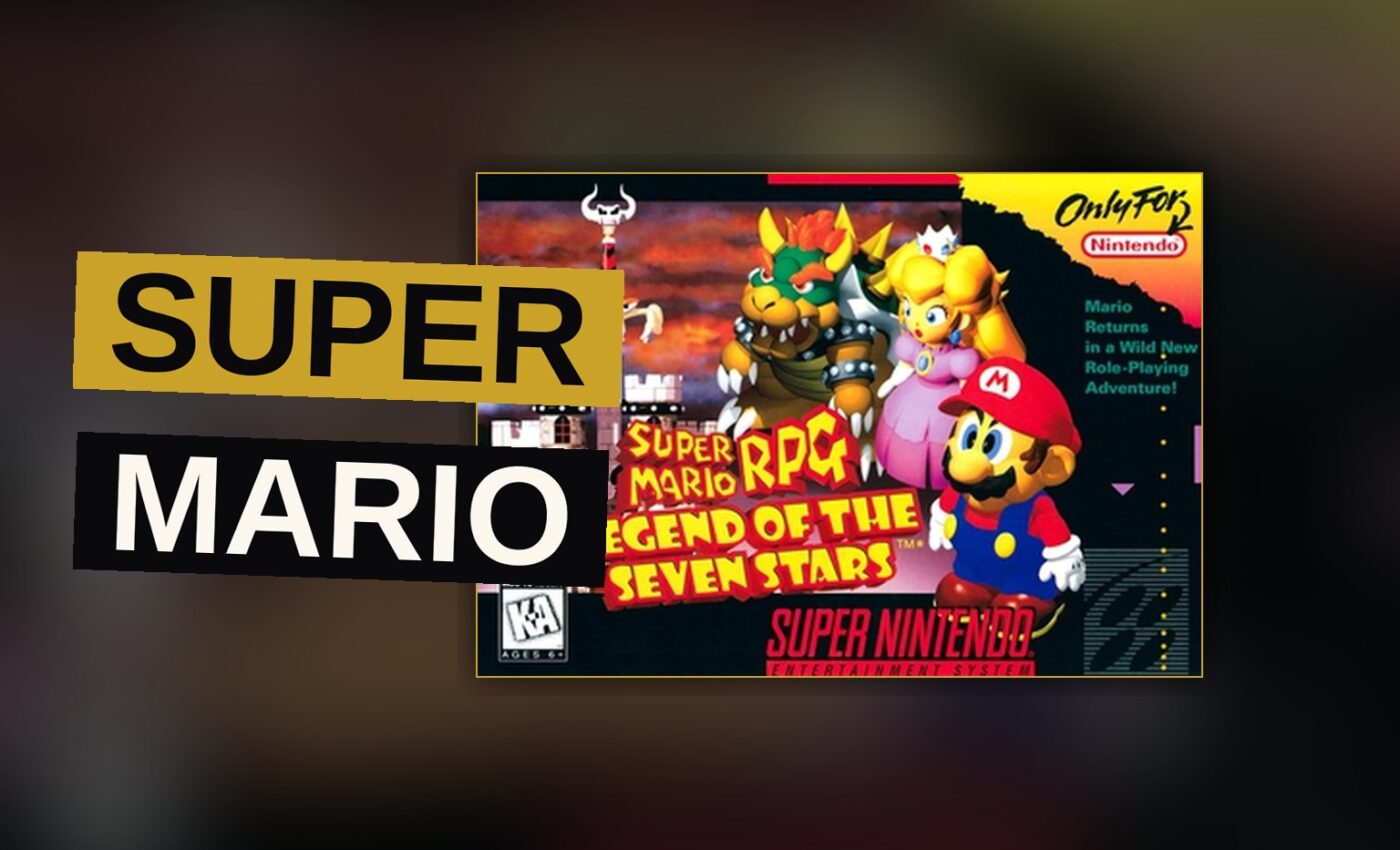
Super Mario RPG: Legend of the Seven Stars landed on the Super Nintendo Entertainment System in 1996 as a real oddity: a Mario game built by Square, the studio behind Final Fantasy, and published by Nintendo. It is a role-playing game with a bird’s-eye view, a single-player structure, and a premise that puts Mario and Bowser on the same side for the first time. It earns an 8.4 out of 10.
Smithy Wrecks the Star Road
The setup starts where Mario games usually end. Mario sets out to rescue Princess Toadstool from Bowser, the familiar scenario the game leans on before it pulls the floor out. A new enemy named Smithy appears, an otherworldly entity who hijacks Bowser’s castle and throws the Mushroom Kingdom into disarray.
Smithy’s damage is specific. He destroys the Star Road, the pathway that grants people’s wishes. That single act reframes the whole quest. Mario is not chasing a kidnapped princess through a run of platforming stages. He is repairing infrastructure — collecting stars to restore the road so that wishes can function again.
It is a strange, almost bureaucratic goal for a Mario story, and it works because the game treats it seriously without losing its sense of comedy.
Bowser Fights on Mario’s Side
The alliance is the headline. Mario and Bowser are forced to fight as allies for the first time in their long history, and the game gets real mileage out of the pairing. Bowser is not a reformed villain here. He is a proud king whose castle got stolen by a bigger problem, and the arrangement is one of convenience on both sides.
Mario also meets many unlikely allies on the journey, characters whose unique abilities are needed to take on Smithy and his gang. The source describes this as a cast assembled for function as much as for charm: each recruit brings something the party cannot do without.
That structure is standard role-playing practice, but Super Mario RPG: Legend of the Seven Stars applies it to a franchise that had spent a decade teaching players that Mario works alone. The shift lands.
Expert Timing and Strategy
Combat is where the game separates itself from its genre peers. The source describes a mix of obstacles requiring both expert timing and strategy to overcome. That combination is the core mechanic: turn-based battles that still ask for input at the right moment, so a player cannot simply select an attack and look away.
Along the way, the party gains experience and grows more powerful. The progression is conventional. The execution is not, because the timing layer keeps every fight active in a way that most role-playing games of the era did not attempt.
The result is a game that respects the reflexes Mario players already had while asking them to learn a new vocabulary of menus and stats.
A Wide Variety of Locations
The quest moves across a wide variety of locations, and the game uses the Mushroom Kingdom as a foundation rather than a ceiling. The source places the adventure in the Mushroom Kingdom and features its cast of well-known characters, which gives the game a recognizable spine while Smithy’s invasion supplies the disruption.
What the game does well is scale. It never feels like a Mario platformer with numbers bolted on, and it never feels like a Final Fantasy game wearing a Mario costume. It sits between them.
- Developed by Square and Square Enix
- Published by Nintendo, Playtronic and Hyundai
- Platforms: Super Nintendo Entertainment System, Super Famicom, Wii and Wii U
- Genres: role-playing and adventure
- Themes: action, fantasy, comedy and kids
- Modes: single player
- Perspective: bird’s-eye and isometric
That platform list matters more than it looks. The game did not stay on the Super Nintendo Entertainment System. It moved to the Wii and the Wii U, which kept it reachable long after the cartridge era ended and gave later players a way in.
The Case for 8.4
The score is not a knock. Super Mario RPG: Legend of the Seven Stars does nearly everything it attempts, and it attempts a lot: a crossover between two studios with different house styles, a genre shift for a flagship franchise, and a story that turns Bowser into a party member without turning him into a joke.
Mario and Bowser are forced to fight as allies for the first time in their long history.
That sentence is the whole game in miniature. It is also the reason the game still gets discussed. Crossovers are common now. In 1996, on the Super Nintendo Entertainment System, this one was a gamble.
Where the game gives up ground is depth. The themes are listed as action, fantasy, comedy and kids, and the last of those is honest. This is not a role-playing game built for the players who were grinding through the heaviest titles of the era. It is built to be finished.
The single-player mode is the only mode. There is no second player, no cooperative option, nothing to hand a friend. For a franchise that had built its reputation on two people in front of one television, that is a real subtraction.
The bird’s-eye and isometric perspective serves the combat and the exploration, but it also keeps the player at a distance from a world that Mario games usually let you inhabit directly. You watch this Mushroom Kingdom more than you stand in it.
Why the Star Road Still Matters
The Star Road is the detail worth keeping. Destroying the pathway that grants people’s wishes is a premise with weight, and it gives the star-collecting a purpose beyond the usual inventory math. Smithy is not just an invader. He is a saboteur of something abstract, and the game understands that the abstract thing is the point.
The alliance with Bowser is the second thing that holds. It is not a gag that runs out. It is a structural change to how the franchise’s two biggest characters relate, and the game commits to it for the length of the quest.
The timing-and-strategy combat is the third. It is the mechanic that makes this game legible to people who do not play role-playing games, and it is the reason the game has aged better than its stat screens suggest.
Where It Comes Up Short
The kids theme is a ceiling. The game is not interested in asking much of its player emotionally, and the comedy carries more of the load than the drama does. That is a choice, not a failure, but it caps how far the game can go.
The lack of any mode beyond single player is a harder limit. It is the one place where the game’s design feels like a decision made for it rather than by it.
And the perspective, while functional, keeps a certain coldness in the frame. Mario games are usually about the feel of a jump. This one is about the math behind it.
What Super Mario RPG Gets Right
Super Mario RPG: Legend of the Seven Stars is a crossover that should not have worked and mostly did. Square brought the role-playing machinery. Nintendo brought the characters. Smithy brought the wreckage, and Bowser brought himself, reluctantly, as an ally.
It is not the deepest role-playing game on the Super Nintendo Entertainment System, and it is not the best Mario game on it either. What it is, is the one that opened a door the franchise kept walking through.
The timing-based combat is the part worth studying. It solved a problem that role-playing games still struggle with — how to keep a player’s hands busy during a turn they are not taking — and it solved it in 1996.
The Star Road is the part worth remembering. A game about repairing the thing that grants wishes is a game about why the wishes matter, and Super Mario RPG: Legend of the Seven Stars knows that.
Get the Notebook.
The day's best stories and every fresh verdict, in plain English, in your inbox by seven. One email a day, no more.