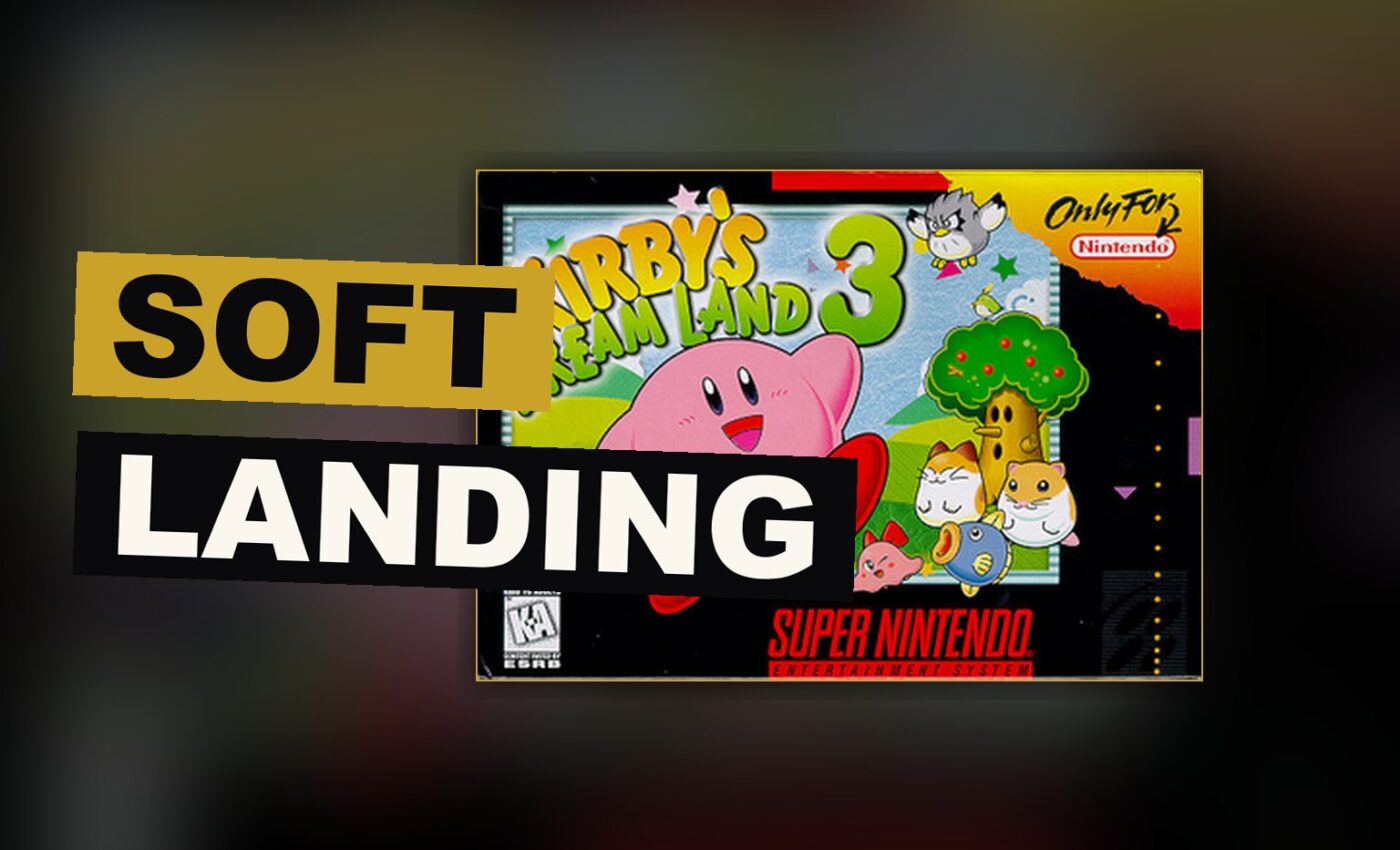
Kirby’s Dream Land 3 arrives on the Super Nintendo system with a soft, drawn look and a familiar promise: swallow enemies, take on their powers, and clear stages with a partner at your side. The game rests on charm more than difficulty, and that choice shapes nearly everything about how it plays.
A Look That Stands Apart
The art in Kirby’s Dream Land 3 sets it apart from earlier games in the series. Every stage looks like it was painted with soft colors and gentle edges that give the whole game a warm, quiet look. Scenery moves and changes in small ways that reward attention, even if the game never demands that attention.
The character designs carry that same soft quality. Kirby himself looks rounder and warmer than in past games, and the animal companions who join him share that same gentle style.
Powers and Companions
Kirby’s Dream Land 3 keeps the system that lets Kirby swallow enemies and take on their abilities. What changes here is how those abilities work alongside animal companions. Pairing an ability with the right companion opens new effects, and working out those pairings gives the game a layer of thought missing from a plain run through each level.
Even so, the difficulty rarely pushes players to use this system with any real need. Most stages can be cleared without much thought given to which power or companion is at hand. The result is a game that offers depth to players who look for it, but never requires it.
The pacing in Kirby’s Dream Land 3 stays gentle throughout. Levels are short, enemies are easy to get past, and losing a life carries little weight. This suits the game well when the goal is a calm, gentle platformer. It works against the game when players want the kind of push or drive found in other games of its kind.
A short list shows where the game succeeds and where it comes up short:
- Art and character design: strong, distinct, and steady from start to finish.
- Power and companion pairings: full of thought, though not required.
- Difficulty: even throughout, with little rise from start to finish.
- Replay value: limited once the main path is cleared.
- Mode for two players: a welcome addition, though not built out much further.
That distance between the game’s ambition in its art and its lack of challenge is the clearest thread running through Kirby’s Dream Land 3.
Secrets and Completion
Placed within each stage are small tasks tied to the animal companions, and finishing them changes the game’s ending. This gives Kirby’s Dream Land 3 a reason to return to stages, since missing one of these tasks means missing part of the full story. It is a quiet reason to keep playing, not a loud one.
Finding everything takes patience rather than skill. Nothing here calls for exact timing or advanced play. The reward is a fuller ending, not proof of great skill over the game itself.
A second player can join at any time, taking control of one of Kirby’s companions. This added mode does not change the core game, but it does let the experience be shared. Younger players or those new to platformers can join in without needing to match the skill of a more practiced player. The mode works best as a way in for less experienced players rather than as a deep second layer of play.
Kirby’s Dream Land 3 succeeds most as a work of art and mood. Its softness, its colors, and its calm pace set it apart from other platformers built for the same Nintendo system in the same period. What it lacks is the challenge or depth of design to match that presentation.
Players who want a demanding platformer will not find it here. Players who want a calm, distinct game with light puzzle elements built around its powers will find plenty to like. Kirby’s Dream Land 3 stands apart through contrast: bold in its art, modest in what it asks of the player. That contrast keeps it from greatness, but it also keeps the game open to a wide group of players.