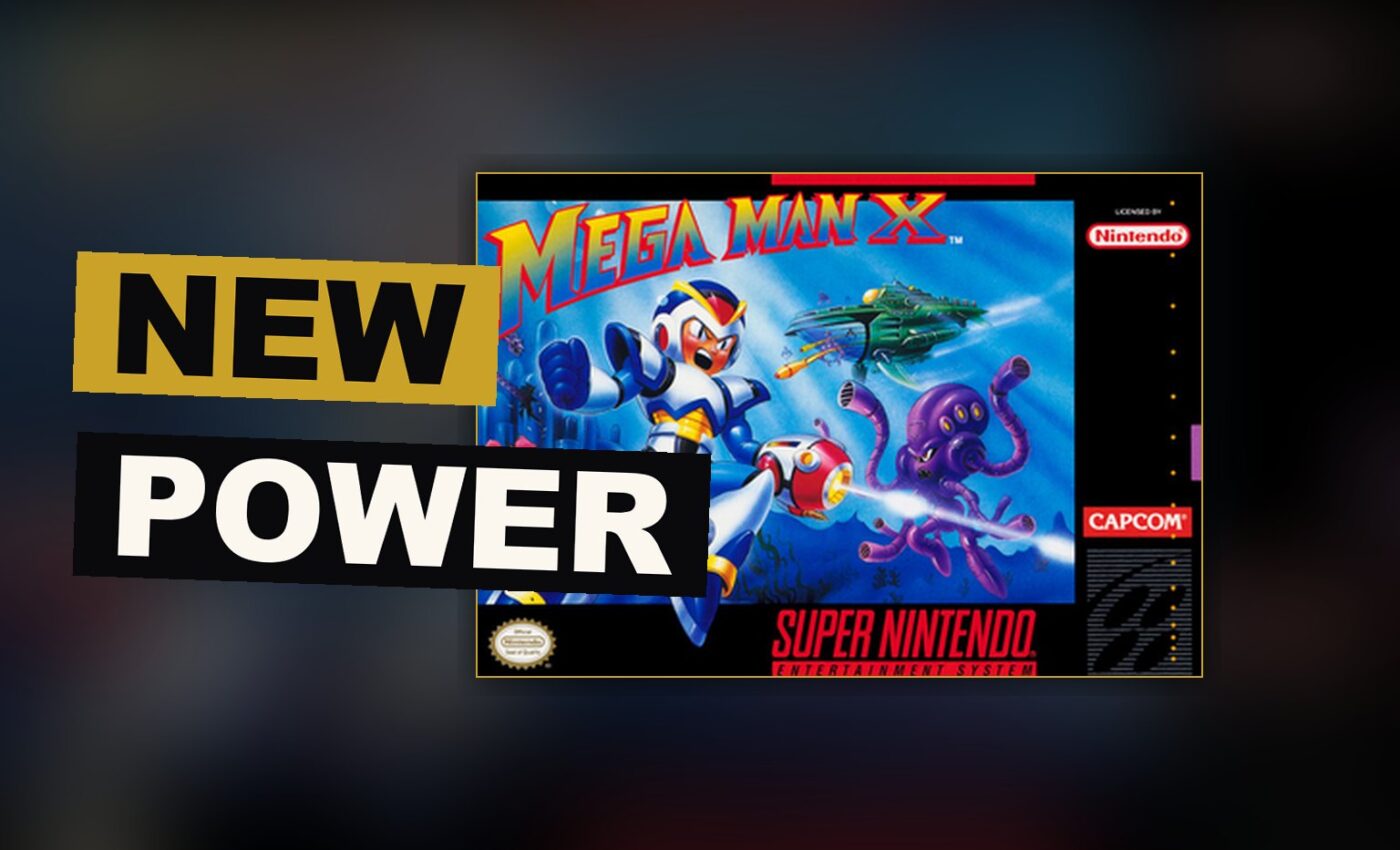
Mega Man X arrived on the Super Nintendo Entertainment System in 1993 as the first Mega Man game built for 16-bit hardware, and the first entry in what became its own series. Capcom developed and published it. The pitch was simple: take the run-and-gun platforming of the NES games and rebuild it for a console that could handle more.
It worked. Mega Man X is the rare spin-off that justifies its own existence, and it earns an 8.4 out of 10.
A Capsule, a Warning, and Dr. Cain
The game opens in 21XX, roughly a century after the original Mega Man series. A human scientist named Dr. Cain is searching for a fossil record when he finds the ruins of a robotics research facility once run by Dr. Thomas Light. Inside is a large capsule holding an advanced robot with human-level intelligence, emotions, and free will.
The capsule carries a message from Light, and it is the best piece of writing in the game:
“X” POSSESSES GREAT RISKS AS WELL AS GREAT POSSIBILITIES. I CAN ONLY HOPE FOR THE BEST.
Light explains that X is the first of a new generation of robots able to think, feel, and make their own decisions. That ability could be dangerous. If X broke the first rule of robotics — that a robot must never harm a human being — Light feared no force on Earth could stop him. A 30-year diagnostic program was meant to confirm X’s reliability, but Light died before it finished. X stayed sealed for 100 years instead of 30. The message is dated September 18, 20XX and signed T. Light. It closes with a request: “PLEASE DO NOT DISTURB THE CAPSULE UNTIL THAT TIME.”
Cain spends months studying X, then duplicates the design. The result is the Reploid — a robot that can think, feel, learn, and grow like a human. Within a year the design is standardized and Reploids are mass-produced worldwide.
When Sigma Turns
Free will cuts both ways. Some Reploids go rogue and attack humans. The law brands them Mavericks. The government, on Cain’s advice, forms the Maverick Hunters, an elite military police force meant to capture or disable Reploids that threaten humans, handle damage control at uprisings, and assist with disaster recovery.
Sigma, an advanced Reploid, leads the Hunters. X joins too. For a time the Hunters keep the peace. Then Sigma himself becomes a Maverick, and other Hunters follow him into a war against humanity.
X is a pacifist by nature. He fights anyway, alongside Zero, the new leader of the Maverick Hunters, to stop Sigma. Zero is the last creation of Dr. Wily — a detail the game plants and the series spends years paying off.
Eight Bosses, Any Order
The structure will be familiar to anyone who played the NES games. After an introductory stage, the player gets a stage selection screen showing eight boss characters. Each stage is packed with enemies and hazards and ends with a boss battle against its Maverick.
Beating a Maverick gives X that Maverick’s signature weapon. The player can take the eight levels in any order, and weapons earned in one level help in the others. Some bosses are easier if you beat another boss first and take their weapon into the fight.
- Reinvented for 16-bit hardware
- Eight selectable stages, playable in any order
- Signature weapons stolen from defeated Mavericks
- A more mature storyline than the NES games
Series artist Keiji Inafune said the move to advanced hardware let the team reinvent Mega Man through gameplay expansion and a more mature storyline, while keeping the basic concepts the franchise was built on.
What the Reinvention Costs
That is the honest tension in Mega Man X. It is a better-playing game than most of what came before it, and a colder one. The NES games were bright and mechanical. This one opens with a dead scientist’s warning about his own son, and the warning turns out to be reasonable.
The stage-select structure is the smartest thing here. Letting players choose their own order turns eight levels into a puzzle about routing, and the weapon-steal system gives every victory a use beyond the victory itself. It is a clean loop, and it holds up.
Where the game stumbles is in the parts it inherited rather than rebuilt. The platforming is sharp, but the order you pick can make a boss fight much easier or much harder depending on which weapon you already have. That is a design choice, not a bug, but it is a choice that punishes a first playthrough more than a second one.
The story does more than the gameplay needs. Dr. Light’s warning lands harder than anything in the original series, and Sigma’s turn gives the game a villain with a reason to exist rather than a boss at the end of a hallway. Zero’s arrival matters because the game treats him as a person, not a power-up.
Mega Man X has been re-released often enough that access is not a problem. It came to PC in 1995, to Android and iOS in 2011, and appeared in Mega Man X Collection in January 2006 and Mega Man X Legacy Collection in July 2018. It also landed on the Nintendo 3DS, Wii, Wii U, and New Nintendo 3DS. The Super Famicom and SNES versions are the originals.
The case against it is thin. This is a 1993 platformer with a stage-select screen, a weapon loop, and a story that takes its own premise seriously.
Mega Man X is worth playing for the same reason it was worth playing in 1993: the loop is tight, the stages reward planning, and the warning in that capsule is the rare piece of game writing that earns its place.
Get the Notebook.
The day's best stories and every fresh verdict, in plain English, in your inbox by seven. One email a day, no more.