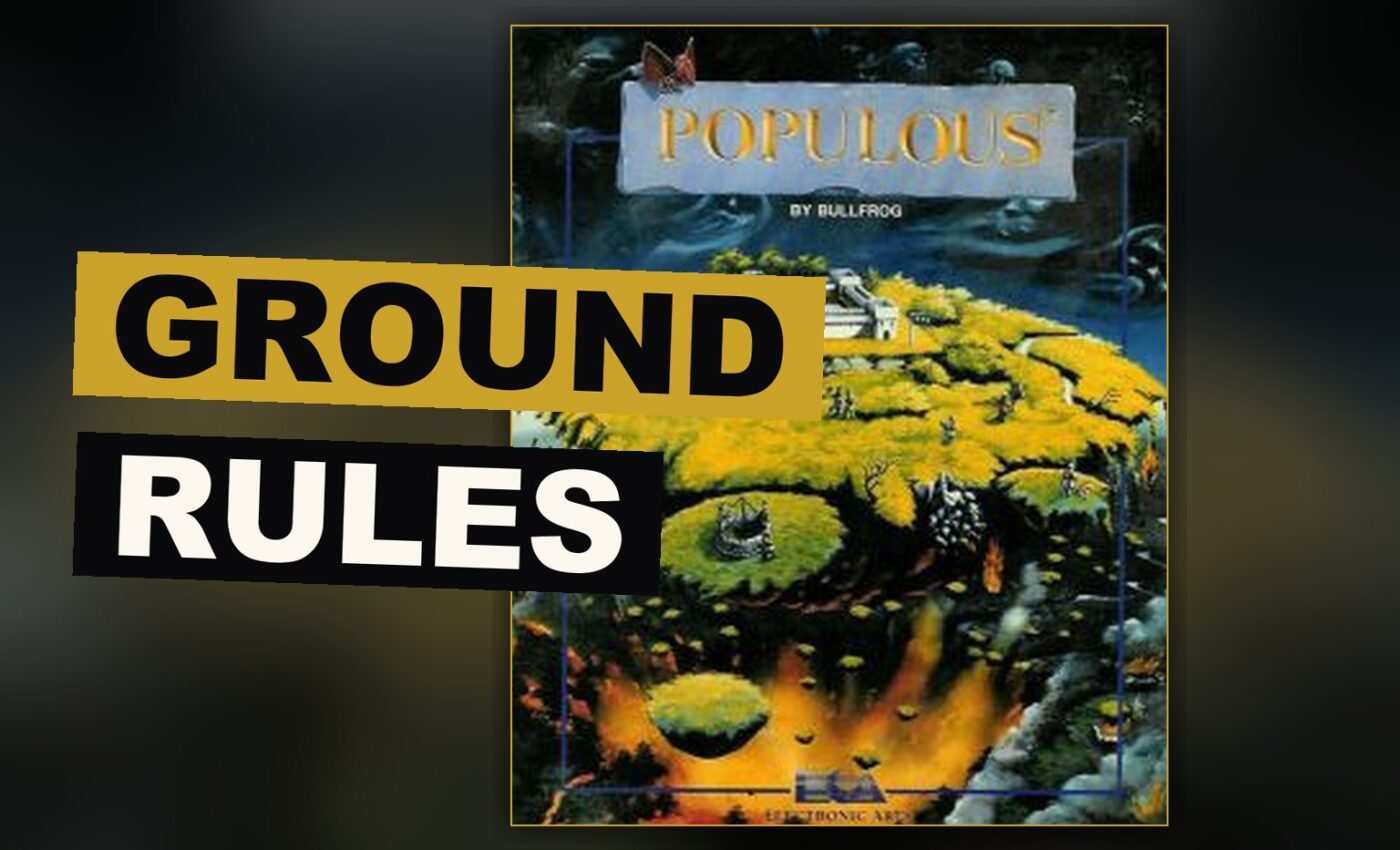
Bullfrog Productions built Populous on a simple, strange idea: you never control a single person. You play a deity, and your followers do the work. The SNES conversion carries that idea intact, and it still holds up as the first god game.
Raising Land and Building Mana
The main action sits on an isometric “tabletop.” Command icons ring the edge. A world map sits open like a book. A slider tracks your mana, the divine power you spend on every miracle.
Your job on each level is to grow your following until it can wipe out the enemy deity’s followers. The most basic tool is raising and lowering land. You flatten ground so your people can build. You can also pull land out from under the enemy.
500 Levels of Desert, Rock and Lava
More houses mean more followers, and more followers mean more mana. That loop unlocks the rest of the powers. Earthquakes, floods, swamps, volcanoes, and the ability to turn ordinary followers into knights.
Landscape is not decoration. Desert, rock and lava, snow and ice each change how your followers and the enemy’s develop. The game has more than 500 levels, and every one is a fresh piece of land with two populations on it.
Here is the order that matters on any given map:
- Raise flat land for your followers to build on.
- Let the population climb to feed your mana.
- Spend that mana on the next divine power.
- Turn followers into knights and wipe out the enemy.
Peter Molyneux and the Lego Prototype
Designer Peter Molyneux and Bullfrog worked out the gameplay prototype as a board game they built from Lego. That origin shows. Populous plays like a physical thing you push around, not a simulation running underneath you.
The game shipped first for the Amiga in March 1989, then the Atari ST and MS-DOS, with conversions for the Genesis, Super NES and PC Engine. It sold over four million copies and is one of the best-selling PC games of all time.
Where the SNES Version Sits
The Super NES conversion is one of many ports that followed the 1989 original. The critical acclaim and year-end nominations, including Game of the Year nods from several publications, went to that original release, not to the SNES version specifically.
What the port cannot fix is the pace. Directing a population instead of a character is the whole point, and it is also the barrier. Levels reward patience, and patience is not the same as excitement.
A God Game That Still Stands
Populous earns its reputation as the first god game because the idea was complete on arrival. Mana, land, followers, enemy deity: every later game in the genre is rearranging these parts.
The SNES version is a faithful conversion of a landmark, and faithful is both the praise and the limit. It gives you the original design without sanding down its slowness. Play it to see where the genre started, not for a thrill.
7.7 of 10, the MobyGames aggregate for the SNES version.
Get the Notebook.
The day's best stories and every fresh verdict, in plain English, in your inbox by seven. One email a day, no more.