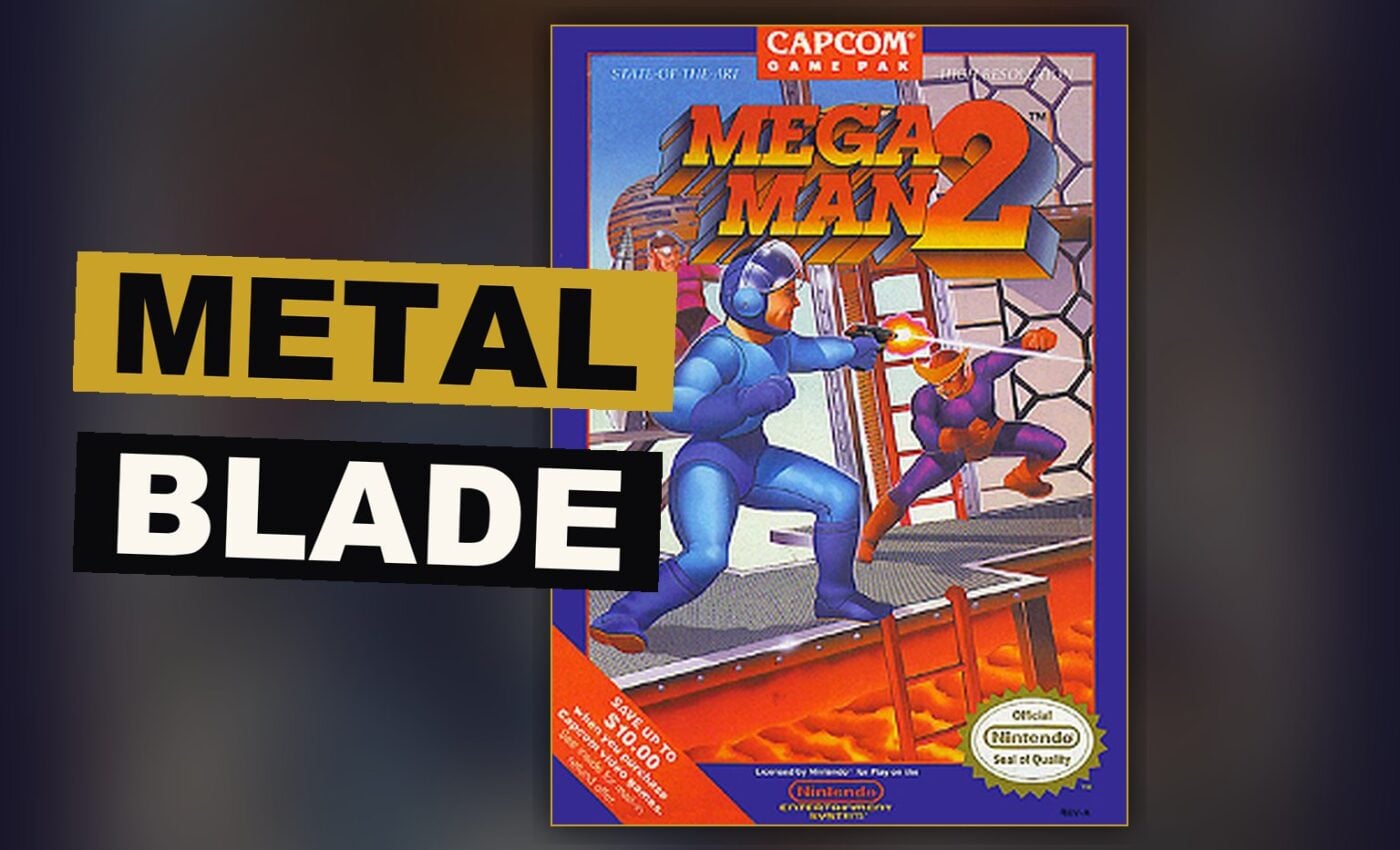
Mega Man 2 opens with a robot walking into eight stages built to kill him, and it never lets up. Capcom released the platform game for the Nintendo Entertainment System, and the source lists it as a 1989 title. It is the sequel that turned a modest first game into a series, and many publications rank it as the best game in that series.
Eight Robot Masters, Eight Choices
Dr. Wily built a new set of Robot Masters to counter Mega Man, and each one defines a stage. Metal Man, Air Man, Bubble Man, Quick Man, Crash Man, Flash Man, Heat Man and Wood Man each carry a signature weapon and a level built around it. Air Man fires small tornadoes in a sky-themed stage. Wood Man hides behind a shield of leaves in a forest.
Beating a boss hands the player that boss’s weapon. Each Robot Master is weak to certain other weapons, so the order you pick matters more than any single fight. That choice is the whole game in miniature.
Capcom let the team build the sequel even though the first Mega Man sold poorly. They worked on it alongside other projects, in their free time, and folded in unused content from the first game. Takashi Tateishi wrote the soundtrack. Yoshihiro Sakaguchi handled sound programming.
An Energy Tank and a Password
Mega Man 2 changes the first game in two ways that stuck. The Energy Tank lets a player refill Mega Man’s health at any time. A password system appears after each Robot Master falls, so a player can quit and come back to that point.
The fortress run is five levels played in order. Mega Man fights all eight Robot Masters again, this time in a single room. Teleportation devices lead to each boss, can be entered in any order, and carry no labels. Then comes Dr. Wily.
The plot is thin and knows it. A year after his defeat, Dr. Wily builds his Robot Masters and a new fortress. Dr. Light sends Mega Man to stop him. Wily flees into the caves beneath his castle and tries to pass himself off as an alien. Mega Man beats the alien, finds a holographic projection device with Wily at the controls, and spares him when the scientist begs.
A Soundtrack That Outlasted the Console
The audio is the part that aged best. Tateishi’s score is the reason people still hum these stages decades later, and it is routinely named among the best game soundtracks ever written. The visuals and gameplay drew praise as a clear step up from the first game.
- More than 1.51 million copies sold
- The best-selling Mega Man game until Mega Man 11 passed it in 2019
- Later included in compilations such as Mega Man Legacy Collection
- Rereleased for mobile devices and console emulation services
- A sequel, Mega Man 3, arrived in 1990
The sales figure is the honest measure of the game’s reach. It did not become a phenomenon on day one. It became one over years, through reissues and word of mouth, which is a stranger and more durable kind of success.
The Case for the Series’ Best
Mega Man 2 earns its reputation. The stage-order freedom gives a short game real replay value, and the weapon weaknesses make every choice feel earned rather than assigned. The Energy Tank and password system are small fixes that remove real friction without softening the challenge.
The fortress is where it sags. Fighting all eight Robot Masters again in one unlabeled room is a test of memory, not skill, and the alien reveal is a gag that lands once. The plot barely registers, and it does not need to.
What matters is that the design holds. Eight stages, eight weapons, one order you choose yourself. Capcom built that in spare time, on hardware with hard limits, and it still plays better than most of what followed it. The rereleases keep proving the point.
Get the Notebook.
The day's best stories and every fresh verdict, in plain English, in your inbox by seven. One email a day, no more.