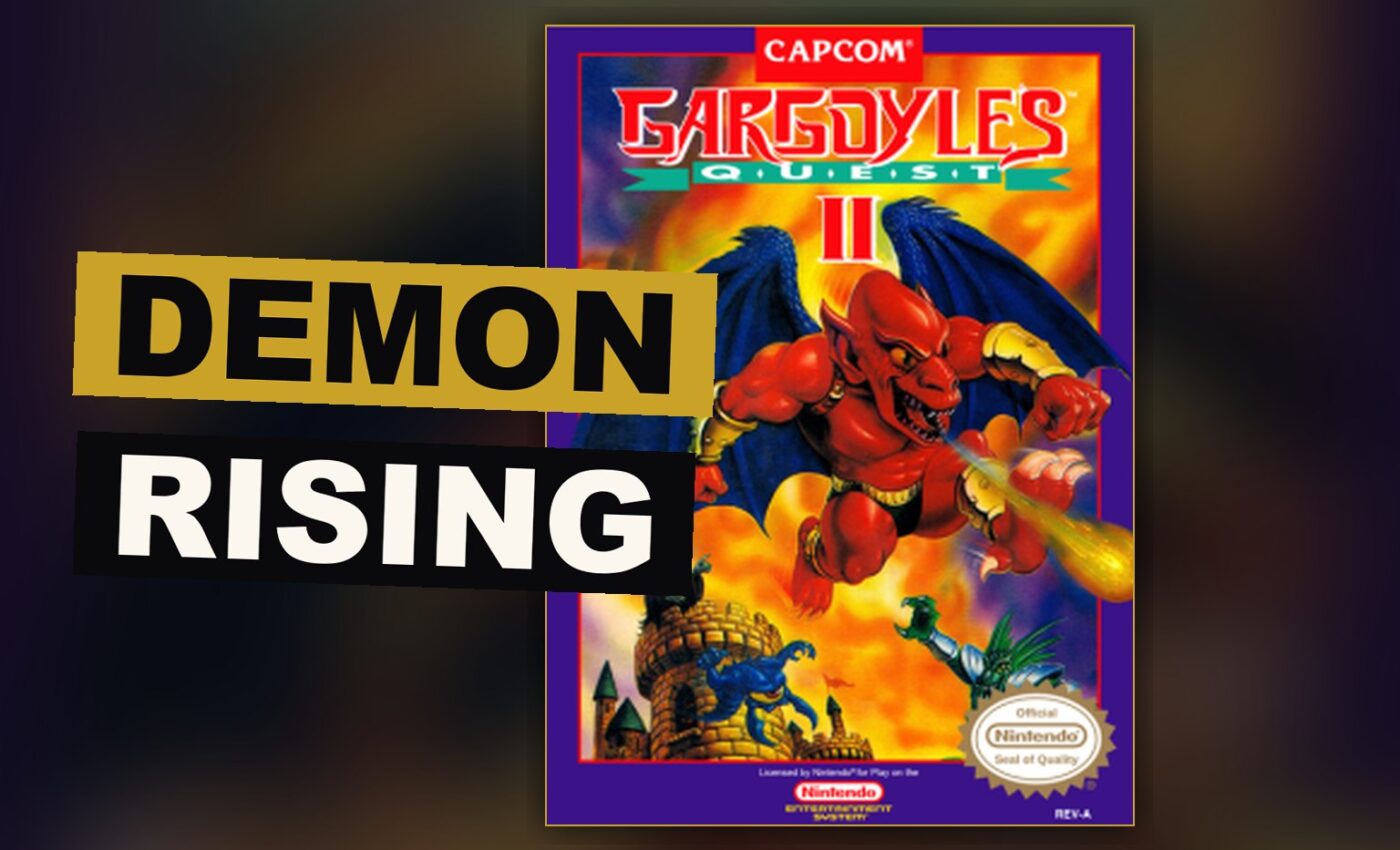
Capcom built a whole mythology on the back of a gargoyle who cannot fly particularly well. Firebrand, the leathery hero of Gargoyle’s Quest II: The Demon Darkness, glides where other characters soar, clings to walls where others run, and shoots magic projectiles at a pace that forces him to stand and fight rather than sprint past. The 1992 prequel to Gargoyle’s Quest takes that stubborn, deliberate movement and builds an entire realm around it. The result is a game that asks for patience and pays it back in atmosphere, even when the action itself feels like it is running through molasses.
The Black Light Destroys Etruria
The story opens long before humans appeared in the Ghoul Realm. Firebrand is a young ghoul warrior from the town of Etruria, training in a small alternate dimension as part of his daily routine. While he is away, a mysterious dark beam called The Black Light appears and destroys his home.
He returns to find the damage already done. Another ghoul tells him to hurry to the local King, then collapses and dies before him. Firebrand fights his way to King Morock, defeating the spaulder-wearing monster Nagus along the way, and learns the King is on the brink of death himself.
Morock gives Firebrand the Spectre’s Fingernail and sends him off to unravel the mystery of The Black Light. An invading army stands in his path the whole way.
That is a lot of setup for a game of this era, and it lands because the game treats it with a straight face. The macabre fantasy setting is not a joke or a parody. It is a world where kings die mid-sentence and messengers collapse in front of you, and the game keeps moving.
Two Games in One Cartridge
The Demon Darkness splits its time between two distinct modes. The first is an overhead map view where Firebrand traverses the Ghoul Realm in four cardinal directions along semi-linear paths. Towns dot the map, filled with ghoul denizens who talk to Firebrand and stone buildings that can be entered.
The second mode is side-scrolling action. These sections take place in dungeons, across giant pits, and in other hazard-filled spaces. The platforming here is nearly identical in broad terms to the previous Gargoyle’s Quest, which is either a compliment or a warning depending on how you felt about the original.
The main addition is the Magic Tornado power-up. It lets Firebrand raise himself into the air in vertical directions by standing on temporary platforms. It is a small change that opens up the level design in ways the first game could not manage.
Firebrand still gets around with his wings, which let him glide horizontally in mid-air. He can shoot magic weapon projectiles at any moment for attack or self-defense. His signature ability is clinging to walls, which he uses for climbing vertical cliffs, grabbing the sides of moving objects, and slowing his descent.
Slow on Purpose, or Just Slow
Here is the thing about Firebrand: he is notably slower than most video game characters of his kind. That is not a bug. It is the design. The game knows he cannot outrun anything, so it builds encounters around standing your ground.
Breathe fire at hideous creatures that hunger for your essence.
That slowness often leads to a necessary confrontation with each foe. You cannot dodge past most enemies. You have to deal with them. Occasionally, Firebrand gets blocked by foes with significantly more health than the regular ones, and those fights happen in confined rooms you cannot leave until the enemy is dead.
This is where the game’s rhythm lives or dies. When the level design supports the deliberate pace, the combat feels weighty and tense. When it does not, the pace just feels like waiting.
The game uses a password system rather than battery saves. At the time, that was normal. Today, it is a small friction point that makes the game feel older than its ideas.
Enchanted Items and a Growing Gargoyle
Firebrand does get stronger. The game hands out enchanted items that improve him as he progresses. Some increase his glide time. Some raise his jumping ability. Some boost his stamina.
That progression matters because the Ghoul Realm does not scale to meet him. The early game is genuinely difficult, and the later game rewards you for having stuck with it. The items are not cosmetic upgrades. They change what routes are open to you and how long you can survive in the action sections.
The marketing copy for the game promised “state-of-the-art graphics with incredible music and sound” and “magical items to boost your awesome powers.” That is advertising language, and it oversells things. The graphics are solid, with a moody palette that suits the macabre setting. The music does its job without becoming memorable.
What the copy got right is the structure. Collecting items and watching Firebrand become more capable is the core loop, and it works. The game understands that a hero who starts weak and ends strong needs a world that feels dangerous at both ends of that curve.
A Prequel That Stands Alone
Gargoyle’s Quest II is a prequel to the original Gargoyle’s Quest, which itself is part of the Ghosts ‘n Goblins franchise. It was followed by Demon’s Crest for the Super Nintendo Entertainment System in 1994.
That lineage matters for understanding what this game is doing. It is not a spin-off that exists to fill shelf space. It is a bridge between the earlier Gargoyle’s Quest and the more ambitious follow-up, and it carries the series’ identity forward without embarrassment.
The original Gargoyle’s Quest set a standard, according to the game’s own marketing. The Demon Darkness takes that standard and expands it onto a home console. The overhead map, the towns, the talking ghouls, the enchanted items — all of it is a widening of the first game’s scope rather than a reinvention.
Whether that is enough depends on what you wanted. If you wanted a bigger Gargoyle’s Quest, you got it. If you wanted a different Gargoyle’s Quest, you did not.
What the Ghoul Realm Gets Right
The best thing about Gargoyle’s Quest II is its commitment to its own weirdness. This is a game where you play a gargoyle from a town called Etruria, where a king hands you a fingernail before dying, and where the villain is a beam of light called The Black Light. None of it is explained away or softened.
The towns are a particular strength. Talking to ghoul denizens and entering stone buildings gives the Ghoul Realm a sense of place that most action games of the era do not bother with. You are not just moving through levels. You are moving through a world that has residents and structures and a history.
The Magic Tornado is the best mechanical addition. Vertical movement through temporary platforms changes how you read a room. It turns simple platforming into a small puzzle of timing and positioning. It is not revolutionary, but it is the kind of small, smart addition that makes a sequel worth playing.
The wall-clinging remains the most distinctive thing Firebrand does. Grabbing onto moving objects and slowing your descent gives the character a physical identity that separates him from the usual jump-and-shoot heroes. He is a creature, not a mascot.
Where the Darkness Drags
The slowness is the problem. Firebrand moves at a pace that makes every screen take longer than it should. When the game is asking you to navigate a dungeon or cross a giant pit, that pace becomes a tax. You are not being challenged. You are being delayed.
The confined-room fights against high-health enemies are the worst offenders. These encounters strip away the gliding and the wall-clinging and reduce the game to standing and shooting. The mechanics that make Firebrand interesting are the ones the game takes away when it wants to raise the stakes.
The password system compounds this. Losing progress to a difficult section and having to re-enter a password is a friction that the later re-releases on the Nintendo 3DS and Wii U do not fully solve. The game is available on those platforms, along with its original Family Computer and Nintendo Entertainment System releases, but the design assumptions of the early 1990s come with it.
The story, meanwhile, front-loads its best material. The destruction of Etruria and the death of King Morock happen early. What follows is a long chase after a mystery that the game is in no hurry to resolve. The invading army is a threat, but it is an abstract one. The personal stakes of the opening never quite return.
The Verdict on Firebrand’s Prequel
Gargoyle’s Quest II: The Demon Darkness is a game that knows exactly what it is and does not apologize for it. It is a slow, deliberate, macabre action-adventure with a hero who cannot fly properly and a world that wants him dead. The overhead map and town sections give it a sense of place that most games of its era lack. The Magic Tornado and the wall-clinging give it a mechanical identity that holds up.
It is also a game that fights its own best instincts. The slowness that defines Firebrand becomes a drag in the action sections. The confined-room fights strip away the mechanics that make him interesting. The password system is a relic that makes the game harder to recommend to anyone who did not grow up with it.
What makes it worth playing is the same thing that makes it frustrating: it is uncompromising. It does not speed up for you. It does not explain itself. It drops you into a Ghoul Realm where kings die and messengers collapse and a dark beam of light has destroyed your home, and it asks you to figure it out with a gargoyle who glides more than he flies.
That is not for everyone. But for players who want an action-adventure with atmosphere to spare and a hero who feels genuinely strange, Gargoyle’s Quest II delivers. It is a prequel that stands on its own, a bridge to Demon’s Crest that is worth crossing.
Get the Notebook.
The day's best stories and every fresh verdict, in plain English, in your inbox by seven. One email a day, no more.