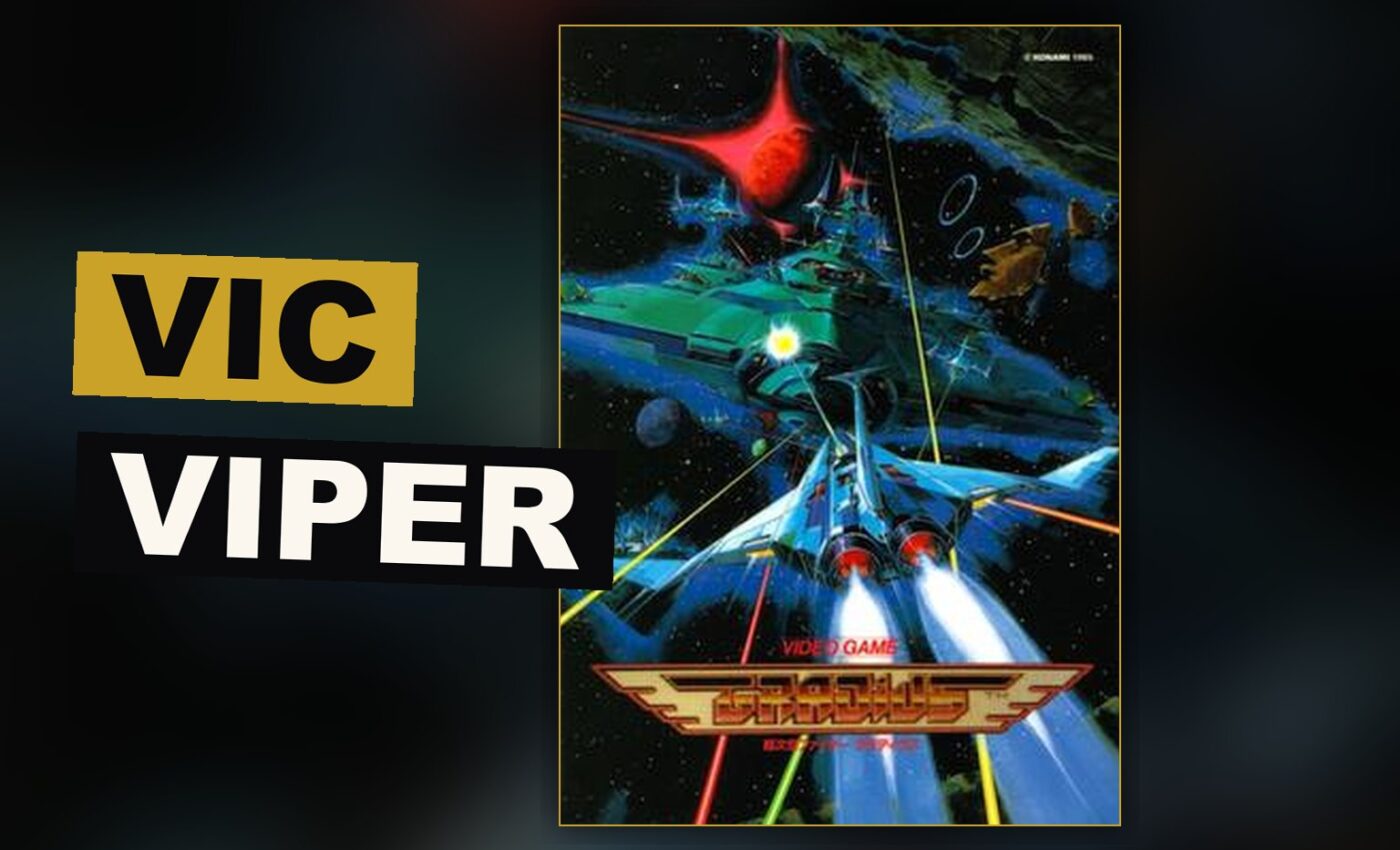
Gradius arrived in arcades in 1985 from Konami and changed what a scrolling shooter could ask of a player. Its home versions for the Nintendo Entertainment System, MSX and PC Engine brought that change into living rooms, and the Famicom port alone sold more than a million copies. The reason is a single mechanic, and it is still in use forty years later.
The Vic Viper
You fly a spacecraft called the Vic Viper through a horizontally scrolling gauntlet of alien enemies. That much is standard. What was not standard is the power meter. Enemies drop capsules. Each capsule advances a cursor along a row of upgrades, and you choose when to cash in: speed now, or wait and take a missile, a laser, an Option pod that follows your ship and doubles your fire, or a shield.
The decision is the game. Take speed early and the ship becomes hard to control. Wait for the laser and you fly the first stretch underpowered. Gradius was the first shooter to make the player a designer, and every entry since has been a conversation with that idea.
Nemesis
The arcade game was initially released outside Japan as Nemesis, and it began development as a follow-up to Konami’s 1981 shooter Scramble, under the working title Scramble 2. What it became was something bigger. In 1986 it was the highest-grossing arcade game in London and one of Japan’s top five table arcade games, and it started a series that is still running.
The NES Version
The home port is the version most people played, and it is a fair compression of the arcade. The Options were cut to two from four, the sprites flicker when the screen fills, and the difficulty was tuned for a console rather than a coin slot. It is still recognizably Gradius, and the Konami Code, which fills the power meter for you, made its debut here.
Where It Falls Short
The difficulty curve is a wall. Die late in a stage and you restart it with nothing, and rebuilding a fully powered ship from scratch in the middle of a hard stage is the series’ most punishing tradition. The stages themselves, moai heads and volcanoes and all, are memorable, but the later ones lean on memorization more than skill.
The Verdict
Gradius is a foundational game. Its power meter is one of the smartest ideas the genre ever had, and the 1985 original remains a hard, elegant proof of it. Play the NES version for history. Play the arcade version for the full ship.
Get the Notebook.
The day's best stories and every fresh verdict, in plain English, in your inbox by seven. One email a day, no more.