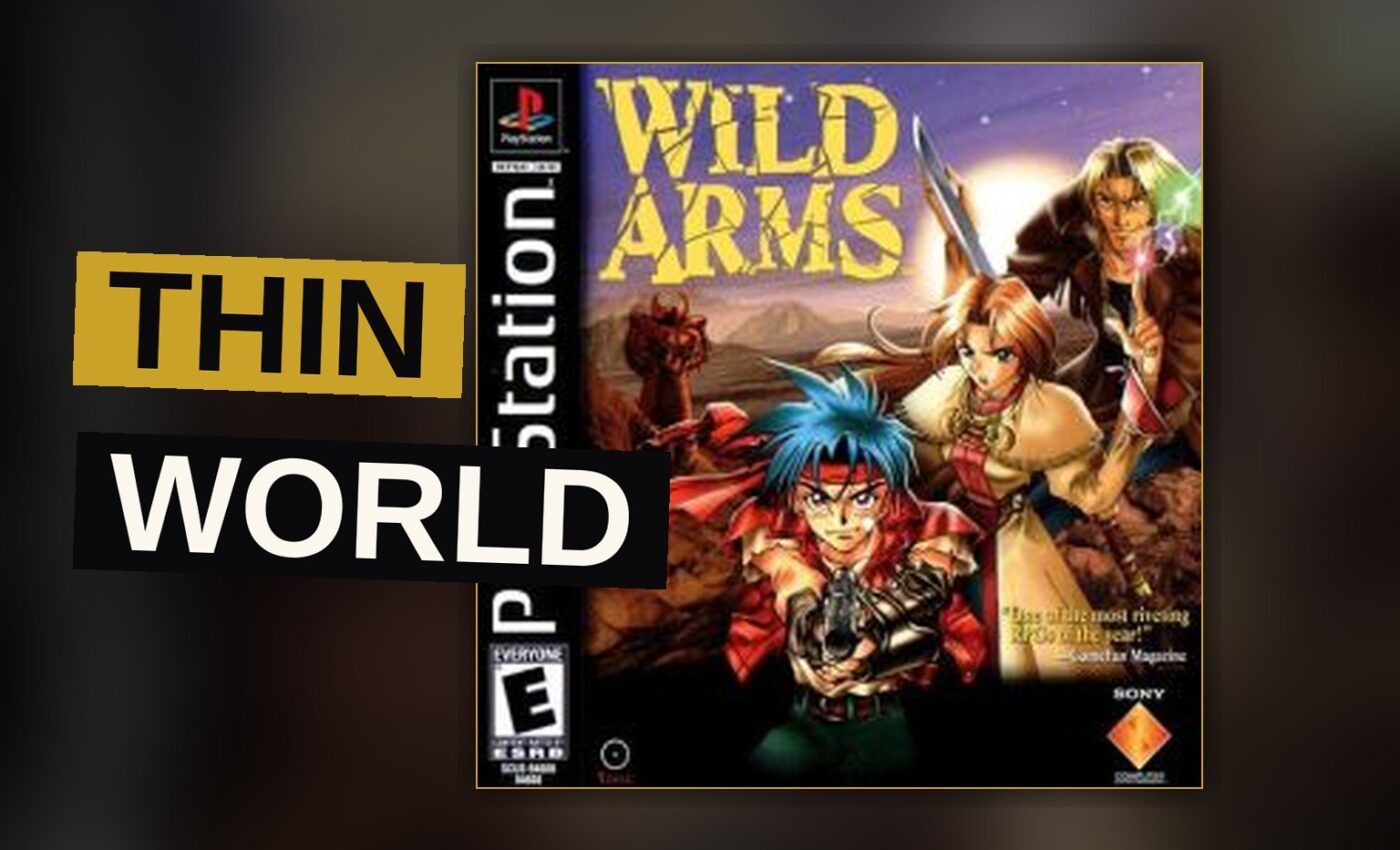
Wild Arms arrived on the original PlayStation in 1996 in Japan, 1997 in North America, and 1998 in Europe, and it did so with a hook few role-playing games of its moment could match: a Western. Not a Western-themed dungeon crawl with a cowboy hat pasted on, but a world that genuinely splits its time between frontier towns and the medieval cloisters and castles of a fantasy realm.
Filgaia Is the Best Idea in the Game
The setting is Wild Arms’ strongest asset. Filgaia is a fantasy world where technology is wildly uneven. Some regions look like medieval Europe, with monasteries and castles. Others look like the American frontier. Motors turn up here and there, scavenged and refitted by archaeologists and engineers from the wreckage of a distant past.
A thousand years before the main story, a war tore Filgaia apart. Humans and the Elw fought an invading race called the Metal Demons, who had lost their own homeworld and wanted this one. The defenders built mechanical golems and artificial warriors called Holmcrosses, metal and flesh combined. They captured the demon leader, “Mother,” and sealed her in a castle in the tundra of Arctica. They could not destroy her regenerating body. With the Guardians’ help they imprisoned her in a cocoon, cut out her heart, tore it into three pieces, and locked each piece inside a stone statue scattered across the world.
The war ended. The surface did not recover. Filgaia is still wastelands and scars, which is exactly why the Western motif works. This is a frontier because something broke it, not because someone thought cowboys were cool.
Three Heroes, One Silent Protagonist
Wild Arms gives you three playable characters. Rudy can operate the Ancient Relic Machines, forbidden remnants of a lost age that resemble firearms. Jack is a treasure hunter and swordsman-for-hire struggling with a past failure. Cecilia is a young princess who studied at Curan Abbey, can communicate with the Guardians, and whose 17th birthday marks her ascension.
The three travel together as Dream Chasers, the miscreants and fortune-hunters who scour the world for excitement and money.
Rudy is a silent protagonist with one line in the game. That was a convention in 1996, and it reads as a hole now. The boy with the most dramatic origin has the least to say about it. Jack and Cecilia carry the personality the game gives them.
Tools, Puzzles, and a Battle Screen From Another Game
Dungeons block progress until you solve them. The party picks up devices called Tools, one set per character, and each Tool answers a different kind of obstacle. Rudy’s bomb demolishes large rocks and other impediments. Jack’s grappling hook crosses large gaps and chasms while dodging traps.
That structure holds up. The Tools turn each dungeon into a small argument about who you are and what you can reach, and the game is better for it than it is for its combat.
Exploration is top-down 2D. Battles switch to 3D. Wikipedia describes the split this way:
It utilizes 2D computer graphics for navigating the world and setting, while battle sequences are rendered in 3D.
That split was a selling point in 1996 and it is the first thing that has aged badly. The two halves of Wild Arms do not look like they belong to the same game.
Enemies appear randomly in dangerous areas, with set-piece boss fights at the ends. Characters grow through experience points, through finding ARMs for Rudy, through crest graphs for Cecilia’s magic, and through sword techniques Jack learns when the story prompts him. You also buy weapons, armor, and single-use items.
A Clear Field in 1997
Wild Arms shipped into a North American market with very few RPGs on the PlayStation. That gave it room. It was also released in the shadow of the hype for the upcoming Final Fantasy VII, and it was a critical and commercial success anyway.
Both things are true, and the second one deserves more credit than it usually gets. In this paper’s reading, Wild Arms succeeded because it was early, it was competent, and it looked like nothing else on the shelf. That is analysis, not a fact the record supplies.
An enhanced remake, Wild Arms Alter Code: F, was released for the PlayStation 2 in November 2003. The game is now available on PlayStation 3, Android, PlayStation, and PlayStation Portable.
Release History
| Release | Platform | Year |
|---|---|---|
| Original | PlayStation | 1996 (Japan) |
| North America | PlayStation | 1997 |
| Europe | PlayStation | 1998 |
| Enhanced remake (Alter Code: F) | PlayStation 2 | 2003 |
What Holds and What Doesn’t
The Western-fantasy setting is the reason to play Wild Arms, and it remains the reason to remember it. Filgaia’s mix of frontier towns, cloistered monasteries, and salvaged motors is a real idea, not decoration, and the backstory earns it: a thousand-year-old war that nobody won cleanly and a surface that never healed.
The Tools-and-puzzles loop is the second reason. It is modest, but it is designed, and it respects the player enough to make each character’s kit mean something.
The combat is where the game gives ground. Random encounters, a 3D battle screen bolted to a 2D world, and a silent lead who should have been the most vocal character in the cast. Rudy’s exile is the emotional engine of the game’s opening, and the game hands it to a boy who speaks only once. In this paper’s view, Jack’s failure and Cecilia’s Guardians get more room to breathe than Rudy’s does.
The clear field of 1997 is worth naming plainly, because it flatters the game less than nostalgia does. Wild Arms was one of the first RPGs on the PlayStation and one of the few with a Western motif, and it succeeded in part because there was almost nothing else to buy. Strip away the empty shelf and what is left is a good setting, a solid puzzle structure, and a battle system that was already showing its age.
That is not nothing. In this paper’s view, it is also not the classic that the remake and the re-releases might lead a newcomer to expect.
Score: 5.6 of 10 (IGDB critic aggregate, 3 outlets).
Get the Notebook.
The day's best stories and every fresh verdict, in plain English, in your inbox by seven. One email a day, no more.