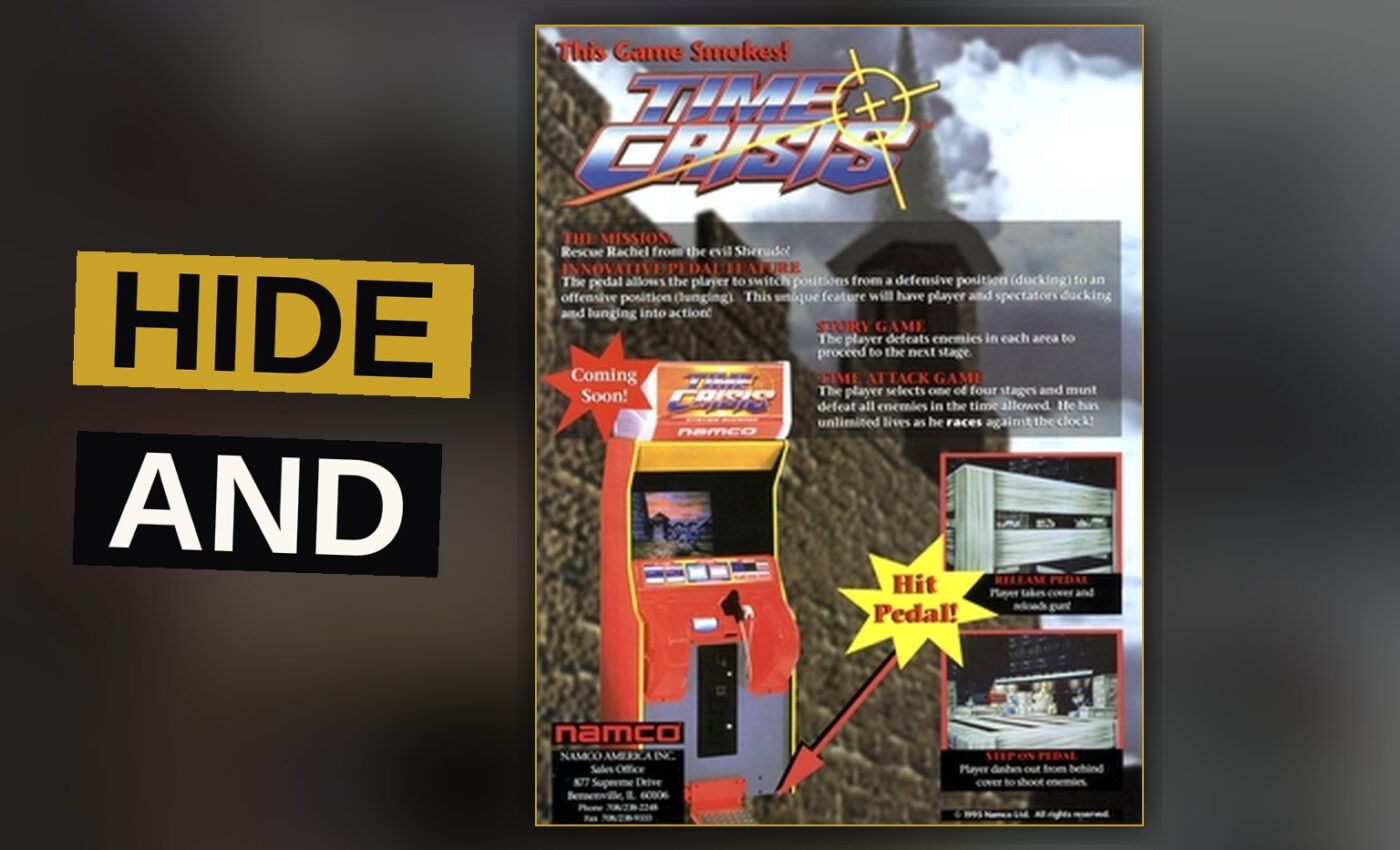
Time Crisis arrives on PlayStation 4 and PlayStation 5 as a port of the 1997 console version, itself a conversion of Namco’s 1995 arcade light-gun shooter. Bandai Namco Entertainment America Inc. publishes it. It is a shooter, single player, first person, and it is the same game you remember, cleaned up with up-rendering, rewind, quick save and custom video filters.
That last part is the whole pitch. This is preservation, not restoration.
Richard Miller and the Castle
The story holds up better than the mechanics do. V.S.S.E., an international protection agency, helps Sercian opposition leader William McPhearson engineer a coup against a century-old authoritarian regime. McPhearson becomes the republic’s first president. Then Sherudo Garo, the last survivor of the old order, launches attacks and assassinations that destabilize the nation, abducts McPhearson’s daughter Rachel, and imprisons her in his family’s castle on a remote island, demanding military secrets for her life.
V.S.S.E. sends veteran agent Richard Miller, the “One Man Army,” to get her back. He rams an explosives-rigged boat into the castle exterior to make an entrance. Sherudo’s head of security, Wild Dog, tells him Miller won’t last long against his mercenaries. Miller fights through the courtyard, reaches Rachel, and she warns him of a setup before she is taken away. He beats Wild Dog’s chief assassin, Moz, and his unit, then interrogates Moz, who gives up the clock tower.
There, Sherudo — a trained knife thrower — attacks. Miller guns him down and finds Rachel held at gunpoint by Wild Dog. Angered that Sherudo’s death means he won’t be paid, Wild Dog plans to blow up the castle with Miller inside and leave with Rachel. On the helipad, Rachel breaks free, Wild Dog shoots her, and Miller fights him across the rooftop until the detonator goes off and kills him. Miller takes the wounded Rachel out in Sherudo’s chopper as the castle burns.
It is lean, mean, and completely uninterested in subtlety. Good. A light-gun game does not need a plot with shades of gray.
The Pedal Is Still the Point
Time Crisis separated itself from other light-gun shooters of its time with one idea: a pedal that controls when the player takes cover to reload and avoid enemy fire. On console, a button does the job. The PlayStation version also lets players use the pedal from a racing wheel peripheral, which is the kind of detail that made sense in 1997 and reads as trivia now.
The structure is three stages, each with three areas and a boss battle. Each area opens with a one-minute time limit that counts down during fights and transitions and only extends when you clear a battle. Specific optional enemies add a few seconds. You cannot play safe. You have to shoot fast and hide only when you must. A set number of lives is deducted when an enemy hits you or you fail to dodge a hazard, and the run ends when lives or time run out.
The arcade cabinet’s light gun, introduced in Point Blank, used a memory chip to sync screen areas as the player rotated the gun, and it had a blowback function that simulated recoil. That feature does not carry over here, and its absence is felt in every stage.
- Three stages, three areas each, plus a boss battle
- One-minute time limit per area, extended only by clearing fights
- Optional enemies that add seconds to the clock
- Lives lost to enemy fire or missed hazards
That is the game. It has not grown.
The Kantaris Deal
The PlayStation version’s real value is the add-on pack of stages set after the main story. The “Kantaris Deal” takes place several weeks later. V.S.S.E. alerts Miller to an illegal arms factory in a Sercian hotel tied to Wild Dog’s organization. He infiltrates and is assigned to eliminate the owner, Kantaris.
After the lobby, there are three paths, and the clock decides which one you get. The first runs through the ballroom and casino, where Miller kills Kantaris’s scythe-hand assassin, Spider, then chases her to the swimming pool as she tries to escape by air. He shoots down an escort gunship and damages her ship’s engines as it takes off, crashing and exploding it.
The second path only opens if fewer than 22 seconds remain on the clock. It goes through the shopping mall and into a garbage disposal, where Miller uses a claw arm to punch through a wall into the underground factory, then reaches Kantaris’s office in the Lounge and defeats her personal security droid, which malfunctions and rolls out the window, taking her with it.
The third path appears if Richard does not activate the claw in time. He goes through the parking lot, beats a spider-legged battle tank, and disables Kantaris’s car, forcing a crash. Fail to act fast enough in any of these and Kantaris escapes and the mission aborts.
Each area features a one minute time limit to begin with, which counts down during battles and transitions between each, and is only extended by clearing a current battle
What This Port Is Worth
Time Crisis was well-received in both its arcade and console forms, particularly for its gameplay mechanics. It was a commercial success and spawned Time Crisis II in 1997, while the PlayStation version got its own sequel, Time Crisis: Project Titan, in 2001. The reputation is earned.
The problem is that this release does not add anything to it. Up-rendering, rewind, quick save and video filters are emulator conveniences, not a reason to play. The cover system still does the heavy lifting, and the Kantaris Deal still justifies the price of admission for anyone who never finished it. But the game underneath is 1995 design with a 1997 conversion, and the missing blowback recoil is a real loss — the physical feedback was part of why the arcade version worked.
This port is for people who want the original intact, and it delivers exactly that. It is not for anyone hoping the series’ first entry has been rethought. It has not been. What you get is a clean, faithful, slightly hollow piece of history.
Get the Notebook.
The day's best stories and every fresh verdict, in plain English, in your inbox by seven. One email a day, no more.