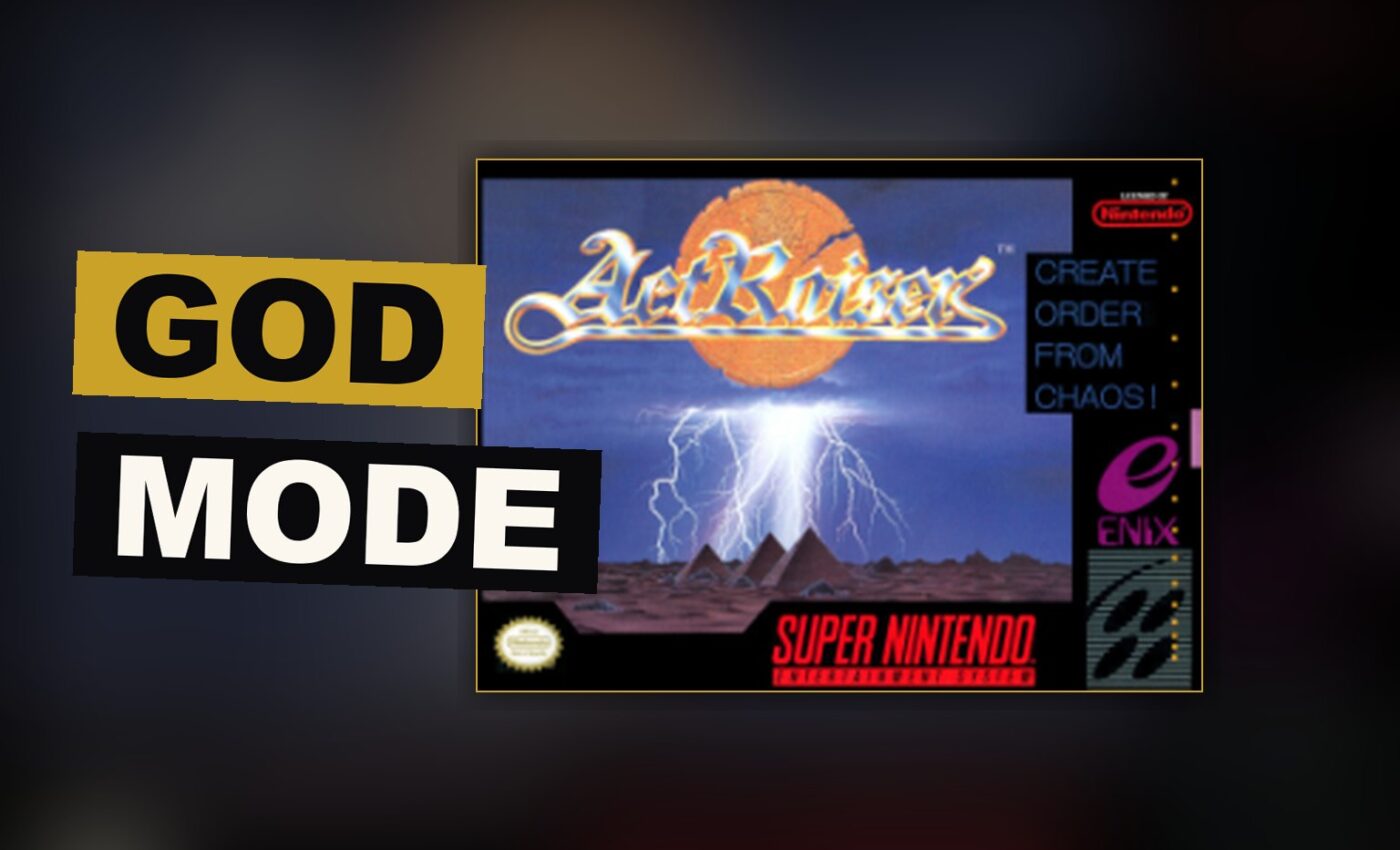
ActRaiser arrived on the Super Nintendo Entertainment System in 1990, developed by Quintet and published by Enix, and it remains one of the strangest things the console ever asked players to do. It is two games bolted together: a side-scrolling action platformer and an overhead city-building simulation. Neither half would carry the package alone. Together they make something that has not really been copied since.
The Master Sleeps in His Sky Palace
The plot follows a godlike being known only as “The Master” — God in the Japanese version — in his fight against Tanzra, also called “The Evil One.” According to the instruction booklet, the Master was defeated in a battle with Tanzra and his six lieutenants. He retreated to his sky palace to tend his wounds and fell into a deep sleep. In his absence, Tanzra divided the world into six lands, one for each lieutenant, and the people were turned to evil. After several hundred years, the Master wakes fully recovered, only to find he has lost his powers because nobody believes in him anymore.
That is a better premise than most games of its era bothered with, and ActRaiser takes it seriously enough to build its whole structure around it.
An Angel, a Statue, and Two Ways to Play
The player never controls the Master directly. Instead, the player interacts with the world through two servants: an angel and an animated statue. The angel handles the simulation sequences. The statue handles the action sequences.
The overhead simulation mode asks the player to guide the Master’s new civilization toward prosperity, starting from two humans. It is not a passive screensaver. The player plans roads and calls down miracles — lightning, rain, sunlight, wind, earthquakes — to shape the land and push the population upward. The angel can also shoot monsters with arrows and mark where the Master should build or work a miracle.
Flying monsters are the main obstacle. They spawn from four lairs around each region at the start of a level and keep coming as the servant kills them. As the population grows, the civilization can seal those lairs, which stops the spawning and eventually clears the land of the creatures. Sealing all four raises the region’s civilization level, unlocks better structures, and lifts the population ceiling. Once every lair is shut, the people start building the most advanced homes they can.
The Master levels up as the world’s total population rises, gaining hit points and SP, which is spent on miracles.
The Statue Fights, and the Simulation Pays for It
Each area holds two side-scrolling action sequences — one before the building simulation and one near the end. This is the loop that makes ActRaiser work. The action is not a break from the building; it is the reason the building matters, and the building is the reason the action gets easier.
The two halves feed each other. Population growth makes the Master stronger. A stronger Master clears more of the map. That is a clean piece of design, and it is the thing most imitators miss.
Tanzra’s Six Lieutenants Fall One by One
As the game progresses, the Master defeats Tanzra’s lieutenants and recovers his powers by rebuilding the civilizations of his people and communicating with them through prayer. After all the lieutenants are slain, he assaults Tanzra’s stronghold, Death Heim, and defeats him.
The ending is the part people still talk about. After Tanzra falls, the Master and his servant revisit the civilizations they helped build and observe the people. Nobody is at the temple worshiping the Master. The servant notes that although the people once prayed in times of trouble, they no longer feel the need, because they can solve their remaining problems on their own. The Master and his servant enter the sky palace and depart into the heavens to await a time when they may be needed.
That is a genuinely unusual note to end a 1990 action game on — the god wins, and then becomes unnecessary.
What Came After
- A sequel, ActRaiser 2, was released for the Super NES in 1993.
- ActRaiser came to the Virtual Console download service in 2007 in Europe, North America, and Japan.
- A version was released for European mobile phones in 2004, published by Macrospace. That release kept the first three side-scrolling levels and cut the town-building portions entirely.
- A remake, Actraiser Renaissance, came out for several platforms in 2021.
A Short History of ActRaiser Releases
| Year | Release | Platform |
|---|---|---|
| 1990 | ActRaiser | Super Nintendo Entertainment System |
| 1993 | ActRaiser 2 | Super NES |
| 2004 | ActRaiser (mobile) | European mobile phones |
| 2007 | ActRaiser | Virtual Console download service |
| 2021 | Actraiser Renaissance | Several platforms |
The 2004 mobile version is the cautionary entry on that table. Strip out the simulation and you are left with three platforming stages and no reason for any of them to exist. The building is not filler between the action. It is the spine.
The Verdict on ActRaiser
ActRaiser earns its reputation. The Master’s arc — a god who wakes up forgotten and has to rebuild belief from two humans and a plot of dirt — gives the simulation real weight, and the action sequences give it teeth. The angel-and-statue split is an elegant solution to a real problem: how do you let a player act in a world without putting them inside the god?
The faults are real too. The simulation can drag when a region refuses to grow, and the action stages are shorter than the premise deserves. But the ending redeems almost everything. A game that spends its runtime rebuilding faith and then admits the faith is no longer needed is doing something no other Super NES title attempted.
ActRaiser is worth playing today for the same reason it was worth playing in 1990: nothing else is shaped like it.
Get the Notebook.
The day's best stories and every fresh verdict, in plain English, in your inbox by seven. One email a day, no more.