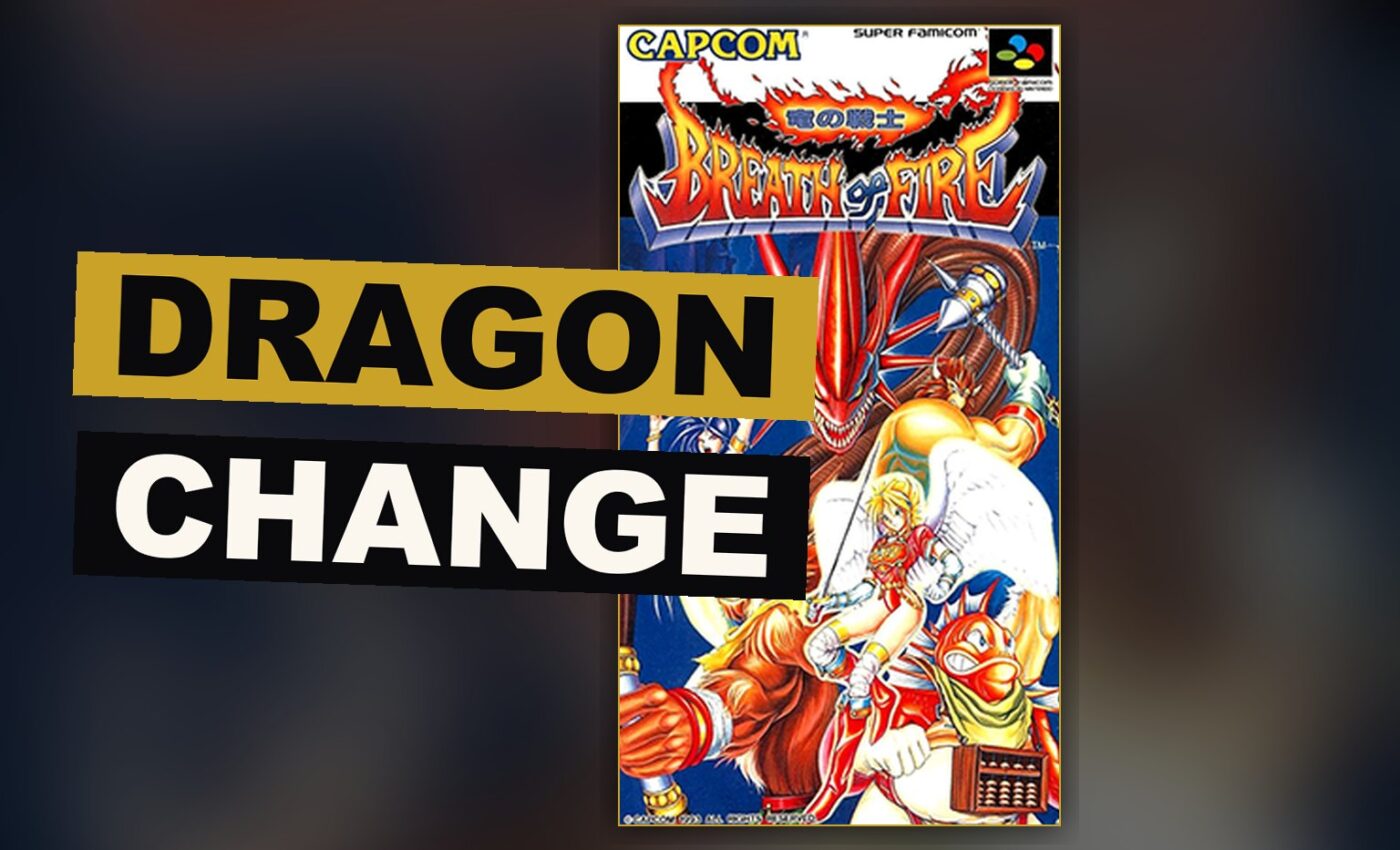
Breath of Fire arrived on the Super Nintendo in North America in August 1994, localized and promoted by Square Soft, and it carried the weight of a studio’s first real swing at a genre it had never tried. Capcom has called it their first traditional role-playing video game. That framing matters, because Breath of Fire plays like a game built by people who studied the genre’s rules carefully and then followed them almost exactly.
Ryu and the Light Dragon Clan
The setup is straightforward. Ryu is a young man, one of the last surviving members of the Light Dragon Clan, a race able to transform into dragons. The Dark Dragon Clan has driven them nearly to extinction. When Ryu’s sister Sara is captured, he sets out across a medieval fantasy world to find her and to unlock his own latent power.
That world is populated by humans and by clans of anthropomorphic animal-like beings, each with distinct magic and field abilities. The prologue lays out the deep history: a goddess named Myria offered to grant any wish, split the Dragon Clan into Light and Dark factions, and watched a war escalate.
Six Keys, Two Towns
Just as the world was on the brink of destruction, a heroic Light Dragon imprisoned Myria and sealed her away using six keys. Each key carries a unique magical property that affects the surrounding landscape.
The Light Key is hidden in the port town of Auria, providing boundless prosperity for its residents. The Dark Key sits near the slums of Bleak, accounting for that town’s perpetual darkness. It is a clean piece of worldbuilding: the map is tied to the plot, not just a series of stops.
A Party of Eight, Built From Clans
Ryu recruits seven companions, and Breath of Fire gives each one a reason to exist beyond a stat line. Nina, princess of the Kingdom of Windia, belongs to a race that can transform into large birds. Bo is a wolf-man held prisoner by the Dark Dragons after they attacked his homeland.
Karn belongs to an ancient order of thieves and can merge two or more party members into a single powerful fighter. Gobi is a fish-man and traveling merchant who turns into a giant fish. Ox is a large ox-man from a town of blacksmiths. Mogu is a mole-person who digs through certain terrain. Bleu is an immortal sorceress with a snake-like lower body and command of powerful magic.
The antagonists are the Dark Dragon Clan, a militaristic empire of soldiers who transform into dragons, led by Emperor Zog. He wants the world, and he wants it by reviving a mad goddess. Several characters carry different names in the Japanese release: Bo is Gilliam, Karn is Danc, Gobi is Manillo, Ox is Builder, Bleu is Deis, and Zog is Zorgon.
Turn-Based Combat and Personal Actions
Breath of Fire is a traditional role-playing game. Sprites and environments are two-dimensional, presented from a top-down view, and the player moves in four directions through towns, dungeons, traps and monsters. Combat is turn-based and random, triggering every few steps in hostile areas.
Each round, the player inputs commands for every character, and those commands resolve in order. The party holds four active members, with reserves that can be swapped in at any time, including mid-battle. An icon-based menu organizes items, equipment and character data, and shortcuts can be bound to unused controller buttons.
Out of battle, each character’s Personal Actions let the player interact with the world, solve puzzles or move through terrain more easily. Gobi’s transformation, Mogu’s digging and Karn’s fusion are not decoration. They are the reason the cast feels like a toolkit rather than a roster.
What Capcom Got Right, and What It Didn’t
Here is the honest read. Breath of Fire is a competent, well-built role-playing game that rarely surprises. The encounter rate is punishing, and random battles stack up fast. The top-down presentation does not push the Super Nintendo the way the genre’s best work did. Capcom’s in-house sound team Alph Lyla handled the music, and Keiji Inafune designed the characters. Both contributions are solid without being the reason to play.
What holds up is the structure. The eight-character party, the swappable reserves, the Personal Actions and the merge mechanic give the game a flexibility that many of its peers lacked. Capcom treated it as the precedent for the series going forward, and that is the right call.
Breath of Fire is a traditional role-playing video game, featuring two-dimensional character sprites and environments presented from a top-down perspective.
Breath of Fire is not the genre’s high point on the Super Nintendo, and it does not try to be. It is the foundation a series needed, and it earns its place. The 2001 Game Boy Advance port added new save features and minor graphical enhancements, and brought the English version to Europe for the first time. Later re-releases put it on the New Nintendo 3DS Virtual Console in 2016 and the Nintendo Switch SNES library in 2019. Those versions are the practical way to play it now, and they are kinder than the original cart.
Get the Notebook.
The day's best stories and every fresh verdict, in plain English, in your inbox by seven. One email a day, no more.